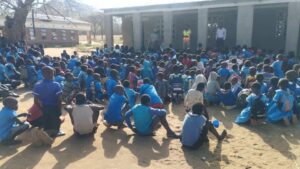
An AI generated image by the DRTSS to protect the identity of the minors
* After the traffic law enforcement agency intercepted and impounded a 16-seater minibus overloaded with 36 school learners
* The DRTSS arranged an alternative transportation for the learners to proceed with their trip, which has also been commended for
By Duncan Mlanjira
The Directorate of Road Traffic & Safety Services (DRTSS) has alerted schools management and transport operators that the law enforcement will be stopping school buses to inspect if they are adhering to legal seating capacity.

Advertisement
Thus, any bus found exceeding the legal seating capacity “will be impounded, and the school [involved] will be fined” — emphasising that the enforcement it to “keep children safe on every journey”.
The DRTSS, which this year rolled out massive campaign on its official Facebook account — which is influencing motorists and members of the public to adhere to road traffic regulations, that in turn translate into compliance to road safety — made the call having intercepted and impounded a 16-seater minibus, which was overloaded with 36 school learners.
The DRTSS reported that they arranged an alternative transportation for the learners to proceed with their trip. A strong message has been brought forward that “when school buses are overloaded, children are exposed to serious danger in the event of sudden braking or a crash”.
“The DRTSS reminds schools and transport operators; respect the seating capacity — one seat, one child. These are our children, our young brothers and sisters, and cousins, let’s protect them.”
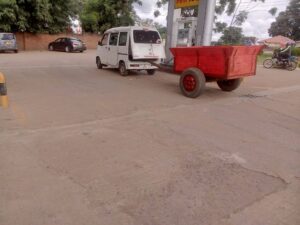
Some offences the DRTSS is encountering its its enforcement campaign
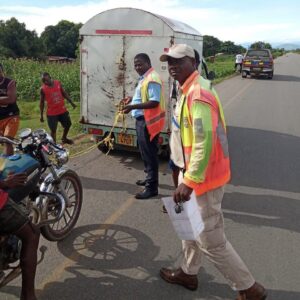
A vehicle found towing a motorbike using a rope
The reaction from the public was instantaneous and overwhelming with over 2,000 likes and over 580 responses since yesterday, with the majority applauding the DRTSS for the ‘safety first’ campaign.
Malumbo Mkandawire agreed with DRTSS that learners in school buses “are innocent souls and it is the duty of every citizen to protect them at all cost: “We are all torch bearers — good job [DRTSS].”
Chimwemwe Mbonela shared that he keeps observing school children “packed like sardines” in minibuses and wondering why parents do not express any concern “as long as [their children are are going to school and back in] a school bus”.
When Eric Mpulula opined that “the issue of [seating] capacity should be with the driver or operator not the school”, Wilson Nyathi contended that the “school should be the first to observe total safety of students” by checking that the vehicle is in good condition, has the right capacity, the tyres are perfect as other tale-tell appearances of the bus hired to transport learners.

Advertisement
Most minibus operators in urban areas allow school learners to sit on one another’s lap as one passenger fare, thus a 16-seater carries 32 kids. This is the learners’ innovation to save money despite their parents providing to them with full bus fare on daily basis.
One minibus operator shared with this reporter some time back that they allow this on humanitarian grounds, giving a benefit of doubt that maybe some of them don’t indeed have full fares and that their school mates volunteer to accommodate them on their laps.
Peter Namanja shared the soft spot that the DRTSS arranged an alternative transport for the children, saying: “Muwaphunzitse amnzanu aja amangoti tsikanitu or uli usiku your safety not their concern” (this should serve as a lesson to public minibus operators who just order passengers off the bus when impounded or when deep in the night after reaching the official dropping off point).
Makweza Bismarck observed that this was also a learning point for the young minds that the experience with the law enforcement and their visit to the DRTSS was educational to them as they have learnt about car seating capacity adherence as part of road safety.
The DRTSS is also involved in sensitising school learners on road safety across the country by distributing scholar patrol equipment to the school, which is one of its mandate to educate the young generation on safe conduct on the road.
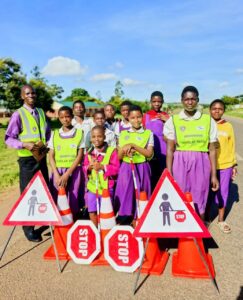
DRTSS highlights that scholar patrol “is vital for enhancing road safety around schools by providing a controlled, visible, and organised system for children to cross busy roads, significantly reducing the risk of accidents”.
“These school pupils regulate traffic, slow down vehicles in their school zones, and instill crucial, long-term road safety awareness in young pedestrians.”
Last week, the DRTSS reported on its Facebook page emphasising that road safety education in primary schools is crucial to teach the learners how to manage road safety activities such as ‘Stop, Look, Listen, and Think’ when crossing roads.
“This helps them to have an inner understanding of safety measures to avoid accidents on the roads of Malawi. The initiative uses interactive, age-appropriate methods to promote walking, crossing and helping others on the road.
“Clubs are formed where patrons and matrons are trained on how the initiative was designed and scholar patrol equipment is being given free of charge. The initiative is practiced across the whole country especially in all schools along the main road with heavy traffic while also considering remote primary schools which also gets there share by educating them on road safety tips.”
The DRTSS took cognizance of Chipoza School located in Kasungu District along Chinkhoma-Santhe road as outstanding where club patrons and learners more often join stakeholders, such as the Malawi Police traffic section in enhancing road safety.
“The school has 2,821 learners of which around 1,088 learners cross the road on a daily basis,” reported the DRTSS. “Mr. Chancy Jere, who is the patron of the school is always available on the road to monitor the road safety programe.”