
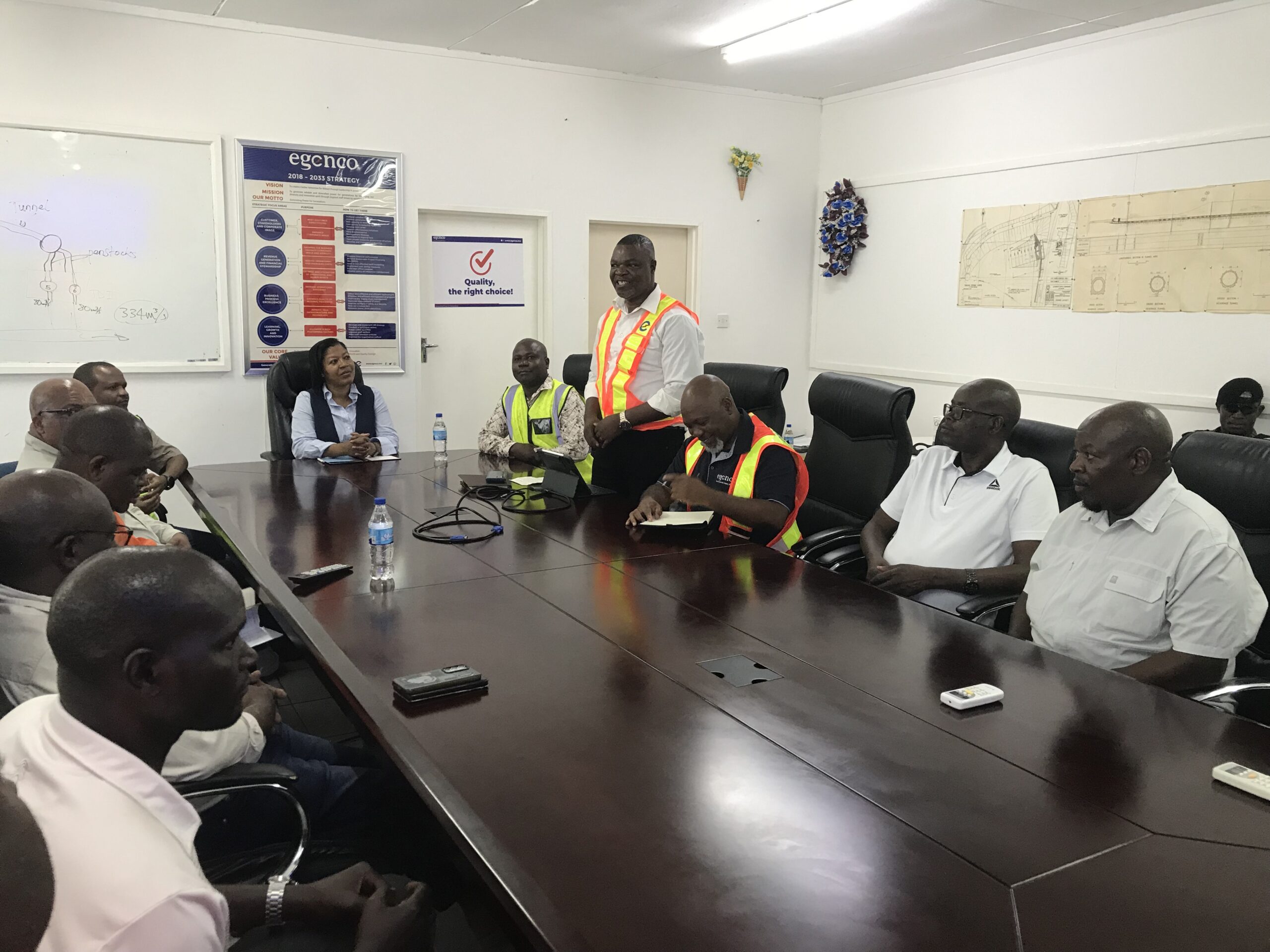
Liabunya first making his presentation at Tedzani Boardroom
* As it rolls out rehabilitation and modernisation projects for Nkula B and Kapichira power plants with support from EU & EIB and AfDB
* The power plant’s rehabilitation projects involve turbine & generator overhauls and replacement of outdated control systems with modern technologies
* Restoration of 32.4MW Tedzani Unit 5 that went off the grid in December 2024 is set to be fully completed by end of this month
By Duncan Mlanjira
Energy Generation Company (EGENCO) Limited has asked the Minister Natural Resources, Energy & Mining, Jean Mathanga to facilitate for additional funding for Kapichira Hydro Power Station’s dam rehabilitation on top of US$44.7 million World Bank support for its hydro plant rehabilitation and modernisation project.

Advertisement
The plea was made by EGENCO Chief Executive Officer (CEO) William Liabunya on Sunday when the Minister visited Tedzani Hydro Power Station to assess the progress made on the restoration of its 32.4MW Unit 5 — that went off the grid in December 2024.
Liabunya appraised the Minister that the repair works is set to be fully completed by end of this month after an expert from the original manufacturer of the machine, Andritz Hydro of Austria, flew in to help with repair works from November 20.

The CEO thus took the opportunity to further appraise the Minister some strategy that EGENCO has under its plans towards a blackout-free nation, which include for Nkula B power plant, that was commissioned in 1992, is to be rehabilitated and modernised at a cost of US$92.941 million.
EGENCO is seeking support from the European Union and the European Investment Bank for this project and for Kapichira I, (commissioned in 2000) needs US$22.936 for its rehabilitation and modernisation with support from the African Development Bank (AfDB).
The additional financing and extension of the closing date thus require the Minister’s support in critical areas that will require a Parliamentary Bill and requests for tax waivers to ease procurement and implementation costs.
Other strategies include increasing power generation from 444.67 megawatts (MW) to 2,434MW by 2040; diversifying by energy source type; diversifying away from the Shire River to other potential sources across Malawi.
Liabunya unpacked that EGENCO has plans each that region of the country should have its own generation plants and to rehabilitate and modernise existing hydro power plants.

Additional capacity is to increase the 4.5MW Wovwe II to double the existing capacity to 9MW; the planned 350MW Mpatamanga hydropower project — under the private-public partnership (PPP) — of which EGENCO will hold 30% equity and the 50MW Salima solar power plant, whose phase 1 of 10MW is in progress and completes this December.
There is also 100MW Chasombo-Chizuma hydropower project whose feasibility studies are underway and a 100MW combined cycle gas turbine, also still in feasibility studies.
On top of that is the 300MW Kammwamba coal powered plant in phases of 100MW, which has since been taken by Electricity Supply Corporation of Malawi (ESCOM) as a single buyer for tendering through independent power producers (IPP) development.
He added that Kapichira hydro plant’s Unit 3 derated from 32MW to 26MW is it currently is using a former Tedzani transformer of lower capacity of 31.5MVA instead of 36MVA but procurement of a new generator transformer is in progress.

Kapichira hydro power stations and below inside the generation plant

Investment in new generation capacity since EGENCO inception after been delinked from ESCOM includes additional 77MW to the national grid through Mapanga diesel power plant of 10MW in 2018, Luwinga (10MW) in 2018, Kanengo Phase II (10MW) in 2019, Likoma-Chizumulu solar PV (1.3MW) in 2019-2020) and 19MW for Tedzani IV that was commissioned in 2021.
The challenges EGENCO faces include ageing Nkula B and Kapichira I hydro power plants; unavailability of critical spare parts due to forex challenges and also that suppliers require to manufacture the parts specifically for Malawi since the machines are obsolete.
High sedimentation of hydropower plant water reservoirs due to high water inflows from Kamuzu Barrage in Liwonde is also a huge challenge as well as high inflow of trash during rain season due to heavy cultivation along the Shire River banks.
Liabunya also told the Minister that they face cash flow constraints due to inconsistent payment by ESCOM for electricity sold to them and that the previous debt had to be written off the books.
Accompanied by Secretary for Energy, Eng. Emmanuel Matapa, Minister Mathanga reaffirmed that President Arthur Peter Mutharika’s administration “is fully committed to delivering stable and reliable power Tedzani’s rehabilitation is a vital part of that mission”.
She took cognizance that Tedzani Hydropower Station, has powered Malawi’s development for decades and her visit allowed her entourage “to witness the important work taking place to maintain a reliable electricity supply and to understand the challenges affecting our national grid”.
“The Democratic Progressive Party made a promise to Malawians — to end blackouts and deliver a modern, reliable energy system. The rehabilitation and maintenance of our hydropower stations, including Tedzani, are central to fulfilling that promise.
“Tedzani remains one of Malawi’s key power stations and a pillar of our energy security. While it continues to contribute significantly to the national supply, ongoing maintenance works are essential to restore full capacity and ensure reliable service for all Malawians.”
She thus commended the engineers, technicians, and staff who worked tirelessly for 24/7 to keep the hydropower station operational, emphasising that “their dedication is critical to maintaining our hydropower assets despite ageing infrastructure and rising demand”.

Tedzani

“This Government recognises that ending blackouts requires action on two fronts: strengthening existing power plants and investing in new generation. Rehabilitation efforts at Tedzani, Kapichira, Nkula, Wovwe, and other stations demonstrate our commitment to energy stability and national development.”
She described the work at Tedzani as transformational, saying: “Every improvement contributes to a more reliable grid, better electricity for homes, businesses, and essential services, stronger investor confidence, and faster progress toward industrialisation.
She urged EGENCO to continue strengthening planning and preventive maintenance, while pledging that “the government will provide the necessary support to ensure that the generation assets remain reliable and modern”.


Advertisement