

Frederik Willem (FW) de Klerk
Maravi Express
Former president of the Republic of South Africa, Frederik Willem (FW) de Klerk — the last white person to lead the country — has died at the age of 85, reports the BBC.

Advertisement
De Klerk, who was also a key figure in the nation’s transition to democracy when was head of state between September 1989 and May 1994, had been diagnosed with cancer this year, the BBC quotes a spokesman as saying.
In 1990, he announced he was releasing anti-apartheid leader Nelson Mandela, leading to multi-party polls in 1994.

A statement from the former president’s FW de Klerk Foundation on Thursday morning read: “Former President FW de Klerk died peacefully at his home in Fresnaye (Cape Town) earlier this morning following his struggle against mesothelioma cancer.”
The foundation had announced the diagnosis — a cancer that affects the lining of the lungs — in June this year.
FW de Klerk had taken over from PW Botha as the head of the National Party in February 1989 and the following year announced he was removing the ban on parties that included Nelson Mandela’s African National Congress (ANC).
His actions helped bring an end to apartheid-era South Africa, and he became one of the country’s two deputy presidents after the multi-party elections in 1994 that saw Mandela become president.

He also shared the Nobel Peace Prize with Mandela in 1993 for his role in the transition to democracy.
According to Wikipedia, FW de Klerk was born March 18, 1936 and is described as a ideologically a conservative and an economic liberal.
He was born in Johannesburg to an influential Afrikaner and studied at Potchefstroom University before pursuing a career in law and after joining the National Party, to which he had family ties, he was elected to parliament where he sat in the white minority of the then President PW Botha.
He held a succession of ministerial posts. As a minister, he supported and enforced apartheid, a system of racial that privileged white South Africans.
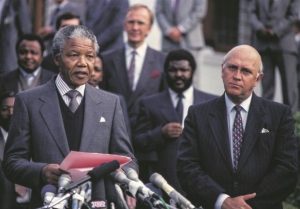
After Botha resigned in 1989, FW de Klerk replaced him, first as leader of the National Party and then as State President and though observers expected him to continue Botha’s defence of apartheid, he decided to end the policy.
He was aware that growing ethnic animosity and violence was leading South Africa into a racial civil war. Amid this violence, the state security forces committed widespread human rights abuses and encouraged violence between the Xhosa and Zulu people — although de Klerk later denied sanctioning such actions.
He permitted anti-apartheid marches to take place, legalised a range of previously banned anti-apartheid political parties, and freed imprisoned anti-apartheid activists, including Nelson Mandela.

A meeting with Hilary Clinton
De Klerk negotiated with Mandela to fully dismantle apartheid and establish a transition to universal suffrage. In 1993, he publicly apologised for apartheid’s harmful effects, but not for apartheid itself.
He oversaw the 1994 non-racial election in which Mandela led the ANC to victory with de Klerk’s National Party taking second place. He then became Deputy President in Mandela’s ANC-led coalition.
As Deputy President, he supported the government’s liberal economic policies but opposed the Truth and Reconciliation Commission that was set up to investigate past human rights abuses because he wanted total amnesty for political crimes.
His working relationship with Mandela was strained, although he later spoke fondly of him. In May 1996, after the National Party objected to a new constitution, de Klerk withdrew it from the coalition government that led the party to disband the following year and reformed as the New National Party.

In 1997, de Klerk, who was never short of controversy, retired from active politics and thereafter lectured internationally.
He received many awards, including Nobel Peace Prize he shared with Mandela, earning wide praise for dismantling apartheid and bringing universal suffrage to South Africa.
Conversely, anti-apartheid activists criticised him for offering only a qualified apology for apartheid and for ignoring the human rights abuses by state security forces.
Some far-right white South Africans accused him of betrayal for abandoning apartheid.
