
* One characteristic of the CDF is that MPs have typically exerted strong influence on how the monies are spent
* Leading some analysts to argue that the CDF benefits MPs more than it does their constituents
By Duncan Mlanjira
A survey by AfroBarometer — following the, in a landmark judgement on May 26 by the Constitutional Court declared unconstitutional the current arrangement of the Constituency Development Fund (CDF), specifically the involvement of Members of Parliament (MPs) and the voting rights they have enjoyed in managing the fund — Malawians believe the CDF benefits politicians most and should be managed by local committees.

Advertisement
The report by Diverson Chirwa and Witness Tapani Alfonso, research intern and research fellow respectively at the Centre for Social Research, University of Malawi (UNIMA), observes that since 2006/2007, Malawi’s central government has used the CDF to funnel money to electoral constituencies to support local development needs and reduce poverty at the grassroots level (Nyirenda & Kalyani, 2023; Government of Malawi, 2014; van Zyl, 2010; Tsubura, 2013).
“During its most recent session, which adjourned in April, Parliament increased the amount given to each constituency by 10%, to K220 million after doubling the amount a year before (Longwe, 2025).
“While supporters extol the potential of the CDF to promote local development through investments in health care, education, water, agricultural services, security, and electricity, critics voice concerns about poor accountability, corruption, elite capture and mismanagement of the fund due to limited community involvement in decision-making processes (Mwangi, 2005).

Advertisement
“One characteristic of the CDF is that MPs have typically exerted strong influence on how the monies are spent, leading some analysts to argue that the CDF benefits MPs more than it does their constituents (Tsubura, 2013; Tshangana, 2010).”
On the May 26 Constitutional Court’s judgement, the AfroBarometer says “it is as yet unclear how this historic ruling will affect future constituency-based projects” adding that the survey’s findings “reveal that a majority of Malawians are unaware of the CDF — especially in rural areas”.
“Among those who are familiar with the fund, two-thirds welcome the doubling of resources in 2024-2025, but almost three-fourths think MPs and other politicians benefit more from the CDF than ordinary citizens.

“A slim majority say the fund should be abolished, but if it continues, virtually all citizens want multiple-stakeholder constituency committees to decide how the monies are used.
Afrobarometer — a pan-African, non-partisan survey research network that provides reliable data on African experiences and evaluations of democracy, governance, and quality of life — says the team in Malawi, led by UNIMA’s Centre for Social Research, interviewed a nationally representative sample of 1,200 adult Malawians in August 2024.
“A sample of this size yields country-level results with a margin of error of +/-3 percentage points at a 95% confidence level.”
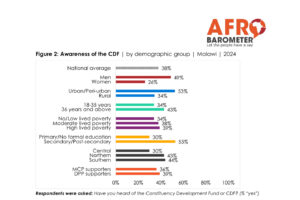
Key findings of the survey are that only about four in 10 Malawians (38%) say they have heard of the CDF) and among those who are aware of the CDF:
* Close to seven in 10 (68%) say the doubling of funding amounts in 2024/2025 was justified;
* Almost three-fourths (72%) say MPs or other politicians benefit most from the CDF, 10 times the proportion (7%) who think that ordinary constituents are the primary beneficiaries;
* More than half (55%) say the CDF should be discontinued, while 43% want it to be maintained;
* An overwhelming majority (91%) say the use of CDF resources should be determined by constituency committees comprising multiple stakeholders rather than MPs alone; and
* More than four in 10 (43%) say village or area development committees would be best placed to manage local development projects, compared to 25% who would assign this task to MPs.

The Constitutional Court nullified the CDF and Water Resource Fund introduced in 2022 stating that they violate principles of the Constitution — declaring as unconstitutional the provision that allows MPs a voting right in local councils as this is also not inconsistent with the constitution.
The Constitutional Court judgement added that the MPs’ role in managing CDF based on the guidelines compromises their oversight function — and thus ordered the removal of the role of MPs in the CDF as responsible for selection, implementation and monitoring of projects.


Advertisement
Meanwhile, Attorney General Thabo Chakaka-Nyirenda indicated that government wants to appeal the judgement in the Supreme Court of Appeal but National Advocacy Platform (NAP) has urged the to prioritise constitutional compliance over institutional protectionism.
MIJ Online reports quoted NAP chairperson, Benedicto Kondowe as asking Chakaka-Nyirenda “to act independently, serve Malawians’ interests and avoid politics”.
