

Chakwera and Alkhalifa after their meeting in Doha
* Our institution started cooperating with Malawi in the 1970s—OPEC Fund Director General
* Our partnership needs to be strengthened, we need more support and assistance—Chakwera
By Lisa Kadango Malango, MANA in Doha
On the sidelines of the 5th UN least developed countries (LDC5) Summit here in Doha, Qatar, President Lazarus Chakwera cemented bilateral ties with OPEC Fund to benefit from the Fund’s reforms through various grants.

Advertisement
The President held talks with OPEC Fund’s director general for international development, Abdullamid Alkhalifa from which a number of areas of mutual cooperation between Malawi and the Fund were discussed that includes infrastructure projects and programmes they render to Malawi.
He said, among others, is the implementation of transforming agriculture through diversification and entrepreneurship, construction of Rumphi, Mchinji as well as Karonga Town water supply scheme.
“Our partnership needs to be strengthened, we need more support and assistance as you are aware that Malawi is still aiming high to graduate into middle income economy — hence the need to collaborate,” he said.


Advertisement
In his remarks, the Director General, Alkhalifa said: “As you know, our institution started cooperating with Malawi in the 1970s and that we have been assisting Malawi in a number of various projects — from road to water sanitation, education, health and various others.”
Alkhalifa emphasized that the meeting with Chakwera cements the relationship between the two and to review some of the portfolio and agree on the way forward for the cooperation.
He said they would continue to assist Malawi in developmental issues, especially those related to those that have high impact and will directly assist the people at the grassroot level.
“We are discussing with the government of Malawi on a clean cooking project for the locals, which will benefit from climate finance and energy innovation which will bring the kind of innovations we need energy — not only on the side of technology but also on the financing and the processes and coming up with ideas to make sure that we do things in the most efficient way of using government resources.”

Finance Minister Gwengwe
Minister of Finance, Sosten Gwengwe commended OPEC Fund for being a true partner to Malawi, saying the partnership dates back since time immemorial — citing eight projects which are currently implemented in Malawi such as the Dowa water project, Karonga water & sanitation project, Nkhata Bay project but also the co-financing of Kaphatenga-Nkhotakota road.
He said the highlight of the discussion is when the President requested for some critical roads, most importantly the Mangochi-Makanjira route that need urgent financing and that the initial reaction was very positive, saying they should be able to form part of co-financiers of important roads.
The Minister revealed that the President presented to OPEC Fund the construction of roads of Usisya, Nambuma-Chisepo and Nkhoma-Mayani as well as Chipoka road to see if OPEC Fund could assist and continue partnering with Malawi in road infrastructure development.

Advertisement
The OPEC Fund for international development is a multilateral development finance institution which was established in 1976 by the Organisation of Petroleum Exporting Countries — with the aim to secure fair and provide stable prices for petroleum to those investing in the industry.
Meanwhile, during the official opening of the LDC5 Summit, President Chakwera said there was growing acceptance among the development partners showing commitment to do their part in lifting the obstacles that stand on a way of least developed countries.
Chakwera — who is the outgoing chairperson of the LDCs, said this year’s conference creates an environment to the United Nations and the international community to put an extra gear to empower landlocked developing countries and small island developing states with full support in order to graduate into middle income status.


He maintained that LDC was the only body of nations that all its members are working towards graduation — hence the need for more support from big economies nations as well as International institutions.
“It is no longer a world in which any nation can enrich itself by invading and looting other nations,” he said. “There is need for collaboration and responsive to the urgent need for development that lifts all nations.”
He added that LDCs are taking the path that is for sustainable development in the context of multilateral cooperation and working together by leaving no one behind following the launch of Doha programme of action.
“We actually have a plan of action, the Doha plan, a development blueprint that captures the vision of LDCs within a complex global developmental landscape.
“The world we live in is no longer the same as it was when the developed nations of the world achieved the prosperity.”

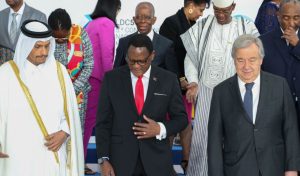
Chakwera with UN Secretary General Antonio Guterres
Chakwera urged the world leaders’ forum to collaborate and work together in solidarity, saying such partnership would strengthen the unity, solidarity and cohesion among the 46 LDCs.
In his remarks, UN Secretary General, Antonio Guterres assured the delegates that the UN was aware of the challenges created by big economies that have slowed down development in most LDCs.
He said there was need to push for resources to address challenges of climate adaptation, energy among others that are hindering the growth of economies in LDCs and during his bilateral talks with Chakwera, Guterres thanked the Malawi leader for the efforts he made during his tenure, saying he faced various obstacles due to challenges such as CoVID-19 and natural disasters, among others.
The UN Chief assured President Chakwera that he would lobby for a basket where LDCs could access resources that could boost their countries’ economies while taking cognizance that LDCs are facing some challenges with remitting loan grants from different financial institution — hence the contributing factor that delays the growth of the nations’ development.
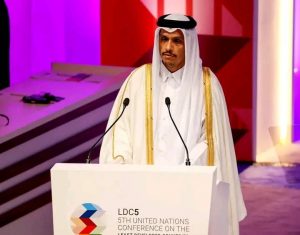
Qatar Deputy Prime Minister, Sheikh Mohammed bin Abdulra Ali-Thani

