
* “Nearly a decade after a military takeover ended Robert Mugabe’s 37-year rule, his widow and children remain wealthy, visible — and quietly accommodated by the very government that pushed them aside”
By Nkhuzana Kamoto, African Politics
On the evening of April 29, 2026, a Mercedes-Benz G-Wagon pulled up at Robert Gabriel Mugabe International Airport to collect a passenger off a flight from Johannesburg. The passenger was Bellarmine Chatunga Mugabe, 28, the youngest son of former President, late Robert Gabriel Mugabe.
Hours earlier, a magistrate’s court in Alexandra had fined him R600,000 for pointing a firearm and for living in South Africa illegally. A gardener at his Hyde Park residence had been shot and critically wounded in February.

Chatunga’s cousin, who pleaded guilty to attempted murder, was sent to prison for three years. Chatunga paid the fine, was deported, and was driven home in a luxury SUV.
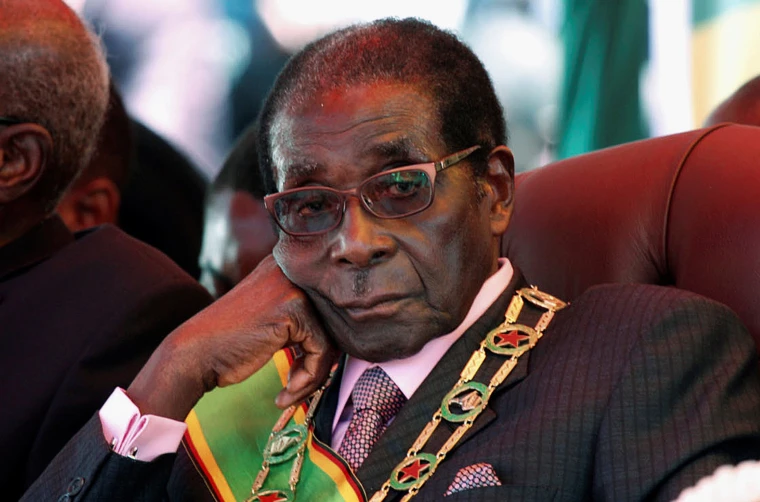
It was a small scene, but it told a larger story. Eight and a half years after the Zimbabwe Defence Forces rolled tanks through Harare and ended Robert Mugabe’s rule, his family has lost very little. The estate is intact. The properties are intact. The name still opens doors.
And the same political party that ousted the patriarch in November 2017 now treats his widow and children with a kind of careful, controlled politeness: “They lost the throne. They never lost the wealth, and they never lost the protection.”

Advertisement
The four children
Robert Mugabe had four biological children. His first son, Nhamodzenyika, was born in Ghana in 1963 to his first wife, Sally Hayfron. He died of cerebral malaria in 1966, aged three, while Mugabe was in prison and could not attend the funeral.
The three surviving children were all born to Grace Marufu, who became his second wife in 1996. Grace had a fourth child, Russell Goreraza, from her earlier marriage to an air force pilot — a stepson Mugabe raised but who is rarely counted among ‘the Mugabe children’.
Bona Mugabe, 38 — the businesswoman in court
Bona, born in April 1988, is the eldest surviving Mugabe child and the only daughter. She studied accounting at the City University of Hong Kong after being deported from Australia in 2008, then earned a Master’s in banking & finance in Singapore.
She married pilot Simbarashe Chikore in 2014 in a ceremony at her father’s residence reported to have cost US$4.49 million. Today she is in the middle of a sensational divorce — and possibly an annulment — that has become a national scandal.
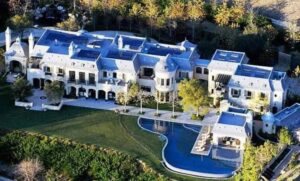
Court papers filed by her estranged husband listed 21 farms, more than 25 upmarket residential properties, an US$8 million mansion in Dubai, and a Rolls Royce, with a combined value estimated around US$80 million. The disclosure caused fury in a country where the late President had publicly preached “one man, one farm.”
In July 2025, the High Court ruled that Bona could simultaneously seek annulment and divorce — after evidence emerged that Chikore had allegedly still been legally married to an American woman when he wed her in 2014. The case continues.
She holds no political office. She has been appointed to the Board of Censors and to the proposed Empower Bank, attended Mnangagwa’s 2023 inauguration, and remains the most publicly visible of the children.
Robert ‘Bob’ Mugabe Jnr., 34 — the campaigner
Born April 1992, Robert Junior was educated in the United Arab Emirates and played for Zimbabwe’s senior men’s basketball team. He runs the xGx clothing label in Johannesburg with his younger brother and is a brand ambassador for the SVG fashion line.

He is also, remarkably, a member of ZANU-PF. In 2022, he served on Emmerson Mnangagwa’s political campaign team — campaigning for the same man his mother spent years trying to destroy. No member of the family has come closer to formal political activity. He has never sought office.
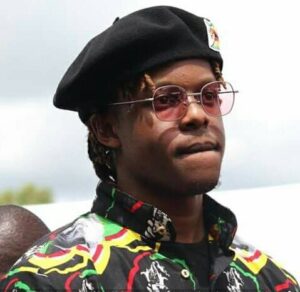
Bellarmine ‘Chatunga’ Mugabe, 28 — the troubled one
Born in 1997 and raised at the family’s Blue Roof estate in Borrowdale, Chatunga was expelled from St George’s College in 2013 and finished his secondary schooling at home. He has spent most of his adult life in Johannesburg’s Hyde Park.
His record now includes a 2023 assault case in Harare, a 2025 violent altercation at a family-linked gold mining concession in Mazowe, and the February 2026 Hyde Park shooting that ended in his April 2026 conviction and deportation. He has no political activity and no realistic political future.
Russell Goreraza, 41 — the stepson
Grace’s son from her first marriage. He keeps a low profile, has been mentioned in the local press in connection with vehicle-import interests, and has never held political office. He is not a Mugabe by blood and is rarely included in family tallies.
The widow, Grace at 60
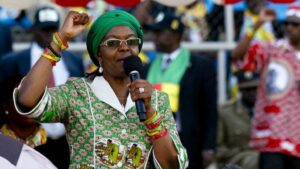
Grace Ntombizodwa Mugabe turned 60 on July 23, 2025. The anniversary passed quietly. There were no rallies, no public statements, no political launches. For the woman once nicknamed ‘Gucci Grace’, who in 2017 declared that she wanted to be vice-president of Zimbabwe, the silence is itself the story.
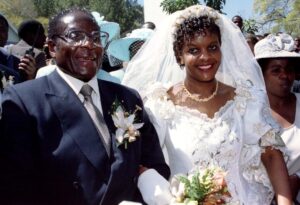
Grace married Mugabe in August 1996, after a long affair that produced Bona and Robert Jr. while he was still married to his dying first wife. She was awarded a doctorate by the University of Zimbabwe in 2014 in circumstances that have never been satisfactorily explained.
She acclaimed her way to the top of the ZANU-PF Women’s League in December 2014, securing a seat on the Politburo. From 2014 to 2017 she fronted the Generation 40 (G40) faction, whose project was to make her the next President.
That project ended on November 19, 2017, when ZANU-PF expelled her along with 20 associates. She and her husband lived under house arrest at the Blue Roof until his death in Singapore in September 2019.
She did, however, win the public fight over his burial: Mugabe was interred at his rural home in Kutama, not at the National Heroes’ Acre, where Mnangagwa had wanted him.
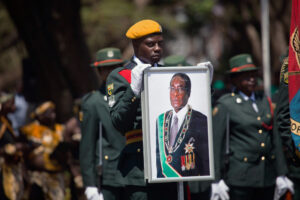
“She can attend events. She can appear in public. She can exist within the national space. But she cannot organise,” this was said by Zimbabwean journalist Gabriel Manyati, writing in March 2026. It captures the present arrangement precisely: Grace attended Mnangagwa’s September 2023 inauguration; she attended Vice-President Constantino Chiwenga’s wedding in December 2023; she has appeared in March 2026 official photographs alongside Mnangagwa and Defence Minister Oppah Muchinguri.
The hostility is not theatre — both sides know what it is — but neither is the civility. It is, as Manyati put it, “a recognition without intimacy, a co-existence without reconciliation”.
The family and State
On paper the relationship between the Mugabe family and the Mnangagwa government should be one of pure enmity. The family was driven from power by the very people who now run the country. By any normal logic, there ought to have been arrests, asset seizures, and a public reckoning. There has been none of that.
Three things explain the accommodation:
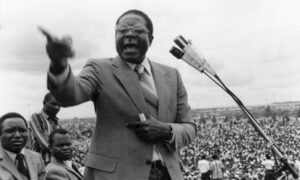
* First, symbolic legitimacy — Mugabe is still the founding father of independent Zimbabwe in ZANU-PF’s official narrative. The party rests its claim to rule on the liberation legacy he embodies. To persecute his widow and children would be to attack the foundation on which the current government stands.
* Second, property and patronage — ZANU-PF reportedly holds title to the Blue Roof itself, and to the Mount Pleasant property occupied by Bona. The party is the family’s landlord. The 21 farms and 25-plus residential properties exposed in Bona’s divorce case were acquired through the same indigenisation and land-reform machinery that ZANU-PF still operates today. Picking a fight with the family means picking a fight with the system that produced the wealth.
* Third, co-optation — Robert Mugabe Jr. campaigning for Mnangagwa in 2022 was the loudest possible signal that the next generation has been folded back in. Bona’s ceremonial appearances do similar work. The family’s status as part of the ZANU-PF furniture, rather than a threat to it, has been carefully rebuilt.
What the family has lost, and what it has not
The honest accounting is short; the family lost political power in November 2017. It lost the presidency, lost the cabinet, lost the prospect of a Mugabe succession. Grace lost her ZANU-PF positions. The G40 faction was destroyed.
It did not lose the farms; it did not lose the houses; it did not lose the foreign assets, the Dubai mansion, the cars, or the cash. None of the children went to prison in Zimbabwe for any aspect of the family’s accumulated wealth.
None of the senior Mugabes was charged at home. The Blue Roof remained their home until — and after — Mugabe’s death. In the South African case that ended last week, Chatunga walked out of court with a R600,000 fine because he could afford it; his cousin, who could not, went to prison.
That sentence captures something about the post-2017 settlement more broadly — the family kept the wealth. The political price was paid by Grace alone, and even then only partly.
The quiet conclusion
The Mugabe dynasty, in any meaningful political sense, is over. There is no plausible Mugabe candidate for office, no Mugabe-led faction inside ZANU-PF, no Mugabe-aligned opposition in formation.
The succession battle now tearing the ruling party apart is between Mnangagwa loyalists and Vice-President Chiwenga’s camp; the Mugabes are spectators. But the Mugabe family, as a wealth-and-symbolism node within Zimbabwean public life, is alive and well.
It has been preserved — deliberately — by the same system that ousted its patriarch. The throne was taken; the estate was not. That, more than anything, is what nearly nine years of distance has revealed.
The 2017 takeover changed the surname over the Office of the President. It changed very little else.