* Exclusive dealing arrangement is a vertical agreement where a supplier restricts a buyer to only purchase their products, or a buyer restricts a supplier to only sell to them — thus prohibiting dealings with other competitors
* Resale price maintenance is a vertical business practice where manufacturers or suppliers dictate the price at which retailers must sell their products— thus restricting competition amongst retailers
By Duncan Mlanjira
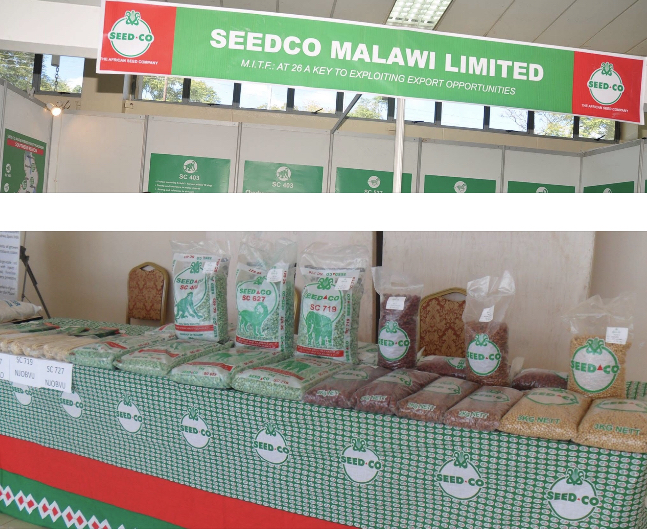
The Competition & Fair Trading Commission (CFTC) is informing the business community and the general public that it is undertaking a market enquiry on proposed exclusive dealing arrangement and resale price maintenance between SEEDCO Malawi and its distributors.

Advertisement
A public notice issued on Tuesday, April 28 by newly-appointed Chief Executive Officer (CEO), Desmond Kaunda, explains that the exclusive dealing arrangement (EDA) is a vertical agreement where a supplier restricts a buyer to only purchase their products, or a buyer restricts a supplier to only sell to them — thus prohibiting dealings with other competitors.
While the resale price maintenance (RPM) is a vertical business practice where manufacturers or suppliers dictate the price at which retailers must sell their products— thus restricting competition amongst retailers.
Kaunda underpins that as a government agency established under the Competition & Fair Trading Act (CFTA) No 20 of 2024, the CFTC is mandated to regulate, monitor, control and prevent acts or behaviour, which are likely to substantially affect competition and fair trading in any of the country’s market.
Thus in pursuant of its mandate, the CFTC emphasises that it “undertakes various activities, including market enquiries, which seek to establish potential impact of trade agreements or arrangements on competition and consumer welfare in the relevant markets and the Malawi economy in general”.


Kaunda thus calls on traders, consumers, the general public and other stakeholders in the seed industry to provide their information regarding the proposed EDA and RPM between SEEDCO and its distributors — whose findings will assist CFTC Board to make its decision on the matter as provided for under Section 30 of the CTFA.
The enquiry is taking place between Tuesday, April 28-May 15, 2026 and for clarifications concerning any aspect of the enquiry, the CEO indicates that the stakeholders can reach out to the CFTC through Toll-free number 2489 or through email address; competition commission@cftc.mw — or direct to Competition Analyst, Khumbo Kawonga on +265 994 275 584 of email khumbo.kawonga@cftc.mw.
“Your information will be treated with strictest confidentiality,” assures Kaunda, who was announced as the new CEO by the CFTC Board a day before — replacing Lloyds Vincent Nkhoma, who served from 2023.
During his tenure, Nkhoma facilitated for the amendment of the Competition-and-Fair-Trading-Act-which-became-operational-on-July-1-2024, which enhanced stiff penalties for perpetual offenders with fines now attracting up to 10% of gross annual turnover for enterprises and companies and up to 5% for natural person.

Vincent Lloyds Nkhoma
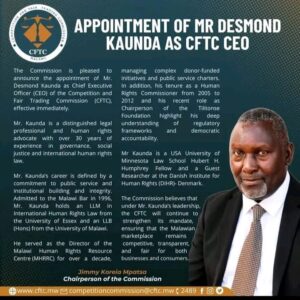
In the announcement, CFTC Board’s chairperson, Jimmy Koreia Mpatsa indicated that Nkhoma’s successor, Desmond Kaunda “is a distinguished legal professional and human rights advocate with over 30 years of experience in governance, social justice and international human rights law”.
The Board described Kasunda’s career as “defined by a commitment to public service and institutional building and integrity” — thus the Board believes that under his “leadership CFTC will continue to strengthen its mandate, ensuring that the Malawian marketplace remains competitive, transparent, and fair for both business and consumers”.
He holds his LLB (Hons) from the University of Malawi and was admitted to the Malawi Bar in 1996. He holds LLM in International Human Rights Law from the University of Essex and is a Fellow of USA University of Minnesota Hubert H. Humphrey Law School and a guest researcher at the Danish Institute for Human Rights.
He served as director of Malawi Human Rights Resource Centre for over a decade — “managing complex donor-funded initiatives and public service charters”.
“In addition, his tenure as a human rights commissioner from 2005-2012 and his recent role as chairperson of Tilitonse Foundation, highlight his deep understanding of regulatory frameworks and democratic accountability,” says the Board.