

* Much of the public discussion has centred on legality. Was the regulator, the Reserve Bank, wrong? Was the court right to say so?
* On that question, there is little mystery. Authority must answer to law. A court that affirms this is merely performing one of its most important democratic functions
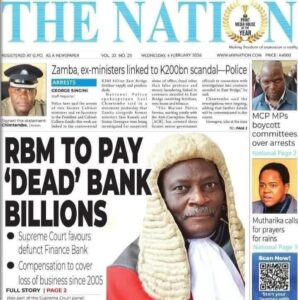
Analysis by By Dr. Ken Lipenga on Supreme Court judgement on Finance Bank issue
I have always been drawn to words before I am drawn to arguments. Perhaps that is the occupational hazard of a student of language and literature. Some words carry within them a history of thought so rich that they quietly discipline the way we reason, long before we take sides.
One such word is jurisprudence.

Back in my undergraduate days, my friends taking law used to impress me a lot with this word. Over a beer in the student common room, they would, with some swagger, confidently throw the word around, with its unique rhythm, in a manner that exuded profound wisdom and left me in awe.
I eventually learnt the various meanings of the word with all their legal and historical intricacies, including its use to refer to case law, the study or philosophy or science of law, what law is, how it works and what it should be.
In recent times I have sought to strengthen my friendship with law professors, including the internationally renowned law Professor Edge Kanyongolo, in the hope that mere proximity to them would afford me better acquaintance with the meanings of the word.
Now, with regard to becoming an expert in this particular word, I cannot say I have succeeded. But most of the meanings I come across appear to be a thinning of the original idea.
At the root of jurisprudence, from the Latin juris prudentia, is an older idea of prudence: judgement shaped by experience, restraint learned over time, an awareness that decisions ripple beyond the moment of decision.
Prudence in this case refers not to timidity, but to seasoned judgment, the kind that comes from knowing that decisions do not end where they are announced and that consequences often travel further than intentions.
An elder might put it the way my father used to teach me on the river banks of Mt. Michesi, during my earliest mountain-climbing expeditions: you do not test the depth of the river with both feet. That saying is about foresight, not fear of drowning.
This linguistic detour is not accidental. It provides a useful way into the public conversation now unfolding around a recent decision of the Malawi Supreme Court of Appeal, a decision that has been debated largely in terms of legality, but, so far, insufficiently in terms of prudence.
Before going further, a necessary honesty is required. Malawians do not arrive at judicial debates as blank slates. Our experience with certain sections of the judiciary, past and present, has too often left much to be desired.
Frustrating delays, dubious inconsistencies, and episodes that strained public confidence have created a climate in which suspicion comes easily, sometimes too easily. That history cannot simply be wished away.

Advertisement
That said, this reflection proceeds on an assumption of judicial integrity in this particular decision, not because courts are beyond reproach, but because institutional thinking becomes impossible if every judgment is reduced to motive-hunting.
This is an essay about judgment and consequence, not about imputing intent, much as that might be a perfectly legitimate separate exercise.
Much of the public discussion has centred on legality. Was the regulator, the Reserve Bank, wrong? Was the court right to say so? On that question, there is little mystery. Authority must answer to law. A court that affirms this is merely performing one of its most important democratic functions.
But jurisprudence does not end where illegality is declared. That, in fact, is where it truly begins.
A finding of wrongdoing answers one question. A remedy answers another. Remedies are what concern us here. They are not abstract gestures. They wander like ghosts through our everyday lives, touching institutions, budgets, and national confidence. Almost by definition, remedies are meant to shape future behaviour.
When a court imposes liability on a public body, it goes beyond merely correcting an error, quietly deciding how society itself will absorb the consequences.
To extend liability across nearly two decades is to invite the court into imaginative reconstruction. It assumes a world in which an institution survives uninterrupted, complies with every requirement flawlessly, weathers economic storms, and prospers steadily through periods of upheaval.
Such a world can be imagined. But whether it should be packaged, priced and presented as a bill to the public, a public that had no seat at the bench, is, shall we say, a slightly different matter.
This is where public policy does its quiet work.

Public policy is the shared sense of what society can live with. It is the set of practical limits a community places on decisions so that what is lawful does not become socially destructive.
It asks whether an outcome, even if technically correct, damages trust, stability, or the common good. It is the set of considerations that prevent lawful decisions from producing outcomes that undermine the public interest.
Public policy is not an escape hatch. It exists to prevent remedies that are logically attractive from becoming socially destabilising. It insists that courts ask not only “Was there a wrong?” but also “What follows if we correct it in this way?” and “Who ultimately pays?”
In fact, this idea of public policy as prudence is not foreign to us at all. Long before we used the phrase, those who presided over disputes in traditional Malawi understood instinctively that judgment was never only about rules, but about consequences.
Village courts did not ask merely who was right, but what outcome the community could live with. I grew up hearing stories of my grandfather, Nuukunuwe, who was widely respected as a judge at the court of Mwene Phodogoma.
His authority did not rest on rigid application of custom, but on an ability to read the wider effects of a decision: whether it would restore harmony, protect the vulnerable, and allow the village to continue living together after the matter was closed.
A judgment that was technically correct but socially disruptive was not considered wise. It was considered a failure of judgment. Elders understood that a ruling might satisfy a rule and still damage the village.
What we now call public policy was once simply the discipline of asking whether a decision would allow the community to wake up whole the next morning.
Other societies have learned this lesson slowly, sometimes painfully. In the United States, the Supreme Court of the United States has long recognised that enforcing the law and protecting society are not competing obligations. Regulators may be told they were wrong. They may even be required to compensate. But American courts are cautious about remedies that stretch far into the past or rest on speculative futures.
I should add that even some recent judgments of the U.S. Supreme Court that many of us instinctively read as partisan, or personally protective of Donald Trump, may also be understood, at least in part, as exercises in prudence.

Advertisement
This does not dispel unease about politics or motive. It simply recognises that courts sometimes act to limit consequences rather than to vindicate personalities. A decision can be politically coloured and still prudential in effect, especially where judges fear that judicial overreach today may fracture institutions tomorrow. Prudence, after all, speaks to the effect and reasoning of a decision, the outcomes and consequences, not to the purity of a judge’s heart.
This is often described as courts “protecting the state”. The phrase obscures more than it reveals. What is being protected is not misconduct, but the public from remedies that risk weakening the very institutions meant to serve it.
As a historical aside, it may be useful to recall how this moment was built into the architecture of our democratic transition. In the early 1990s, as Malawi emerged from long years of executive dominance under a one-party dictatorship, those tasked with drafting a new constitutional order were understandably determined to strengthen the courts. Judges were to be more assertive, more willing to check power, more confident in saying no to the state.
At the time, in conversations with lawyer friends who were directly involved in drafting the Constitution, who would occasionally share language and clauses for reflection and comment, the intention was clear and, given our history, entirely justified. A vigorous judiciary was seen as the necessary antidote to the abuses and excesses of the past.
What follows in many young democracies, however, is a predictable phase. Courts awaken to their new authority and, in doing so, sometimes lean heavily toward principle and assertion, occasionally at the expense of consequence.
This is not a democratic failure, but part of the learning curve, where the restoration of the rule of law briefly runs ahead of the quieter work of institutional calibration.
Over time, mature systems rebalance. Legislatures step in to clarify liability. Boundaries are drawn between error and abuse, between bad judgment and bad faith. Courts continue to enforce the law, but within a framework that reflects collective learning rather than case-by-case improvisation. This evolution is a refinement rather than a retreat from accountability.
Seen this way, the deeper question raised by the current debate may not be judicial at all. A regulatory system that exposes public institutions to open-ended historical liability is going beyond correcting past error; it is shaping future behaviour.
Fear of ruin can chill regulation as effectively as impunity can corrupt it. In the end, instead of protecting our perpetually fragile economy, officials learn to hesitate, to defer, to avoid decisions whose risks are personal while the benefits are public.
Here, legislative responsibility becomes unavoidable.

Traditional chiefs applies logical common sense in their judgement
Many jurisdictions have responded by drafting laws that protect regulators acting in good faith, while preserving accountability for recklessness, malice, or corruption. Such frameworks do not place regulators above the law. They place them within it, but with clearer lines between mistake and abuse.
As Malawians, we may need to think much more seriously, and with urgency, about this direction. The aim would not be to overturn judgments or to undermine the courts, but to clarify, prospectively, how society wants regulation to function when regulators act in good faith in response to conduct that genuinely alarms them.
Financial supervision does not operate with the luxury of hindsight. It operates in real time, on the basis of what officials see, patterns they encounter, and risks that strike them as sufficiently grave to demand intervention.
Courts, by contrast, assess those decisions years later, with full information, cooled tempers, and the benefit of reconstruction.
A framework that judges regulatory action exclusively through judicial hindsight, while ignoring the conditions of regulatory foresight under which it was taken, risks sending a dangerous signal: that officials who act decisively to protect the public may later be punished precisely for having acted.
Clarifying how much retrospective risk society is willing to impose on those charged with safeguarding Malawians is, therefore, an act of collective self-preservation and not just an exercise in institutional self-protection.
This, too, is jurisprudence in its deeper sense: not merely the accumulation of cases, but the cultivation of judgment across institutions and across time. Our elders knew this long before we had appellate courts: a decision that satisfies a rule but fractures the community is not justice; it is judgment without prudence.

Advertisement
Editors note:
For more on the Supreme Court of Appeals’s judgement, read malawi-law-society-faulting-supreme-court-of-appeal-on-delayed-pace-of-justice-delivery/.
Dr. Ken Lipenga is a journalist, writer, former legislator and former Cabinet Minister. He was the Member of Parliament for Phalombe East from 1997-2014 and served in various ministerial positions.
He studied and graduated in Bachelor of Education from the University of Malawi in 1976 majoring in English and History and then completed aa Masters of Arts at University of Leeds in 1978.
Lipenga won a Graduate Assistantship to study for PhD in English Literature at the University of New Brunswick in Canada graduatipinh in 1984, whose thesis was entitled ’Alienation in the novels of Ayi Kwei Armah’. He returned home to continue with his teaching work at Chancellor College.

Dr. Ken Lipenga
He worked at Blantyre Printing & Publishing (BP&P), now The Times Group, as general manager and editor-in-chief of Blantyre Newspapers Ltd but was dismissed in 1992 Lipenga following a series of provocative articles under his column, Off the Cuff through the article ‘Of Gallileo as Dissident’ — metaphorically criticising the one-party rule under former President, late Dr. Hastings Kamuzu Banda’ regime as he sided with those calling for multi-party rule.
He became a correspondent for Reuters news agency and Radio Netherlands and after meeting with former Cabinet Minister late Aleke Banda, who had just been released from political detention, he joined a group that sympathised with the United Democratic Front (UDF).
When Banda and family decided to establish The Nation newspaper in 1993, Ken Lipenga became the founding editor-in-chief before resigning in 1995 after was appointed special Apsssistant to ruling President Bakili Muluzi.
After become an MP in 1997, Ken Lipenga served as Minister of Education, Science & Technology from 1999 to 2004; Minister of Information, Communication & Tourism between 2004 and 2005; of Labour & Vocational Training (2005 to 2006); of Trade & Industry in 2007; Deputy Minister of Finance (2007 to 2008); Minister of Economic Planning & Development in the DPP administration; of Tourism, Wildlife & Culture until 2011, when he was appointed as Minister of Finance.
He served under the presidency of Joyce Banda until October 10, 2013, when he was dropped in a cabinet reshuffle and was unseated by independent candidate Amos Mailosi in the 2014 general election.
Dr. Lipenga is a recreational angler, photographer and mountain climber. His published works are Waiting for a Turn: Short Stories (1981) and Of “been-tos” and Messiahs: Millenialism in Armah’s Fiction (1986).

Update on Tropical Cyclone Gezani