
* Despite significantly falling from 23.4% in May 2026 to 21.1% in June offering some relief to households and businesses
Maravi Express
Following the release of the inaugural Malawi Pressure Index (MPI) by South Africa’s Don Consultancy Group (DCG)on Thursday, which classified the country’s inflation environment as ‘High Pressure’, the analysis continues to indicate that the inflation remains substantially above target band of the Reserve Bank of Malawi (RBM).

Chifipa Mhango
The MPI was developed under the leadership of Chifipa ‘Chifi’ Mhango, the DCG Chief Economist and Executive Director-Economic Research & Strategy, who reports as follows:
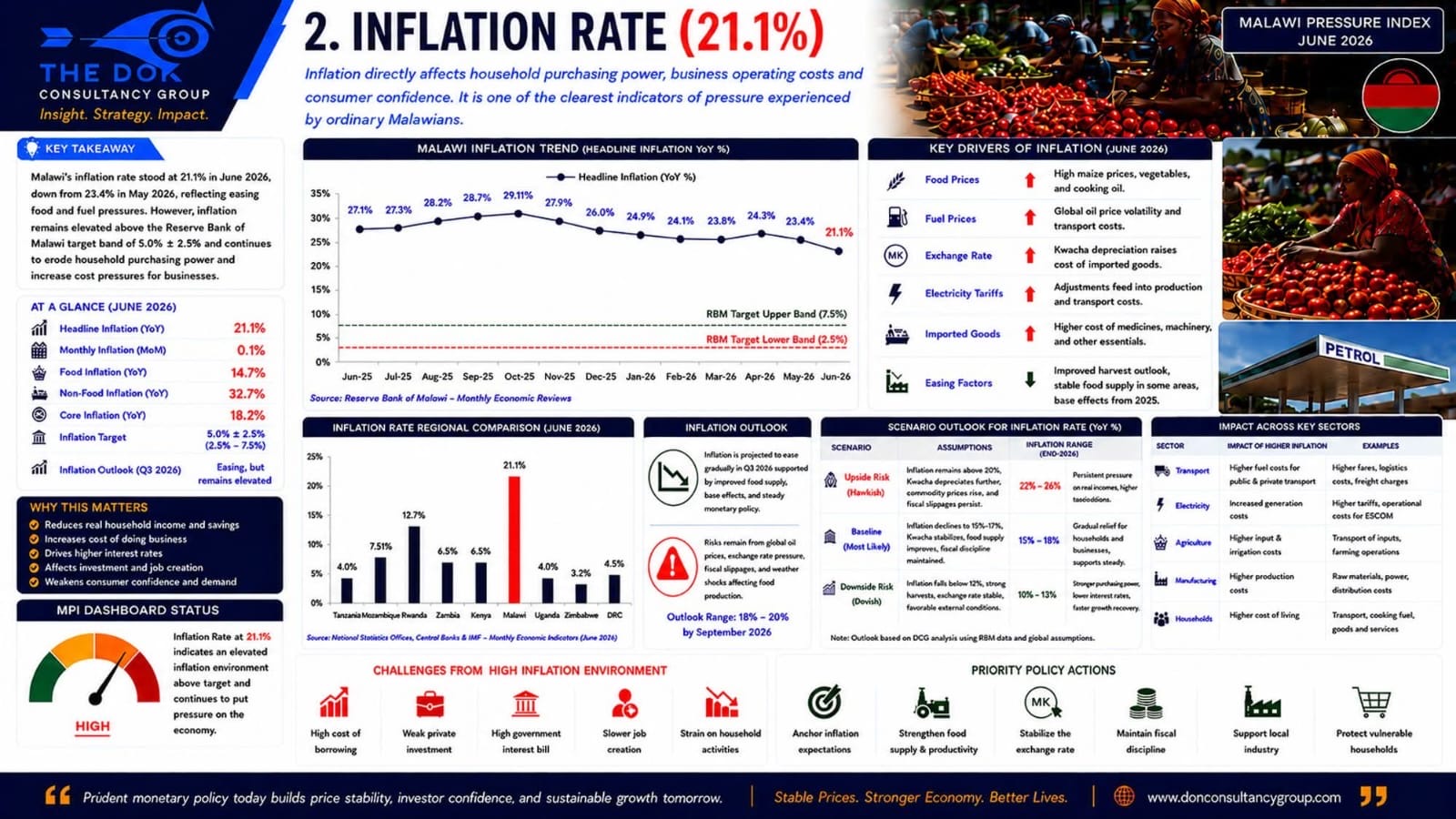
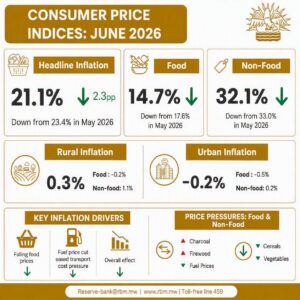
Malawi’s headline inflation rate declined significantly to 21.1% in June 2026, from 23.4% in May, offering some relief to households and businesses.
However, the latest reading should not be interpreted as the end of Malawi’s inflation challenge.
The June decline of 2.3 percentage points is encouraging and continues the broader disinflationary trend that has emerged since inflation reached 29.1% in October 2025.
Nevertheless, inflation at 21.1% remains substantially above the Reserve Bank of Malawi’s target range of 2.5%–7.5%, with the current rate almost three times the upper limit.
The central message from the June data is, therefore, clear: Malawi is experiencing disinflation, but it has not yet achieved price stability.
Inflation is coming down, but remains uncomfortably high
The inflation trajectory provides evidence of meaningful improvement. Headline inflation declined from 29.1% in October 2025 to 27.9% in November, 26.0% in December, 24.9% in January 2026, 24.1% in February, 23.8% in March, before briefly increasing to 24.3% in April.
Then it fell to 23.4% in May and 21.1% in June. The 0.1% monthly inflation rate recorded in June is particularly encouraging, suggesting that the pace of price increases has slowed considerably.
However, the underlying structure of inflation remains a concern. Food inflation stood at 14.7%, while non-food inflation remained considerably higher at 32.7%.
Core inflation was also elevated at 18.2%, pointing to persistent underlying price pressures across the economy. This explains why the MPI continues to classify the environment as HIGH PRESSURE.
The MPI is designed to look beyond whether inflation is moving up or down. It considers the magnitude of the pressure and its implications for households, businesses and economic activity.
At 21.1%, inflation continues to undermine household purchasing power and increase the cost of doing business.
For ordinary Malawians, lower inflation does not mean that prices are falling. It means that prices are rising at a slower rate than previously.
The cumulative impact of high prices remains embedded in household budgets.
For businesses, elevated inflation continues to affect input costs, transport, electricity, imported machinery, raw materials and financing conditions.
This is why the latest MPI dashboard continues to place Malawi in the high pressure category despite the recent improvement in inflation.
Malawi’s inflation performance is also concerning when compared with other countries in the region. In June 2026, Malawi recorded inflation of 21.1%, compared with 12.7% in Rwanda, 7.51% in Mozambique, 6.5% in Zambia, 6.5% in Kenya, 4.5% in the DRC, 4.0% in Tanzania, 4.0% in Uganda and 3.2% in Zimbabwe.
This makes Malawi a clear regional inflation outlier. The gap is economically significant. Persistently higher inflation can weaken Malawi’s competitiveness, increase production costs, reduce real incomes and make domestic goods and services more expensive relative to those produced in neighbouring economies.

Advertisement
Several factors continue to shape Malawi’s inflation environment. These include:
* Food prices remain important, particularly maize, vegetables and cooking oil. Fuel prices remain vulnerable to global oil-price movements and transportation costs, while Kwacha depreciation continues to raise the domestic cost of imported goods.
* Electricity tariff adjustments are also feeding into production and transport costs, while imported medicines, machinery and other essential goods remain exposed to exchange-rate pressures.
There are, however, some positive developments. An improved harvest outlook, more stable food supplies in some areas and favourable base effects from 2025 could support further disinflation during the second half of the year.
The outlook is improving, but risks remain
At DCG, our assessment is that inflation could continue to ease, with the September 2026 inflation outlook estimated at 18%-20%. But the trajectory is not guaranteed:
* Under an upside-risk scenario, inflation could remain between 22% and 26% if the Kwacha depreciates further, commodity prices rise, fiscal slippages occur or adverse weather conditions disrupt food production.
* Under the baseline scenario, inflation could decline to 15%–18%, supported by improved food supply, stronger fiscal discipline and continued moderation in domestic price pressures.
* Under a more favourable downside-risk scenario, inflation could fall to 10%–13%, particularly if the harvest is strong, the exchange rate stabilises and inflation expectations improve.

Advertisement
The most likely path remains one of gradual disinflation, but risks remain tilted towards the possibility of renewed pressure. The cost of high inflation extends beyond the CPI.
The most concerning aspect of the current inflation environment is its wider economic impact. High inflation increases the cost of living, weakens household purchasing power and can reduce consumer demand.
For businesses, it raises production and operating costs and can discourage investment.
The MPI identifies several consequences of the high-inflation environment, including high borrowing costs, weak private investment, a high government interest burden, slower job creation and increasing pressure on household economic activity.
This creates a difficult policy environment in which authorities must simultaneously support economic growth while preventing renewed inflationary pressures.
Policy must now consolidate the gains. The immediate policy priority should be to ensure that the recent decline in inflation becomes a sustained disinflationary process.
* First, Malawi needs to anchor inflation expectations through credible and consistent monetary and fiscal policy;
* Second, the country needs to strengthen food supply and agricultural productivity. Sustainable food-price stability will require improvements across production, storage, logistics and distribution;
* Third, exchange-rate stability remains essential. Excessive Kwacha volatility can quickly translate into imported inflation;
* Fourth, fiscal discipline must be maintained. Fiscal pressures that increase domestic financing requirements can undermine efforts to bring inflation sustainably lower;
* Fifth, Malawi needs to support domestic production and local industry, reducing excessive dependence on imported goods and inputs; and
* Finally, vulnerable households must be protected through targeted interventions that provide relief without creating additional broad-based fiscal pressures.
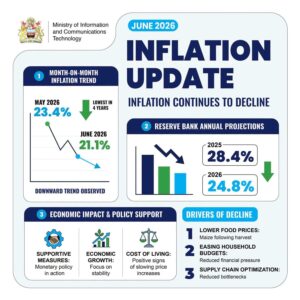
The June inflation figures provide a reason for cautious optimism. The decline from 23.4% to 21.1% represents meaningful progress, and the broader trend since October 2025 suggests that inflationary pressures are gradually easing.
But 21.1% is still far too high. The MPI’s High Pressure classification is, therefore, appropriate. Malawi has moved in the right direction, but the economy remains under substantial price pressure.
The challenge now is to convert disinflation into genuine price stability. The June inflation decline is welcome, but we should not confuse slower inflation with falling prices.
Malawi remains in a High-pressure inflation environment because the rate of price increases is still significantly above the RBM’s target and regional benchmarks.
The policy task now is to lock in the gains, stabilise the exchange rate, strengthen food production, maintain fiscal discipline and protect vulnerable households.
* As Don Consultancy Group Executive Director of Economic Research & Strategy, Chief Economist Chifipa Mhango specialises in macroeconomic analysis, public policy, and governance across emerging markets, particularly in Africa. He is known for providing data-driven insights on economic trends, fiscal policy, and institutional accountability, with a strong focus on strengthening economic and governance frameworks.

Advertisement