
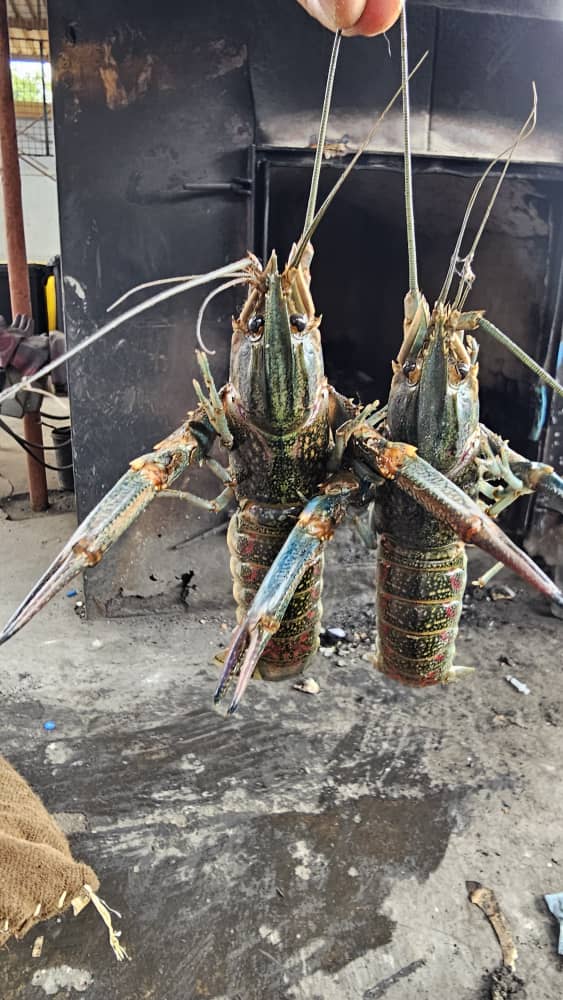
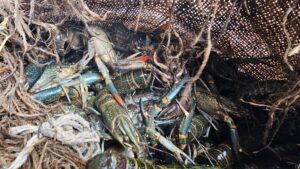
* Court has since convicted the Zambians for illegally bringing into Malawi without government authorisation the live crayfish commonly referred to as lobsters
* Authorities need to be vigilant — this can be an act of terrorism where they may have had intentions to throw them in our lake to destroy the good fishes we have
* Let them be investigated, maybe a similar act was already done — we need high intel. These appear to be a big threat in any ecological setting
By Duncan Mlanjira
News of the Magistrates Court in Lilongwe convicting four Zambian nationals for illegally bringing live Crayfish into Malawi, without government authorisation, was accompanied by images of the crayfish, which have aroused some debate on social media — as most Malawians had never seen or heard of such water creatures before.

Advertisement
The four Zambians — Patrick Phiri, Evans Nyirenda, Aremo Simanono and Kennedy Muntanga — were intercepted and arrested on May 16, 2025, at the Ludzi Malawi Revenue Authority checkpoint in Mchinji and appeared before the court charged with three counts.
According to Section 41(1)(c) of the Constitution of Malawi, it is prohibited to introduce non-indigenous fish into the country’s waters without permission from the Director of Fisheries.
MBCDigital reports that they were convicted after pleading guilty to the charges, which were:
* Transferring exotic species without a licence (contrary to Section 41(1)(a) of the Fisheries and Aquaculture Conservation Act);
* Engaging in activities involving specimens of alien or invasive species (contrary to Section 71(2) of the Environmental Management Act); and
* Possession of uncleared goods (contrary to Section 134A of the Customs and Excise Act).

The MBCDigital report further says during court proceedings, the first accused, Patrick Phiri, confessed that he intended to sell the crayfish valued at K3 million to a Chinese national based at Grand Business Park in Lilongwe.
He further disclosed that this was his second transaction, having previously sold 20kgs of the same species to the same buyer. When intercepted and arrested, the four were found in possession of five bags of live crayfish, weighing a total of 250kgs.
MBCDigital reports that Principal Resident Magistrate, Benjamin Chulu has set Monday, May 26 as the date for sentencing and further quotes Senior Deputy Director in the Department of Fisheries, Maxon Ngochera, as saying such species pose some ecological threat.
“It is dangerous to bring prohibited fish like crayfish into the country,” he is quoted as saying. “These species have already caused problems in countries such as Zambia, South Africa and Namibia.
“They are alien to Africa and are known to feed on other fish species, their eggs and aquatic vegetation — thereby disrupting the ecosystem,” he said while Malawi Police Central West Region prosecutor, Superintendent Kalanguluka said the prosecution would present its opinion on the appropriate sentence.
“Before sentencing, we intend to advise the court on the sentence we believe is appropriate. We also aim to provide expert testimony on the ecological dangers these species pose,” Kalanguluka is quoted as saying.

Advertisement
News of the conviction, coupled with the images shared of the crayfish and the dangers they pose to the country’s water ecosystem, prompted the public to expect a stiffer punishment in the upcoming sentence to act as a deterrent.
“These are appear to be a big threat in any ecological setting,” opined one on a WhatsApp group. “I think these are not much different from a certain tree species called Black Wattle which was banished from being planted in Malawi because of its is aggressiveness and much more aggressive indeed than the known invassive plants in an ecological setting.
“This case, therefore, does not deserve any leniency at all. Handing down any leniency could entice other would-be law breakers to be trying to test the waters.”


Advertisement
The social media observer further appealed to the law enforcers to engage and warn the Chinese community that the convicts identified to first declare to the Fisheries Department their intention to import what they believe are edible fish or any other animal specie — with strong warning that “any failure to do so will be treated as a deliberate move, subject to prosecution”.
“Bringing the crayfish not alive should also be discouraged or barred as, unless otherwise, the bones or intestinal organs and other stuff usually thrown away into the environment could a big threat to the environment in general,” advised the concerned citizen, whom we do not name.
On his part, Andrew Nkoloma declared that “crayfish are not fish — they belong to the crustacean family, which includes other shellfish like lobsters, crabs and shrimp”.
“Crayfish are freshwater crustaceans that live in streams, rivers, and lakes and are often referred to as crawfish or crawdads. While they are aquatic animals, they are distinct from fish in terms of their biology and classification.”

However, Rhonex Tembo said these spices of crayfish “are edible and cannot feed on fish in lake Malawi — it’s a lie. Google ‘Spiny Lobster’ — you will learn what they eat — izi sizingameze chambo or bombe. They can’t even survive in lake Malawi, I doubt.
“These spices are same like crabs, octopus, shrimp, snails etc. Anthu amapelekera mma hotel. Zoona mkulu oyang’anira za nsomba mdziko angakanike kudziwa za nsomba zimenezi mkutinamiza kuti zitha nsomba zathu mu lake Malawi? What fish education did he go through? This fish is eaten across the world.”
However, on the commemoratiion of the International Day for Biological Diversity on Thursday, environmentalist Mathews Malata highlighted that the attempt by the Zambian nationals to introduce invasive crayfish specie can expose the country’s vulnerability to invasive species in aquatic ecosystems.

Malata told MBCDigital that more needs to be done for the country to achieve effective biodiversity conservation while Secretary for Ministry of Natural Resources & Climate Change, Yusuf Mkungula stressed for the need to protect biodiversity, which is rapidly declining in the country due to human activities.
Another environmentalist on social media observed that Malawi is struggling to contain some invasive alien plants on and around Mulanje Mountain and Nyika National Park — which distorting the original grassland/ecosystem plus beauty.
Last year, the Ministry of Natural Resources & Climate Change — in collaboration with various development partners — developed and launched three main publications that sensitise efforts being undertaken to address invasive alien species in the country.

Invasive alien species are destructive non-native plant and animal species — some of which are deliberately imported or brought in by accident — which are posing as one of the biggest threats to biodiversity and livelihoods.
The publications were launched at the joint commemorate of the 2024 International Day for Biological Diversity and the World Environment Day held at Neno Community Sports Centre on Friday.
On social media, Felix Mnthali observed the image of the intercepted crayfish “looks dangerous” and agreed that the fisheries officers “are right in preventing it from entering our borders”.
Angella Matenje suggests that the authorities should also have an aquatic conservationist at the borders to deter foreign nationals from infiltrating strange animal species which Chinese nationals are fond of doing.
Tawachi Kaseghe hope that the Zambian nationals were extensively interrogated if indeed their Chinese customers were going to eat the crayfish — otherwise “they can be charged with an act of terrorism looking at the type of fish. You never know they might [had intentions] to introduce it secretly in our water bodies”.

Mchinji One Border Post
Alex Sungani asked the Immigration Department to check their records on how many times the Zambian nationals might have entered Malawi before, hinting that “this might not be their first attempt — maybe they might have smuggled these into the country before”.
To which Twalibu Tandwe agreed, saying: “…we must investigate — perhaps they have been doing this for long. This is a serious offense much as conservation of aqautic ecosystem is concerned and it poses a serious threat to our fisheries.
“Big up to those on duty at the border — you could have received corruption to let them pass but you made the right choice.
Gray Ibn Saizi made some simple calculations that given the convict Patrick Phiri intended to sell K20kgs of the crayfish at K3 million to the Chinese national based at Grand Business Park in Lilongwe — and the four were found with a total of 250kgs, they were going to rake in K154 million after sales — anapita awa!”
