

Morocco football federation’s president (right) is Motsepe’s (left) vice-president in CAF
* How this matter ends will undoubtedly be a defining moment for the five-year presidency of Patrice Motsepe — judging from the mood within the African football community
* Which is yet to recover from the unacceptable and inexplicable postponement of the Women’s Africa Cup of Nations, which he promised would take place in Morocco on time
* The South African billionaire is on an extremely sticky credibility and legacy wicket
Ed Aarons, Romania Molina & Osasu Obayiuwana, The Guardian
Confederation of African Football (CAF) president, Patrice Motsepe, has been accused of allowing Morocco to “dictate its law” after Senegal were stripped of their Africa Cup of Nations (AfCON) 2025 title on Tuesday.

Advertisement
But while Senegal’s football federation indicates that it would appeal to the court of arbitration for sport and the Senegalese government suspects corruption within CAF, Motsepe said in a statement released in a video on Wednesday evening that Senegal have “a right” to appeal to CAS and that the African confederation will “respect the decision that’s taken at the highest level”.
He said the CAF appeal board had taken its decision independently and was made up of “some of the most respected lawyers on the continent” — but he quickly added that “suspicion and distrust” of referees was “a legacy issue”.
Journalist Osasu Obayiuwana, writes: “In more than three decades of reporting on African football, I have gone through the entire gamut of emotions: exhilaration over some of the continent’s great moments at the AfCON and World Cup; frustration over the errors its governors make; and deep despair, wondering whether its custodians will ever live up to their responsibilities and do their jobs diligently.
“The decision on Tuesday to strip Senegal of the 2025 Afcon title and hand it to Morocco, leaves me gobsmacked, as it did a former member of the appeals committee, who said: ‘As a person who was on the appeals board for six years, I know it does not have the power to change the on-field decision of a referee. I cannot understand how they came to this disgraceful decision’.”
Augustin Senghor, the Senegal federation president and a member of CAF’s executive committee, expects CAS to overturn what he described as the “dangerous precedent” to award Morocco, the tournament hosts, a 3-0 win in the final.
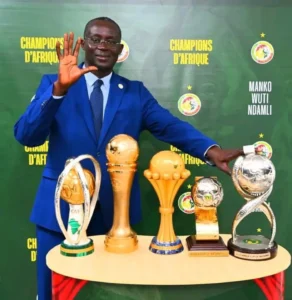
Augustin Senghor
The FSF is understood to be confident on the grounds that article 5.2 in the International Football Association Board’s laws of the game states that the decisions of the referee are final regarding the result of a match.
Senghor posted on X: “Does the appeals committee master the laws of the game validated by FIFA and is, therefore, superior to this AfCON regulation according to FIFA and CAF statutes? Has it disregarded them? The CAS will censor this dangerous precedent.
“They dared to do this! They dared to substitute themselves for the referee of the final in violation of the laws of the game! Africa and the world will know how to recognise the champions of the Cup of Nations Morocco 2026. Senegal will keep its trophy no matter what. Too bad for African football.”
Senghor, the chair of the African confederation’s legal affairs department, sent a private text message to Motsepe on Tuesday just before the decision was made public, alleging the ruling had been taken during “a secret meeting in Cairo”.
Senghor wrote: “Something that nobody can imagine in the other continents or confederations, why should we accept and allow it to happen here in CAF, in Africa because someone is more strong or powerful or a country is more rich and then has more influence to dictate its law against all odds and despite the clear rules of our organisation?”
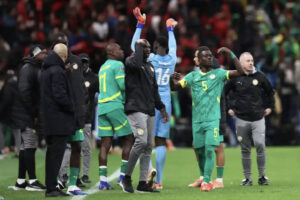
Senegal’s Idrissa Gueye gestures to his teammates to leave the pitch after a penalty is awarded to Morocco in the Afcon final in January. (Amr Abdallah Dalsh/Reuters)
“How long shall we continue to stand and look at this disastrous situation going on in full view of everyone of us and specially of the entire world?”
The Senegal government also expressed “profound dismay” on Wednesday at the decision and said it “directly contradicts the fundamental principles of sporting ethics, foremost among which are fairness, loyalty and respect for the truth of the game”.
It said CAF’s credibility and trustworthiness had been undermined by the ruling and that all legal avenues would be pursued to reverse it: “Senegal unequivocally rejects this unjustified attempt at dispossession,” it said.
“It calls for an independent international investigation into suspected corruption within the CAF’s governing bodies.”
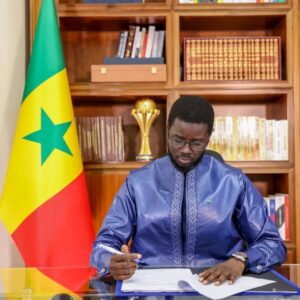
Senegal State President
At an initial disciplinary hearing, CAF imposed fines of more than US$1 million and bans for Senegal and Morocco players and officials, but left the result untouched.
Sadio Mané and several of his Senegal teammates have criticised the decision, with the former Liverpool forward writing on Instagram: “What happened has gone too far. This is not the football we fight for, not the Africa we believe in. There is too much corruption in our game, and it’s killing the passion of millions of fans across the continent.”
Several members of Caf’s executive committee are considering not attending the next meeting, scheduled for the end of the month, as a protest against Motsepe’s leadership. “He is no longer able to run CAF,” one insider said.
In his analysis, The Guardian’s Osasu Obayiuwana observes that the controversy has also left members of the CAF executive committee furious, knowing that point 5.2 of the laws of the game makes it clear ‘that the decisions of a referee regarding facts connected with play, including whether or not a goal is scored and the result of the match, are final’.
“It’s a big joke,” said Samir Sobha, the CAF exco member from Mauritius, on Wednesday. “We cannot correct a mistake by making another mistake …correcting one injustice with another cannot be considered an acceptable response, either from a sporting or an ethical standpoint.”
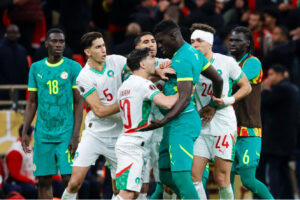
Senegal and Morocco players clash during the Africa Cup of Nations final (AFP/Getty Image)
It is not the first time CAF has made a ridiculous decision. In May 2019, during the second leg of the CAF Champions League final between Espérance Tunis and Wydad Casablanca, the Gambian referee Bakary Gassama declared Espérance the winners when Wydad’s players had walked off the field after the official’s decision to disallow Walid El Karti’s second-half goal.
With play stopped for more than an hour and the Moroccan side refusing to resume, Gassama ended the game and awarded the Tunisian team a 3-0 victory, leading to the CAF Champions League final being abandoned for the only time in its history.
Despite Gassama’s verdict being in accordance with the CAF Champions League tournament rules and the laws of the game, CAF’s executive committee met in Paris that June and overturned Gassama’s ruling, ordering a replay of the abandoned second leg.
It took a slap down from the Court of Arbitration for Sport (CAS) for CAF to respect the referee’s verdict and subsequent judicial processes, confirming Espérance as the winners.
Remarkably, nine years on, CAF has returned to a self-imposed governance quagmire, as the appeals body, led by Roli Harriman, a Nigerian high court justice, issued a ruling that makes a mockery of the laws of the game, that one CAS is certain to reverse, in order to protect football’s hallowed rule — that the decision of a referee, whether good or bad, is final (excluding the video assistant referee).
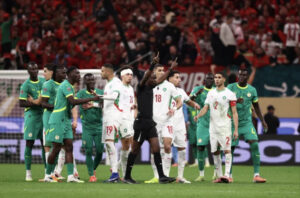
The referee Jean-Jacques Ndala Ngambo. (Franck Fife/AFP/Getty Images)
There is no doubt Jean-Jacques Ndala Ngambo had a nightmare during the Afcon final. His officiating was atrocious: denying Senegal a penalty they deserved and failing to declare the game abandoned, in favour of Morocco, when the west Africans walked off for more than a quarter of an hour in protest against a penalty awarded against them.
But once Ngambo took the decision to resume play the result could only be determined on the field of play and not in the court of football justice.
How this matter ends will undoubtedly be a defining moment for the five-year presidency of Patrice Motsepe. Judging from the mood within the African football community, yet to recover from the unacceptable and inexplicable postponement of the Women’s Africa Cup of Nations, which he promised would take place in Morocco on time, the South African billionaire is on an extremely sticky credibility and legacy wicket.—Edited by Duncan Mlanjira, Maravi Express

Advertisement