

* Allocates 85% of contractual volumes for the current fuel supply to Malawian transporters following concerns of dominance by international transporters
* NOCMA addressing concerns of loading delays at sea ports in Mozambique and Tanzania by establishing offices in Beira and Dar es Salaam
By Duncan Mlanjira
Malawi Energy Regulatory Authority (MERA), in collaboration with the Ministries of Energy and of Transport, has averted an industrial strike planned by Bulk Vehicle Operators Trade Union (BVOTU) from tomorrow April 7 after addressing some of the key issues the fuel supply transport operators were demanding.

Advertisement
In a statement following an “urgent” multi-stakeholder meeting held today, April 6, MERA indicates that the intention by BVOTU to proceed with the industrial action arose from “persistent welfare and operational challenges faced by drivers”.
MERA further reports that at an earlier engagement, the Authority had “emphasised the urgency and national importance of the matter, noting risks of fuel supply disruption if grievances remained”.
Key issues that were raised in the engagement included dominance of international transporters and thus the government, through National Oil Company of Malawi (NOCMA) has now allocated 85% of the contractual volumes of the current fuel supply year to Malawian transporters.
The other key issue was loading delays at sea ports in Mozambique and Tanzania and NOCMA has now established an office in Beira and another is being established in Dar es Salaam by April 30, 2026 in order to facilitate loading efficiencies.
“Based on the agreements, MERA indicates that “the planned industrial action has been called off as agreed by the BVOTU representatives led by their secretary general Mathews Sibale.
Last week, when MERA increased pump fuel prices by 35% and 34% for petrol and diesel, Consumer Association of Malawi (CAMA) called on oil importers “to continue bringing in fuel to avoid local scarcities that will trigger black market prices and force consumers to experience long queues and sleepless nights at filling stations”.
“We would also like to mention that it is important for fuel importers in the country to continue importing fuel to avoid any shortages of fuel on the market, as in the past consumers have suffered more when faced with fuel scarcities more than high prices.
“Our appeal is to ensure that there no fuel scarcities on the market,” said CAMA Executive Director, John Kapito in his statement, in which he also appealed to traders-and-transporters-not-to-unfairly-push-prices-beyond-reach-of-consumers-due-to-the-fuel-price-increase, saying:
* “It is important to understand that both consumers and traders are affected by the fuel price increases and it will be necessary for both parties to recognise that they need each other during these difficult times.”
Meanwhile, while the government maintains that the fuel hike was necessary and unavoidable given the situation across the globe, the opposition UTM Party disagrees, contending that Malawi’s fuel prices are stacked with “a cascade of domestically imposed levies and charges”.
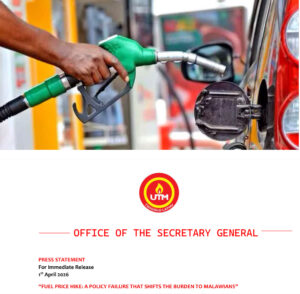
The UTM, whose president if former Reserve Bank of Malawi (RBM) Governor, Dailitso Kabambe, thus proposes that the government should cut-down-on-the-cascade-of-levies-than-wholesale-pump-price-increase/ — observing that after Import Base Landed Cost (IBLC) for petrol at 404,551.33 tambala (K4,045.51/litre, on top of that are charges, that include:
* Road levy is at K521/litre; rural electrification levy at K207/litre; under-recovery (K350/litre); price stabilisation fund (K168.77/litre); excise duty (K279.32/litre); duty (K253.92/litre) — along with carbon tax, SFR levy, energy regulatory levy, distribution fund and IBLC loss recovery.
“UTM, therefore, calls on government to urgently reconsider its position,” said the Party in its statement. “A calibrated approach that includes temporary reductions in fuel levies and taxes, combined with targeted support measures, would provide relief while maintaining supply and economic stability.”

Advertisement