
* Malawi’s public institutions must not only be independent and professional, but must also be seen to be independent and professional
* Public confidence in State institutions depends heavily on the integrity, fairness, and transparency of public appointments
By Duncan Mlanjira
Civil society organisation (CSO), Youth and Society (YAS), has condemned “the continued perception and growing pattern of politicised appointments within statutory corporations and public institutions”.

Advertisement
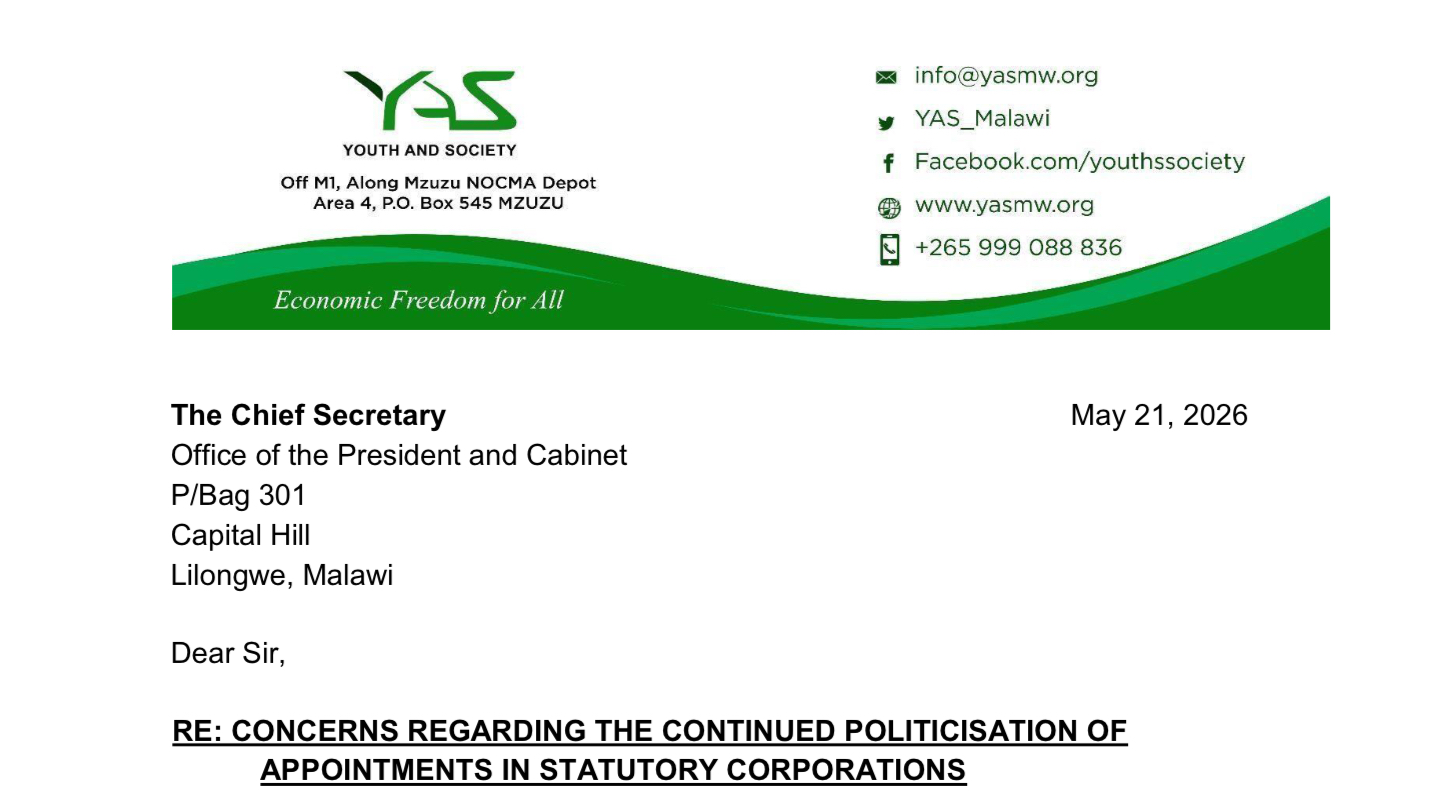
In a statement addressed to Chief Secretary in the Office of the President & Cabinet (OPC), dated May 21, 2026, YAS Executive Director, Charles Kajoloweka, maintains that the politicised system of appointment in public institutions — “is not a mere administrative concern [but] a fundamental governance issue that strikes at the core of constitutionalism, institutional independence, public confidence, and the integrity of Malawi’s public service system”.
The prominent CSO and advocacy NGO, which empowers young people and marginalised communities by promoting human rights, democratic governance and social accountability — through civic education, legal action and public policy dialogue — explains that the concern comes against a background of recognising the positive steps the OPC has recently undertaken “to clean the wage bill of the public service by terminating employment of all those that were irregularly employed by the previous government”.
Kajoloweka welcomes that action, which “was expected to be sustained” — and also draw particular attention to a 2021 report by the Ombudsman, entitled; ‘Secure in Deception’, “which remains one of the clearest and most authoritative statements on the standards governing public appointments in Malawi”.
The Ombudsman report, says YAS, “underscored that recruitment to senior public positions must be grounded in merit, transparency, fair competition, and strict adherence to lawful procedures”.
“Those principles are neither optional nor cosmetic — they are essential safeguards against abuse of power, institutional capture, and erosion of public trust. It is, therefore, deeply troubling that serious concerns continue to emerge regarding the transparency, competitiveness, and legality of appointments to senior positions in statutory corporations and some cases in the civil service.

Charles Kajoloweka
“Where appointments are perceived to be influenced by political considerations rather than open and merit-based processes, the inevitable consequences are weakened institutions, compromised professionalism, poor governance outcomes, and growing public distrust in the State.
“Not only does such practices erode public trust but they also breed demotivated public servants who legitimately expect to rise through established structures without cultivating political patronage,” says YAS, whose statement comes after the-government-completed-appointments-for-posts-of-diplomatic-missions-in-various-countries, most of which are deemed to be political appeasement.
YAS further maintains that public institutions “cannot effectively serve the nation where competence is subordinated to political loyalty” but that “institutions thrive when leadership is based on integrity, professionalism, independence, and accountability”.
“Conversely, when public appointments are perceived to be predetermined, externally influenced, or politically engineered, statutory boards are reduced to spectators in processes they are legally mandated to oversee.
“That fundamentally defeats the purpose of institutional governance structures established by law. Section 4 of the Public Service Act (1994) is unequivocal that entry into and advancement within the public service must be based on merit, ability, knowledge, skill, and aptitude following fair and open competition.
“This principle is central to equal opportunity, effective governance, and the rule of law. Any deviation from it undermines not only institutional legitimacy, but also the constitutional values upon which public administration must operate.
“YAS is particularly concerned that failure to uphold merit-based recruitment risks normalising a culture where public office is increasingly viewed as a reward for political proximity rather than a position of public trust and service.
“Such a trajectory is dangerous for democratic governance, institutional stability, and long-term national development. Malawi cannot build strong institutions on weak governance foundations.”
YAS thus “firmly calls upon the OPC to take immediate and decisive steps to restore confidence, legality, and meritocracy in public appointments” and in particular asks that:
* all appointments to statutory corporations made outside lawful and competitive recruitment procedures be reviewed and, where necessary, rescinded without delay;
* all affected institutions be directed to undertake fresh recruitment processes that are transparent, merit-based, competitive, and fully compliant with the law;
* statutory boards be allowed to discharge their recruitment and governance mandates independently and without political interference;
* no senior appointment in any public institution be made without public advertisement, shortlisting, and lawful interviews, except where expressly permitted by law;
* the OPC publicly reaffirm its commitment to constitutionalism, the rule of law, and merit-based public administration; and
* clear monitoring and accountability mechanisms be instituted to ensure full compliance with lawful recruitment standards across all public institutions.

Advertisement
“Malawi’s public institutions must not only be independent and professional, but must also be seen to be independent and professional,” says Kajoloweka. “Public confidence in State institutions depends heavily on the integrity, fairness, and transparency of public appointments.
“The long-term strength of the public service lies not in political patronage, but in competence, integrity, institutional independence, and public trust,” says YAS, while “unequivocally” urging the OPC “to treat this matter with the seriousness and urgency it deserves in the broader national interest of protecting governance standards, strengthening institutions, and safeguarding public confidence in the administration of public affairs”.
“Failure to take timely corrective measures risks deepening public distrust, further weakening institutional credibility, and inevitably inviting heightened public scrutiny and appropriate constitutional, legal, and accountability interventions by concerned stakeholders committed to defending the integrity of public administration.”

Advertisement