

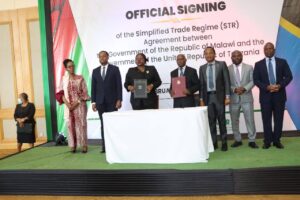
* After the two countries sign a Simplified Trade Regime (STR) Agreement aimed at strengthening cross-border trade and deepening regional integration
* Steady growth in trade between the two countries in recent years increased from US$86.5 million in 2021 to US$98.2 million in 2024, representing a 13.5% rise
* Tanzania’s exports to Malawi grew from US$64 million to US$77.7 million over the same period, while imports from Malawi declined slightly from US$22.5 million to US$20.5 million
By Duncan Mlanjira
Tanzania’s Minister of Industry & Trade, Judith Salvio Kapinga, has reaffirmed her country’s commitment to deepening bilateral trade and economic cooperation with Malawi following the signing of the Simplified Trade Regime (STR) Agreement today, February 16, 2026, at the Bingu International Convention Centre (BICC) in Lilongwe.

Advertisement
On its official Facebook page, the Malawi Government Media reports that Minister Kapinga, labelled the event as “a Historic occasion for both nations” as she highlighted highlighted the steady growth in trade between Tanzania and Malawi in recent years.
She indicated that total trade increased from US$86.5 million in 2021 to US$98.2 million in 2024, representing a 13.5% rise and that Tanzania’s exports to Malawi grew from US$64 million to US$77.7 million over the same period.
But imports from Malawi declined slightly from US$22.5 million to US$20.5 million — but despite this progress, Kapinga noted that significant untapped potential remains, particularly in value addition, cross-border trade and investment partnerships.
The Tanzanian Minister described the STR as a transformational instrument that will simplify customs documentation, reduce administrative barriers and encourage traders to shift from informal routes to formal channels.
She is quoted as saying the agreement will improve safety and dignity for women and youth traders, strengthen food security and livelihoods in border communities.

Tanzanian Minister Kapinga
Malawi Minister of Industrialisation, Business, Trade & Tourism, Simon Itaye, described the agreement as a significant milestone in the growing economic cooperation between the two neighbouring countries and as a practical and people-centred step forward in advancing bilateral trade relations.
The STR is designed to facilitate small-scale cross-border trade by reducing administrative barriers, simplifying customs procedures, and promoting transparency in the movement of goods.
The agreement is expected to benefit women and youth in particular, who rely heavily on informal cross-border trade for income and employment. By streamlining documentation and improving coordination among border agencies, the two governments aim to make trade more accessible and efficient for small and medium-sized enterprises.
Itaye is quoted as saying “the agreement directly addresses long-standing challenges faced by informal traders, including complex procedures, high transaction costs and uncertainty at border posts”.
“The initiative also aligns with national development strategies, regional integration efforts and the aspirations of the African Continental Free Trade Area (AfCFTA).”

Minister Itaye
The Minister commended technical teams from both countries for successfully negotiating the agreement and acknowledged the support of the Government of the United Kingdom, provided through Alliance for a Green Revolution in Africa (AGRA).
Under the Malawi Congress Party (MCP) administration, there was a trade standoff between the two neighbours when the then Minister of Trade Vitumbiko Mumba gazzeted in Parliament a motion on March 13, 2025 — that imposed ban on the imports of flour, rice, ginger, bananas and maize from Tanzania; under the Control of Goods (Import and Export) (Commerce) (Prohibition) Order.
In response, Tanzania also threatened to bar Malawi from accessing its sea port of Dar es Salaam, which is a lifeline for Malawi’s economy. Mumba told the media that Malawi’s decision was designed as a temporary measure and a strategic move to create an environment where local businesses can thrive without the immediate pressure of foreign competition.

Advertisement
But when there was a backlash, that immediately attracted international attention, the MCP administration swiftly engaged Tanzania for a joint ministerial meeting held in Dodoma where the two countries strengthened-their-trade-ties-after-the-trade-standoff/ and reaffirmed their commitment to enhance bilateral trade relations.
When Tanzania first reacted to the MCP administration’s decision, some international analysts questioned if tanzania-just-trying-to-apply-pressure-for-malawi-to-capitulate-to-its-demands-to-reverse-agricultural-trade-importation-ban/.
Malawi was to bear a huge blunt on this international trade war and Tanzania was seen as taking the measures just so that she can continue to enjoy immense benefits she gets through Malawi’s agricultural exports.
In his State of the Nation Address (SONA) made in Parliament on Friday, February 13, 2026, President Arthur Peter Mutharika announced that in the quest for economic transformation, the strategy is to leverage the country’s diplomatic missions abroad as hubs for investment and remittances.
In this regard, he announced that since he took over the leadership, his administration restored global confidence and trust for the country by recalling all diplomatic officers and replacing them with fewer and qualified diplomats.

President Mutharika in Parliament on Friday