* Issues moratorium on all outstanding and unimplemented functional review recommendations
* No further role changes, redeployments, or grading adjustments are to be effected
* Identify employees whose redeployment or demotion has resulted in loss of critical skills or operational inefficiencies
* Reinstate such employees to their previous substantive roles and grades, where justified
By Duncan Mlanjira
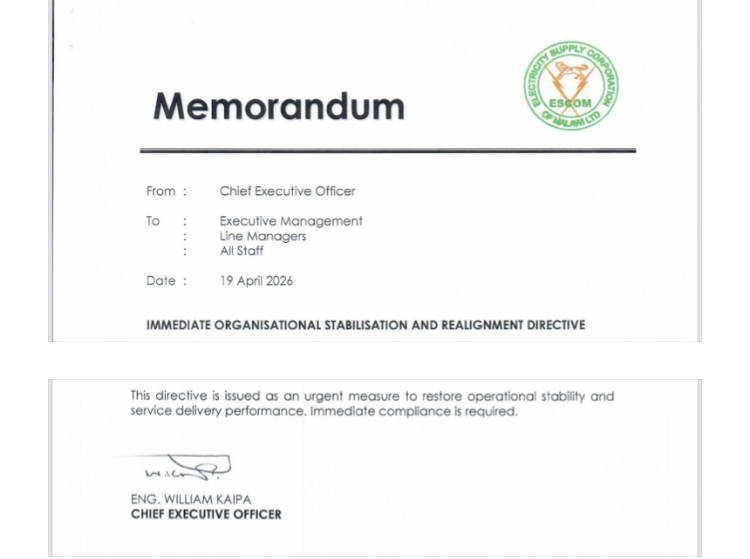
Newly-appointed Electricity Supply Corporation of Malawi (ESCOM) Chief Executive Officer (CEO), Eng. William Kaipa has hit the ground running by issuing directives as an urgent measure to restore the power utility service provider’s “operational stability and service delivery performance” — with emphasis that “immediate compliance is required”.

Kaipa was introduced by the Board to ESCOM Executive Management last week
In an internal memo issued Sunday, April 19, to his executive management, line managers and all staff — which Maravi Express has in possession — Kaipa says following the implementation of the Functional Review, it has been established that certain outcomes have resulted in misalignment between roles and competencies and loss of critical critical technical and operational skills.
He has also observed that there is loss of experienced personnel within the System Control Centre, that is impacting real-time system operations; reduced operational efficiency, particularly in faults management and network response; and declining service delivery performance and increased customer complaints.
“These developments pose an immediate risk to ESCOM’s operational stability and service delivery mandate,” says the CEO in the memo, and goes on to issue a directive “to stabilise the organisation and restore operational capability”.

Advertisement
The moratorium on functional review implementation placed on all outstanding and unimplemented recommendations includes:
* No further role changes, redeployments, or grading adjustments are to be effected;
* No structural changes are to be implemented without express approval of the CEO; and
* All ongoing implementation process must be halted immediately.
On immediate organisational realignment, Kaipa directs all executives to:
* Identify employees whose redeployment or demotion has resulted in loss of critical skills or operational inefficiencies
* Reinstate such employees to their previous substantive roles and grades, where justified; and
* Prioritise critical areas including System Control Centre operations, faults management, network operations, and customer service.

Priority intervention for the System Control Centre stabilisation include immediate review of all staffing changes affecting it; urgent restoration of experience personnel to ensure effective system monitoring and stable operations.
“A Task Team is hereby established to review all outcomes of the Functional Review, identify misalignment and critical skills gaps, and recommend sustainable structure,” says Kaipa, who has given a timeline of 14 days.
On governance and control, the CEO directs that all changes must be documented and justified; human resource and legal must validate all reinstatements; to submit weekly reports to the CEO; and that no deviation should be done without approval.
On staff engagement, Kaipa orders that “all managers are required to engage affected employees immediately, communicate clearly, and restore confidence and focus on service delivery.”
Expected outcomes of his directive includes “stabilized operations; improved fault response times; restored technical capacity; and improved staff mandate”.

Advertisement
“All staff, particularly Executives and Managers, are expected to support and comply with this directive. Non-compliance or delays in implementation will be addressed accordingly.
“This directive is issued as an urgent measure to restore operational stability and service delivery performance.”
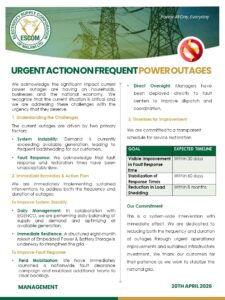
Meanwhile, just this Monday afternoon, ESCOM management issued a press release assuring-of-its-dedication-to-reducing-power-outage-frequency-and-duration — through urgent operational improvements and sustained infrastructure investment.
The management acknowledged the significant impact current power outages are having on households, businesses and the national economy , saying: “We recognise that the current situation is critical and we are addressing these challenges with the urgency that they deserve.”