
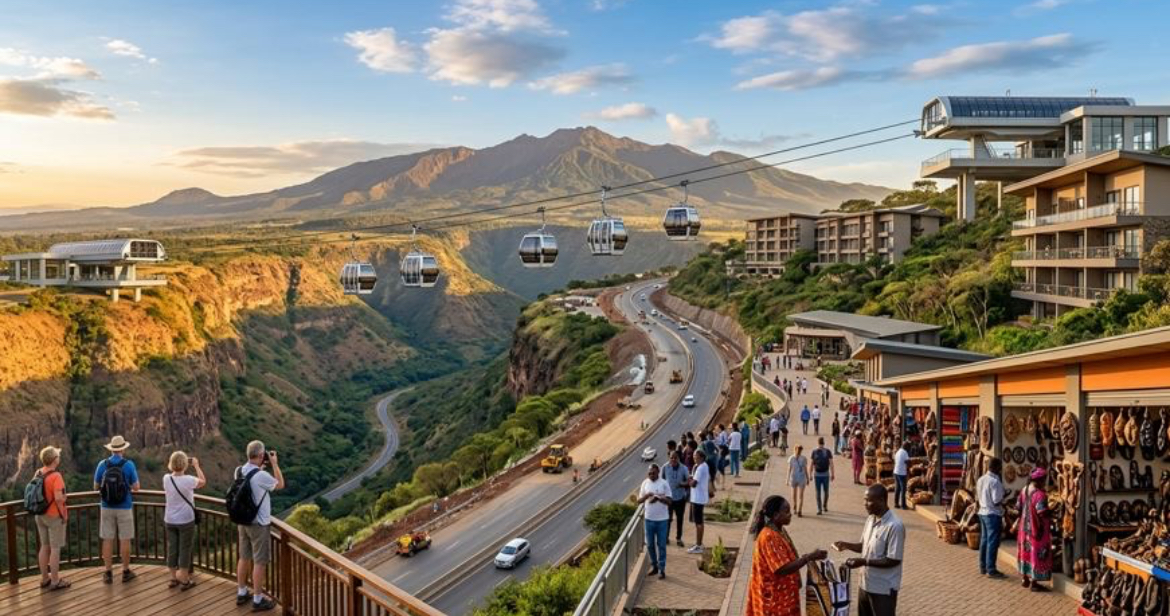
AI-generated artistic impression of Kenya’s Great Rift Valley Viewpoint, showcasing the potential of the proposed transformation
* Major tourism upgrade alongside its major wildlife reserves that is set to earn billions of money for Kenya
* To transform the iconic Great Rift Valley Viewpoint along the Nairobi-Nakuru highway into a world-class tourism hub
By Duncan Mlanjira
In order to transform its thriving tourism industry, that is complemented by its major wildlife reserves, Kenya’s government is finally rolling out the construction of cable cars, under a public-private sector partnership.

Advertisement
The media there report that the project was approved by the Cabinet in August 2018 but failed to take off amid stakeholder wars between Kenya Ferry Services and the Kenya National Highways Authority.
A report by Construction Kenya indicates that Kenya is moving forward with the US$57 million project by April next year after securing land for the venture connecting Mombasa Island with the South Coast.
It highlights that the project includes transforming the iconic Great Rift Valley Viewpoint along the Nairobi-Nakuru highway into a world-class tourism hub, luxury hotel developments, and redesigned commercial spaces.
Nairobi Wire quotes Transport Cabinet Secretary, Davis Chirchir, indicating that the cable car system will transport visitors in suspended passenger cabins, offering panoramic aerial views of Mount Longonot, the floor of the Great Rift Valley, and the surrounding escarpment landscape
Alongside the aerial cable system, the state plans to upgrade commercial infrastructure and attract private investment to lengthen visitor stays at the landmark stopover.
“We are going to re-do the curio shops that will force tourists to stop and want to spend time,” he is quoted as saying.
“We will probably let investors put up hotels. We want to leverage the God-given tourist attractions of the Rift Valley.”
This new development follows another mega project that Kenya announced in July 2026, of an ambitious plan to construct in underground railway system in the Capital Nairobi.
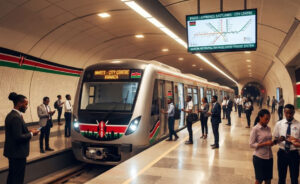
Artistic impression of the proposed underground train system in Nairobi

It will also be funded by public-private partnership, pension funds and transport-oriented development initiatives — with additional funding to be raised through land value capture, where increased land value around transport corridors is used to support infrastructure development.
This is the power of public-private sector partnership, which Speaker of Malawi Parliament Sameer Suleman described as vital for economic development when National Bank of Malawi (NBM) and others corporates sponsored the hosting of the 55th Commonwealth Parliamentary Association (CPA) Africa Region Conference last August.
The government has recently been supported by the private sector through road network upgrades.
Meanwhile, Malawi Ministry of Tourism has been singing the song of constructing cable cars for Mulanje Mountain to boost tourism.
In 2022, the Ministry indicated that it was awaiting investors to finalise its plans of introducing cable cars on Mulanje Mountain as well as Zomba Plateau.
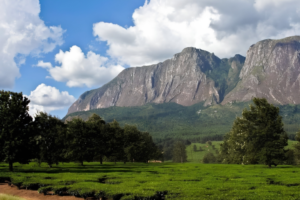
The beauty that is of Mulanje Mountain


Passionate Malawian hikers that support Mulanje Mountain local tourism
The Ministry indicated that feasibility study was completed while assuring investors that Mulanje is an already a popular tourist destination — thus the need for public-private sector partnerships.
The Mulanje and Zomba cable car project is one that the private sector can indeed venture into, whose return would be generation of revenue from already established tourism destinations.
Just last month, government signed a landmark housing partnerships to tackle urban informal settlement crisis with Malawi Housing Corporation (MHC), Centre for Community Organisation & Development and Habitat for Humanity Malawi — with FDH Bank as the main sponsor of the funding for the houses.
In August, the government also indicated that it was engaging the private sector partnership to expand electricity generation, saying the combined investments in generation and storage will strengthen grid stability.

Advertisement