
* Anchored on two key pillars, Preparedness and Resilience, the Plan spans 14 priority clusters
* Including agriculture, food security, nutrition, health, water and sanitation, energy, protection, and logistics
* It focuses on strengthening early-warning systems, safeguarding food and water security, pre-positioning supplies, and ensuring rapid response capacity
By Duncan Mlanjira
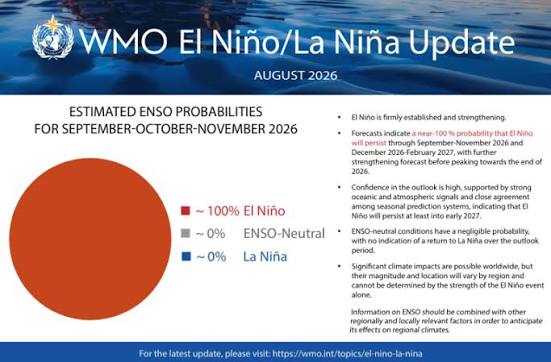
Following the forecast from the Department of Climate Change & Meteorological Services (DCCMS) — that indicates that a high likelihood of El Niño conditions during the 2026/27 agricultural season, the Government has established comprehensive national preparedness measures to address potential its impacts.

Advertisement
A statement issued today by Chief Secretary, Justin Saidi, who is the chairperson of the adhoc Cabinet committee on El Niño, takes cognizance that the 2026-2027 Rainfall Season Outlook that indicates the high chance of below-normal rainfall over most-areas of southern-and-central-regions — while normal to above-normal rainfall is expected over much of Northern Region.
“These conditions pose risks to rainfall patterns, agriculture, food security, water resources, energy generation, nutrition, health, and livelihoods,” says Saidi in his statement.
Thus, to mitigate these risks, through the Department of Disaster Management Affairs (DoDMA) and line ministries, the Government has developed the 2026/27 National El Niño Preparedness Plan.
He reports that it is anchored on two key pillars, Preparedness and Resilience,, which spans 14 priority clusters, including agriculture, food security, nutrition, health, water and sanitation, energy, protection, and logistics.
Chief Secretary Saidi
“It focuses on strengthening early-warning systems, safeguarding food and water security, pre-positioning supplies, and ensuring rapid response capacity.
“The preliminary financial requirement for implementation is estimated at MK488.5 billion, of which MK163.7 billion has already been mobilised through ongoing programmes and projects — leaving a financing gap of MK324.8 billion.”
These figures, says Saidi, “remain preliminary and will be refined as more detailed forecasts, sector-specific assessments and costing become available”.
Meanwhile, Saidi states that the Government “is taking proactive measures to further strengthen national preparedness and resilience against the potential impacts of El Niño”.
They include securing 440,000 metric tonnes of maize, pre-positioning essential supplies, strengthening early-warning and early-action systems, financing drought insurance, and scaling up interventions to enhance livestock and water resilience.
“Collectively, these actions are aimed at safeguarding food and water security, protecting vulnerable communities, and strengthening Malawi’s capacity to respond effectively to El Niño-related shocks.”
To ensure effective execution, Saidi reports that President Arthur Peter Mutharika, constituted the Adhoc Cabinet Committee on El Niño to provide strategic oversight.

President Mutharika
“DoDMA will coordinate implementation through the national inter-cluster mechanism, while district councils will drive local preparedness — prioritising 23 drought prone districts under strict accountability standards.
“However, the scale and potential magnitude of the anticipated impacts require a whole-of-society approach and concerted action by all stakeholders.
“The Government, therefore, calls upon development and humanitarian partners to align their interventions with the National Plan and support efforts to mobilise the resources required to close the financing gap.
“At the same time, the Government is strengthening engagement with the private sector through the Private Sector Disaster Risk Management Platform, in collaboration with the Malawi Confederation of Chambers of Commerce and Industry (MCCCI) and the wider business community.
“The private sector’s capabilities in transport, warehousing, telecommunications, finance, technology, food supply chains and logistics will be critical to strengthening preparedness, ensuring continuity of essential services, and enabling timely and effective response to El Niño-related impacts.
“At the community level, Government urges farmers and communities to take seasonal forecasts and official early-warning information seriously, follow guidance from authorities, and work closely with extension officers on planting periods, crop varieties, water conservation, and other climate-resilient practices.”
Saidi assures the nation that “there is no cause for panic, as these measures are designed to prepare Malawi early and reduce risks”.
“Further updates will follow the Southern African Regional Climate Outlook Forum and Malawi’s National Climate Outlook Forum on 7 September 2026, with interventions continuously reviewed as forecasts become clearer.
“Early action remains Malawi’s best defence. Government is, therefore, committed to protecting lives, safeguarding livelihoods, and building resilience against climate-related shocks.
“The success of these measures depends on collective effort — the Government, development partners, humanitarian organisations, the private sector, civil society, the media, communities, and citizens — must all prepare early, coordinate effectively, and act decisively.”

Advertisement