
* That’s preemptive to the maximum. If these entities are clean, why not welcome the probe to clear their names publicly?
* Running to the High Court for an interim order before any terms of reference are even drafted smells like someone is trying to hide shaky ground — not to defend constitutional purity
By Duncan Mlanjira
Canada-based accountable governance advocate, James Kadyampakeni observes that the timing and pressure of Austin Mkoka to file for an urgent judicial review to challenge Speaker Sameer Suleman from instituting 12 Parliamentary Committees to investigate several government entities, that haven’t even started yet are suspicious.

Advertisement
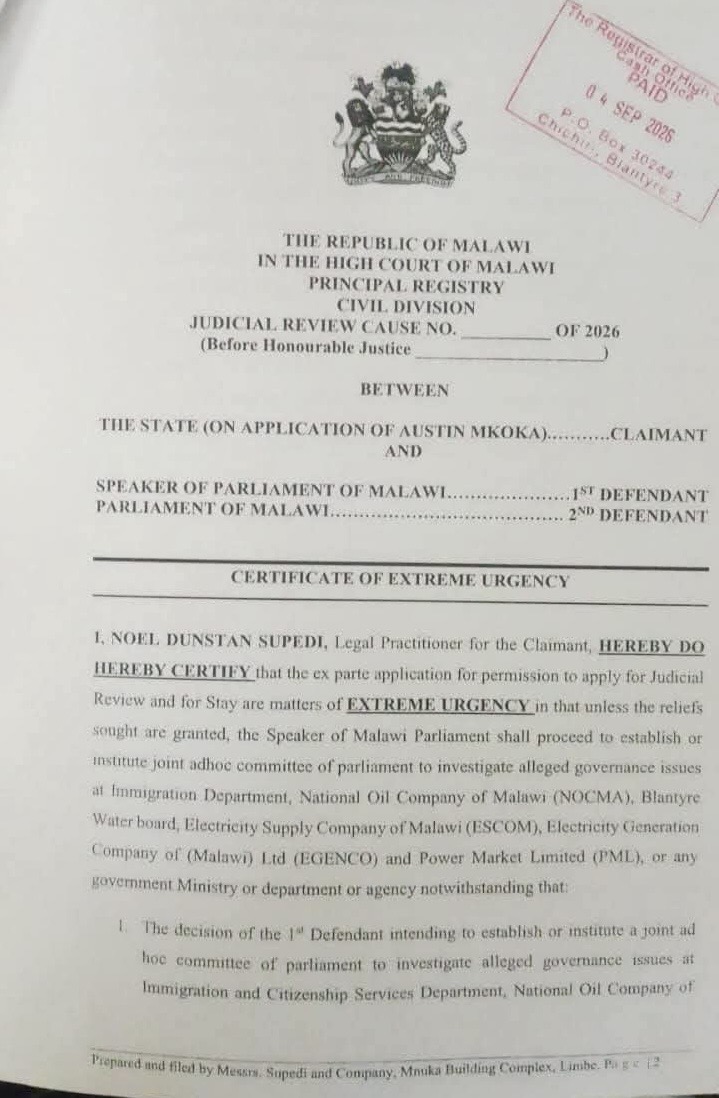
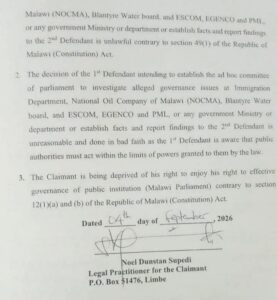
The case, lodged on Friday, September 4, 2026 — through his lawyer Noel Dunstan Supedi, Mkoka names the Speaker of Parliament Sameer Suleman and Parliament as respondents seeking an interim order restraining the National Assembly from proceeding with its investigations until the High Court makes a determination on the matter.
Mkoka argues that creating such committees is unlawful and falls outside Parliament’s powers as outlined in Section 49(1) of the Constitution, that the move is in bad faith, and that public institutions must operate strictly within the limits of their legal mandate.
In his reaction, Kadyampakeni maintains that when institutions of good governance try to do their job, “those who feel threatened turn around and misuse the very tools and institutions designed to protect accountability and democracy”.
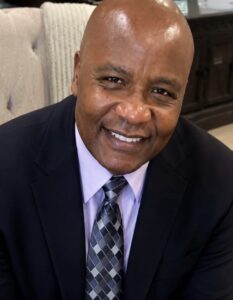
Dr. James Kadyampakeni
He observes that Parliaments in most democracies in the world do what Suleman is trying to execute and that Mkoka as a claimant is leaning hard on Section 49(1) of the Constitution, which outlines Parliament’s legislative powers.
“But here’s the kicker, Parliament’s oversight function isn’t solely crammed into that one sub-section. The Constitution and Standing Orders grant the august House the inherent authority to hold the Executive accountable.
“Creating ad-hoc committees to probe parastatals isn’t some rogue invention — it’s a standard parliamentary procedure globally.
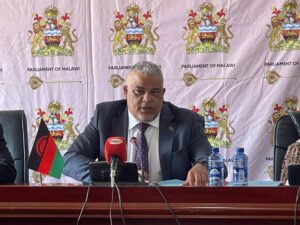
Sameer Suleman was accompanied at the press conference by a whole host of members of the august House
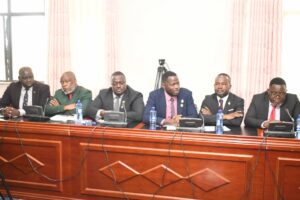
“Unless [Mkoka] is arguing they skipped a specific procedural step in the Standing Orders, crying ‘unlawful’ feels more like a legal scarecrow than a concrete knockout punch. Besides, The timing and ‘urgency’ filing are suspicious.
“He’s filing for an urgent judicial review to stop investigations that haven’t even started yet — that’s preemptive to the maximum.
“If these entities are clean, why not welcome the probe to clear their names publicly? Running to the High Court for an interim order before any terms of reference are even drafted smells like someone is trying to hide shaky ground, not defend constitutional purity.
“Only in Malawi where corruption will go all out to fight accountability!” contends Kadyampakeni, who regularly comments on the country’s economic and governance issues.
He thus amplifies what he already stood his ground on, saying Malawi needs the kind of courage displayed by the Speaker-of-parliament-sameer-suleman, saying he is doing what his office requires him to do — “uphold the Constitution and protect the integrity of Parliament”.
“There is an old saying in Malawi; ‘Whoever wants to fight corruption, corruption fights back’. What we are witnessing now appears to be exactly that.
“Instead of allowing the Speaker to do his job, those who feel threatened by scrutiny are trying to muzzle him.
“We must ask ourselves: who did the Speaker take his Oath to serve? It was not a political party; it was not an individual leader; it was not a group of politicians who may see public resources as their personal cash cow — his Oath is to the Constitution.
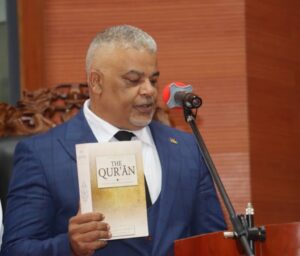
Suleman taking his Oath of Office
“That distinction matters. Parliament is not an extension of any political party. The Constitution stands above every party, every politician, and every government.
“When Parliament exercises its constitutional responsibilities, it should not be intimidated simply because its actions make powerful people uncomfortable.
“Malawians must, therefore, stand together and support the Speaker not because he is perfect, not because we necessarily agree with every decision he makes, but because the principle of constitutional accountability is bigger than any individual.
“If there was ever a time for Malawian influencers, journalists, civil society, professionals, artists and public voices to stand together, that time is now.
“If there was ever a time for our young people to raise their voices and say, ‘enough is enough; our country belongs to all of us’, that time is here.
“And if there was ever a moment for every Malawian who genuinely loves this country to put Malawi above party loyalty, personal interests, and political friendships, that moment is now.
“History has shown us that governments can fall when leaders become too greedy, too arrogant, and too disconnected from the people they govern.
“Self-serving decisions eventually have consequences. The events surrounding the Democratic Progressive Party (DPP) should remind us of one fundamental lesson: political power is temporary, but the institutions of the Republic must endure.”
Kadyampakeni thus calls on all Malawi to defend Parliament, the Constitution and to demand accountability.
“And let us make it clear that no political party, not MCP, DPP, or any other party is bigger than Malawi.
“The Constitution is above every political party; Malawi is bigger than every politician — and the people must never surrender their right to question those entrusted with their power.”
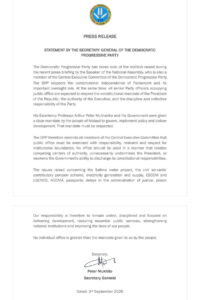
An audio that’s gone viral on social media has DPP spokesperson Shadric Namalomba describing Speaker Suleman as “mbuli” (ignorant), while advising him to read and understand the law governing the powers and responsibilities of the Speaker.
Namalomba maintains that Suleman does not have the power to constitute parliamentary committees on his own, arguing that such authority belongs to Parliament and not the Speaker personally.

Shadric Namalomba
According to Namalomba, the Speaker’s primary responsibility is to moderate parliamentary deliberations and facilitate the business of the National Assembly.
He further warned Suleman to be careful in exercising his authority, saying anyone holding public office should understand where their powers come from.
“Sometimes ignorance is not good,” Namalomba said, who also questioned whether some public officials abuse their authority because they expect to benefit from doing so.
Suleman, however, defended his decision, saying he consults before taking action and fully respects President Arthur Peter Mutharika.
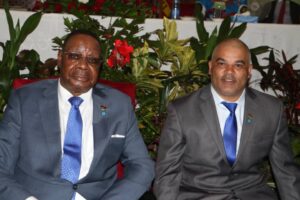
The Speaker said he had received a number of petitions from Malawians and, after consultation, decided to constitute the committees in an effort to address issues affecting citizens.
He stressed that his intention was to help suffering Malawians and not to undermine any authority and was quick to indicate that there was the need to resolve the disagreement.
In what could be seen as an attempt to lower the political temperature, the Speaker maintained that “two wrongs don’t make a right” and called for a round-table discussion to iron out the differences.—Additional details by ZBSNews

Advertisement