
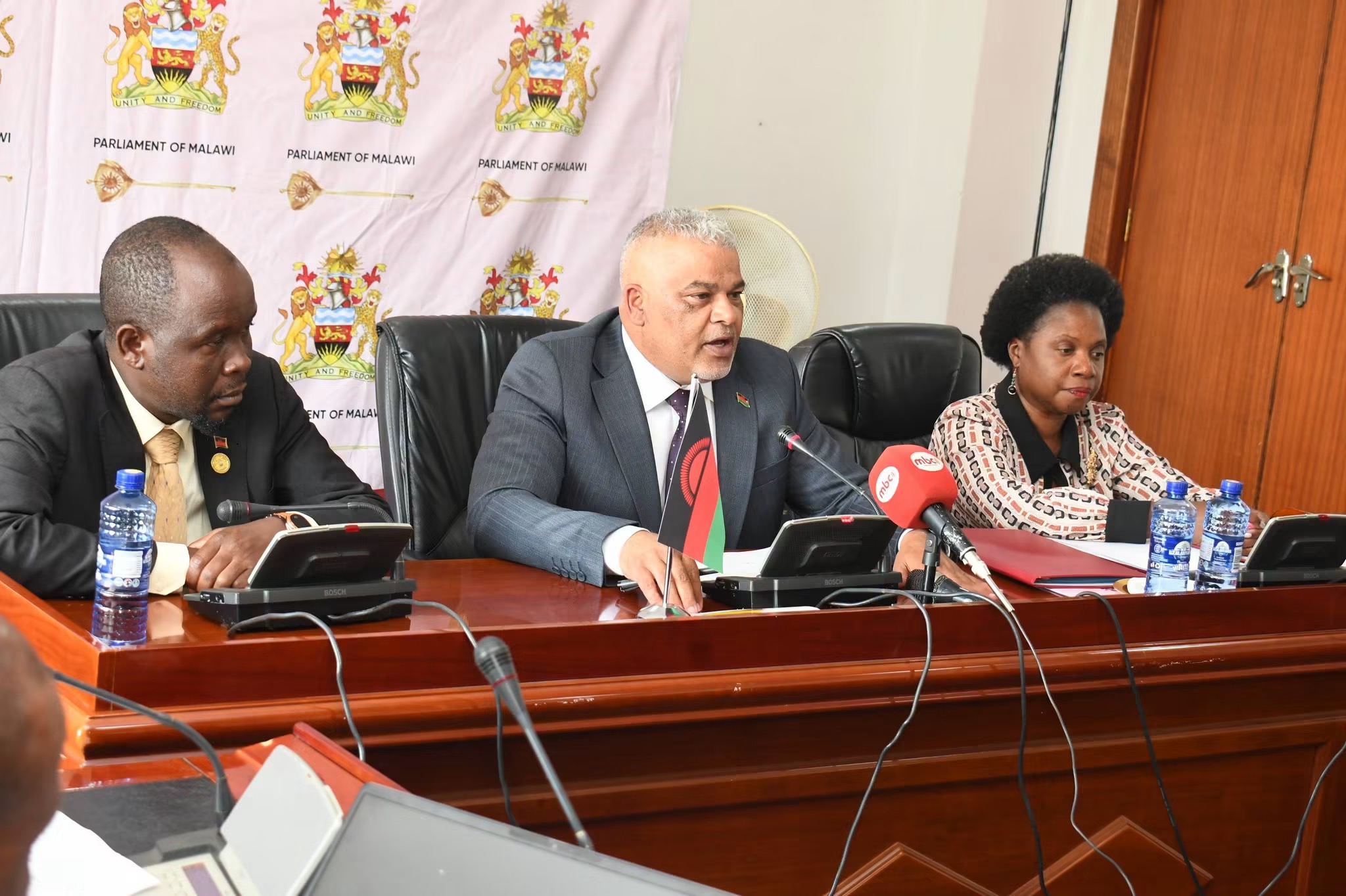
Sameer Suleman at the press conference he convened yesterday accompanied by several member of the august House
* Censures him that as a member of the DPP Central Executive Committee, he must also remain conscious of the political organisation whose confidence and parliamentary support contributed to his elevation to that office
* The DPP, therefore, expects the Speaker, like every other senior DPP official, to respect the President, respect the constitutional authority of the Executive, respect the collective decisions of the Party, and observe the boundaries of the office he occupies
By Duncan Mlanjira
The announcement by the Speaker of Parliament, Sameer Suleman, to constitute a joint parliamentary committee to investigate a range of public concerns in public institutions, has ruffled feathers within the Democratic Progressive Party (DPP).

Advertisement
Suleman was elected into Parliament for a second term under the ticket of the DPP and is also its Central Executive Committee member, whose decision to investigate public institutions under the DPP administration, as announced yesterday at a press conference in Lilongwe, has agitated the Party.
In a statement issued today, May 3, by the DPP secretary general, Peter Mukhito, censures Suleman that as a member of the DPP Central Executive Committee, “he must also remain conscious of the political organisation whose confidence and parliamentary support contributed to his elevation to that office”.
“The DPP, therefore, expects the Speaker, like every other senior DPP official, to respect the President, respect the constitutional authority of the Executive, respect the collective decisions of the Party, and observe the boundaries of the office he occupies.”
Mukhito, who is Minister of Homeland Security, maintains that the DPP “respects the constitutional independence of Parliament and its important oversight role”.
“At the same time, all senior party officials occupying public offices are expected to respect the constitutional mandate of the President of the Republic, the authority of the Executive, and the discipline and collective responsibility of the Party.”

Peter Mukhito
He stresses that President Arthur Peter Mutharika and his administration was given “a clear mandate by the people to govern, implement policy and deliver development”.
“That mandate must be respected,” stresses Mukhito. “The DPP, therefore, reminds all members of the Central Executive Committee that public office must be exercised with responsibility, restraint and respect for institutional boundaries.
“No office should be used in a manner that creates competing centres of authority, unnecessarily undermines the President, or weakens the Government’s ability to discharge its constitutional responsibilities.”
However, the DPP takes cognizance that the issues raised by Suleman “are important national matters” — that include the Salima water project, the civil servants contributory pension scheme, electricity generation and supply (ESCOM & EGENCO), NOCMA, passports, delays in the administration of justice, prison conditions, mining, and the agriculture and tobacco sectors.

“They deserve proper scrutiny,” emphasises Mukhito. “They must, however, be handled through the institutions constitutionally and legally mandated to investigate, supervise, review and implement corrective action.
“Where concerns arise regarding contracts, public finances or procurement, including matters relating to NOCMA, the competent authorities must establish the facts and act where wrongdoing is proven.
“Challenges affecting passport services should be addressed by the responsible government institutions and, where necessary, examined by the relevant parliamentary committee.
“Concerns about delayed judgments, prolonged detention and the conditions of prison facilities also require serious attention.
“At the same time, the independence of the Judiciary must be respected, while Government continues working towards correctional institutions that uphold security, rehabilitation, human dignity and reintegration.”

In the mining sector, Mukhito stresses that “the DPP supports transparency, accountability and meaningful participation of Malawians in the country’s mineral wealth”.
“Likewise, in agriculture and tobacco’s, the interests of Malawian farmers must remain paramount and no individual or commercial interest should be allowed to unfairly dominate or exploit producers.
The DPP thus maintains that “Parliament must exercise oversight; the Executive must be allowed to govern; the Judiciary must remain independent; and Party leaders must respect party discipline”.
“The DPP is particularly concerned when senior members of the Party use public platforms in ways that may create the impression of institutional conflict within a government that the Party itself leads.
“Political maturity demands consultation before confrontation; accountability should strengthen government — not paralyse it; oversight should expose and correct weaknesses, not become centre of executive authority.
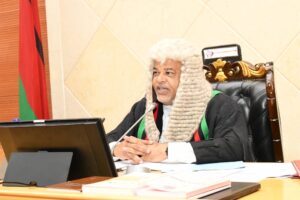
“The office of Speaker is a respected constitutional office and must be exercised with impartiality and fidelity to the Constitution,” says Mukhito, while reminding Suleman that it was the DPP that voted in majority to put him on that National Assembly chair.
“The DPP will not discourage legitimate oversight, nor will it shield wrongdoing. But neither will the party accept conduct that unnecessarily weakens the authority of the President, frustrates government programmes, or brings the Party and government into avoidable public confrontation.
“Malawians elected the DPP to govern. Our responsibility is, therefore, to remain united, disciplined and focused on delivering development, restoring essential public services, strengthening national institutions and improving the lives of our people.
“No individual office is greater than the mandate given to us by the people,” says Mukhito in the letter.

Last month in Parliament, Suleman expressed his outrage over suspected irregularities at Kangankude rare earths mine in Balaka and ordered Minister of Mining to suspend its mining operations.
He was reacting to a report presented by Parliamentary Committee on Natural Resources, Energy & Climate Change that indicated that the Australian company is operating under a medium-scale mining licence issued in April 2022 — despite the scale of operations suggesting it qualifies for a large-scale licence.
However, he was silently overruled by Justice Minister, who diplomatically explained that the mining company’s contract must be respected to avoid legal implications.

Advertisement