
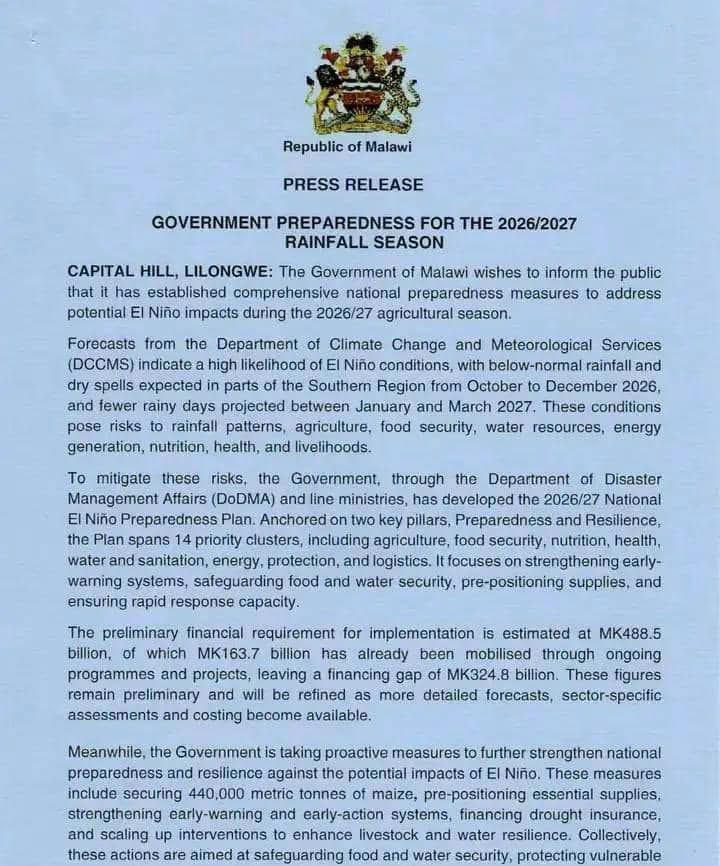
* K163.7 billion (US$94.4 million) has been mobilised through existing projects run by government, development partners and NGOs
* That leaves a gap of K324.8 billion (US$187.3 million) — the shortfall that Chief Secretary, Justin Saidi highlighted on September 10, when he urged the private sector to support
By Frank Humphreys, Malawi News Agency (MANA)
The Department of Disaster & Management Affairs (DoDMA) has unveiled K488 billion (US$281.7 million) national El Niño Preparedness Plan to protect millions of people from a strong El Niño forecast for the 2026/27 rainy season.

Advertisement
However, DoDMA indicates that has only managed to secure a quarter of the funds it needs for the plan as K163.7 billion (US$94.4 million) has been mobilised through existing projects run by government, development partners and NGOs.
That leaves a gap of K324.8 billion (US$187.3 million) — the shortfall that Chief Secretary, Justin Saidi highlighted on September 10, when he urged the private sector to support.
Speaking in Lilongwe as chairperson of the Adhoc Cabinet Committee on El Niño, Saidi asked the private sector to contribute expertise, resources and logistical capacity to priority interventions.
“Malawi cannot control the climate, but we can control how prepared we are to respond to its impacts” he said, saying food security is the largest item in the plan, at K311.8 billion (US$179.8 million).
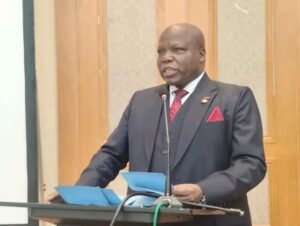
Justin Saidi
About K150 billion has been mobilised, leaving a shortfall of K161.8 billion (US$93.3 million). The food cluster aims to reach 6.5 million people with food or cash assistance.
The Department of Climate Change and Meteorological Services (DCCMS) puts the chance of a very strong El Niño at 80%, saying for October to December, most southern districts are likely to see late and erratic planting rains, fewer rainy days and prolonged dry spells.
The plan warns that the shock will hit a food system that is already stretched and that national food requirements exceeded maize production in both previous El Niño years — of 2015/16 and 2023/24.
Weaker production systems, rising input costs and population growth are adding to the pressure and the document adds that severe climate shocks have historically left between a quarter and a third of Malawians food insecure.
A state of disaster was declared in 2025, when 4 million people were food insecure. In 2023/24, more than 5.6 million were projected to need food assistance.
Weather update
The plan also flags risks to power generation, which depends heavily on Shire River flows from Lake Malawi.
The government says it will draw on budget allocations and existing commitments, which include the African Development Bank-funded ADRIF, the UNDP-funded RID4R and the World Bank-funded RCRP-2.
The plan also lists UNICEF, the International Organisation for Migration, civil society and the private sector.
The Coordination Cluster and individual sectors will lead the fundraising in the plan that spreads in over seven quarters and is expected to run from July-September 2026 to January-March 2027.

Advertisement