
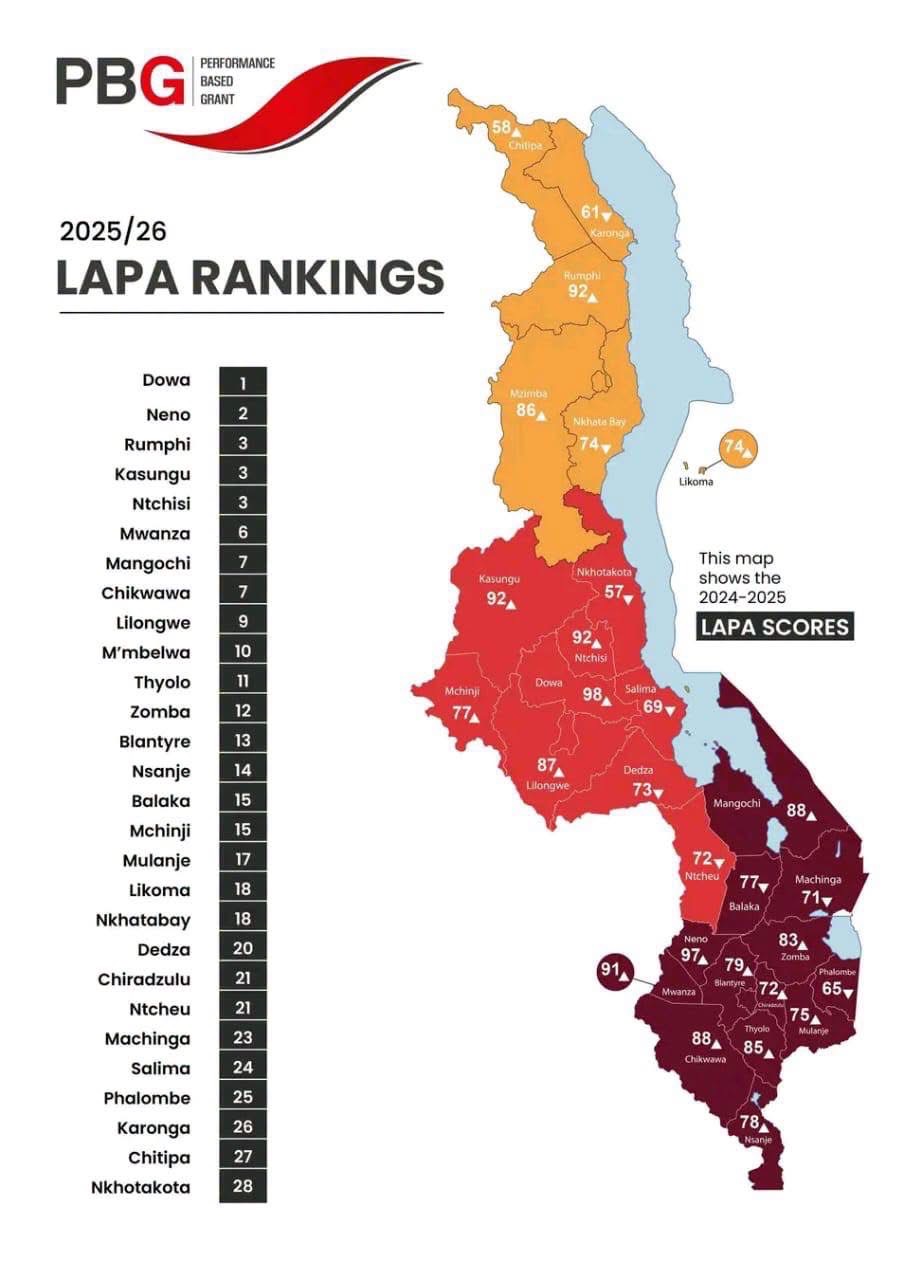
Dowa District Council ranks highly
* A total of K41,674,500 has been allocated to all local authorities to implement development projects
* A performance-based grants under the Governance to Enable Service Delivery (GESD) 2.0 and the Regional Climate Resilience Programme (RCRP-2) for the 2026/2027 financial year
* Dowa emerged as the top-performing district council with a score of 98%, followed by Neno with 97%, with Rumphi, Ntchisi and Kasungu tying at third place with 92%
Maravi Express
District councils have started receiving Local Authority Performance Assessment (LAPA) funding from the total of K41,674,500 that has been allocated to all local authorities to implement development projects.

Advertisement
This is performance-based grants run by the Local Government Ministry and National Local Government Finance Committee (NLGFC) under the Governance to Enable Service Delivery (GESD) 2.0 and the Regional Climate Resilience Programme (RCRP-2) to be implemented in the 2026/2027 financial year.
The programme was announced on July 31, 2026 by Minister of Local Government & Rural Development, Ben Phiri at Bingu International Convention Centre (BICC) in Lilongwe.
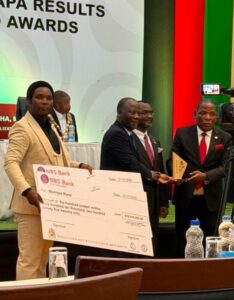
Dowa emerged as the top-performing district council with a score of 98%, followed by Neno with 97%, with Rumphi, Ntchisi and Kasungu tying at third place with 92%.
Some notable allocations include Dowa at K2.226 billion, with K1.817 billion under GESD and K408.23 million under the RCRP-2.
Karonga District receives K1,034,834,006 with K830,754,508 under GESD and K204,079,498 in RCRP-2 while Blantyre is at K897.4 million (GESD) and K616.9 million (RCRP-2) — with Nkhata Bay at K786,357,563 (GESD) and K213,941,285 (RCRP-2).
The funds to support development projects and enhance service delivery in various districts across Malawi, whose assessment success rate being 27 out of 28 councils passing the minimum requirements to qualify for financial allocations.
From the assessment process, 18 councils achieved completely clean audit opinions, including Blantyre, Lilongwe, Kasungu, Zomba, and Chikwawa — with Nkhotakota beingthe only council that failed and was disqualified after spending 10.4% of its Performance-Based Grant resources on administrative overheads, exceeding the strict 8% allowable threshold.
Funded heavily by the World Bank’s GESD programme, the grants ensure that highly accountable councils receive adequate funding to construct local schools, clinics, and roads.
Speaking in an interview with Malawi News Agency (MANA) on Saturday, Blantyre District Commissioner (DC) Alex Mdooko described the outcome as a positive step while acknowledging that the assessment had also identified areas requiring improvement.
“It is encouraging to note that the assessment highlighted areas needing improvement, including documentation, revenue mobilisation, budget execution, record management, and the consistent application of recommended practices,” said Mdooko.

Advertisement
The council pledges to strengthen internal supervision, departmental self-assessments, management reviews and staff mentorship to improve future performance.
The DC also urged council officers to maintain complete and accurate records, saying proper documentation of financial transactions, procurement processes, project files and service delivery activities is essential for accountability.
“With teamwork, discipline, integrity and commitment, Blantyre District Council will significantly improve its performance in the next LAPA assessment and position itself among the highest-performing local authorities in Malawi,” he said.
Blantyre District Civil Society Organisation Network chairperson Malango Maganga welcomed the funding, saying it presents an opportunity for the council to improve infrastructure and public services.
He urged the council to ensure the resources are managed transparently and that communities are actively involved in planning, implementing and monitoring development projects.
“Every kwacha should deliver tangible benefits to the people and contribute to sustainable local development in the district,” said Maganga.
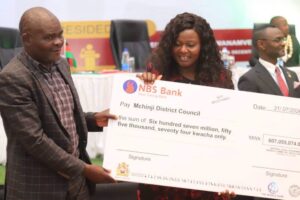
Mchinji, which moved 11 places up the rankings from position 26 in the previous assessment to 15th, secured more than K1.8 billion — K1,289,603,999 under GESD 2.0 and K607,055,074 under RCRP-2.
Mchinji DC Reinghard Chavula described the results as a major achievement, saying the grants would help the council implement projects that directly benefit communities.
“We have done well as a district,” he told MANA. “This means we will implement more development projects. Our communities will benefit from improved infrastructure and other development interventions that these projects will deliver.”
Chavula added that the improved ranking demonstrates the council’s commitment to strengthening performance and meeting governance standards required under LAPA.
Mchinji Civil Society Network chairperson Aubrey Chidziwitsano commended the council for the progress, describing the achievement as a positive development for the district.
“It is a significant improvement for Mchinji compared to last year. It means a lot for the district’s development,” he said, while commending the council management “for a job well done”.
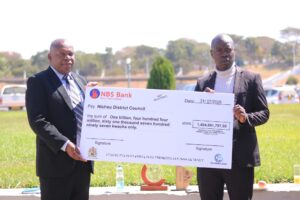
Ntcheu received a total of K1,404,061,797 with K318,261,776 being RCRP and was also awarded with two trophies — consistent unqualified audit opinion 2021-2025 and for 2025 unqualified audit opinion.
Ntcheu DC, Francis Matewere commended Inkosi Ya Makosi Gomani V and chairperson for Ncheu District Council for their commitment to development of the district.—Reporting for MANA by Beatrice Bangula, Vincent Khonje & Maston Kaiya; editing by Duncan Mlanjira; Maravi Express

Advertisement