

* As the Malawi Pressure Index (MPI) currently places the country’s GDP growth rate in the Moderate Pressure category
* Suggesting that although economic conditions have improved in some areas, the country continues to face meaningful economic pressures that constrain the strength and sustainability of the recovery
By Chifi Mhango, DCG Chief Economist and Executive Director of Economic Research and Strategy
Malawi’s real Gross Domestic Product (GDP) growth increased to 2.5% in 2025, from 1.7% in 2024, marking a modest improvement in economic activity.
While the recovery is encouraging, the pace of expansion remains insufficient to generate the scale of employment, income growth, investment and poverty reduction required to materially improve living standards.
Don Consultancy Group’s (DCG) assessment is that Malawi is recovering, but the economy is not yet growing fast enough.
Importantly, the Malawi Pressure Index (MPI) currently places the country’s GDP growth rate in the Moderate Pressure category.
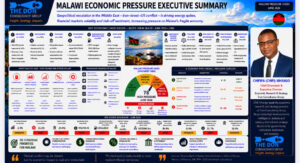
This suggests that although economic conditions have improved in some areas, the country continues to face meaningful economic pressures that constrain the strength and sustainability of the recovery.
The Moderate MPI status should, therefore, not be interpreted as an absence of economic risk. Rather, it indicates an economy experiencing significant pressures, but not yet at a level classified by the DCG framework as high or severe.
The Moderate MPI reading is consistent with the underlying GDP picture. The economy is growing, but at only 2.5%, while several important structural constraints remain firmly in place.
The country continues to face challenges relating to the cost of doing business, energy costs and reliability, access to finance, infrastructure, fiscal conditions and vulnerability to external shocks.
The MPI, therefore, provides an important complementary perspective to the GDP growth rate. GDP tells us how fast the economy is growing; the MPI provides a broader assessment of the intensity of economic pressures surrounding that growth.

Advertisement
In this context, the 2.5% growth combined with a Moderate MPI reading points towards an economy that is recovering, but whose recovery remains vulnerable.
The 2025 recovery was relatively broad-based, with several productive sectors recording stronger performance.
Agriculture grew by 1.3% in 2025, compared with 0.2% in 2024, supported by favourable weather conditions, improved input availability and seasonal recovery.

Mining and quarrying expanded by 5.3%, from 4.8% in 2024, supported by stronger coal and uranium output and global demand.
Manufacturing improved from 0.2% in 2024 to 1.8% in 2025, while construction recorded 5.6% growth. The services economy also demonstrated considerable momentum. Information and communication grew by 5.8%, financial and insurance services by 5.9%, accommodation and food activities by 4.9%, and public administration and defence by 5.1%.
This increasingly diversified sectoral performance provides a foundation for stronger economic expansion.
However, the overall growth rate remains too low.
Malawi continues to lag several regional economies. Its relatively weak growth becomes clearer when compared with other regional economies:
In 2025, Tanzania 5.9%; Mozambique -0.5%; Rwanda 7.0%; Zambia 3.8%; Kenya 4.9%; Uganda 6.7%; Zimbabwe 7.5%; DR Congo 5.7%; and Sub-Saharan Africa average of 4.5% (as data sourced from IMF) — meaning Malawi’s growth remained below the regional benchmark.
This suggests that Malawi’s challenge is no longer simply to return to positive growth. The country needs to accelerate growth sufficiently to close the gap with faster-growing regional economies while simultaneously reducing the economic pressures reflected in the MPI.

Advertisement
The 2.5% question: is Malawi growing fast enough? DCG’s answer is no — the increase from 1.7% to 2.5% is positive, but the improvement should not be mistaken for an economic transformation.
For Malawi, stronger growth must translate into higher productivity, greater employment opportunities, rising household incomes, increased government revenue, stronger private-sector investment and improved economic resilience.
The current performance remains constrained by four major factors: the high cost of doing business, high energy costs and unreliable energy supply, limited access to affordable finance, and infrastructure constraints and variability.
These structural limitations continue to restrict productive capacity and help explain why the MPI remains in the Moderate Pressure category.
While the 2.5% GDP growth recorded in 2025 is an actual outcome, DCG’s scenario analysis highlights a wide range of possible outcomes for 2026 and 2027:
* Under the optimistic scenario, stronger reforms, good rains, improved energy stability and increased private investment could lift growth to 3.6% in 2026 and 4.1% in 2027.
* Under the baseline scenario, gradual improvements in economic stability and reforms, combined with normal weather conditions, could result in growth of 3.0% in 2026 and 3.5% in 2027.
* However, the downside scenario presents a significantly weaker trajectory. Drought, energy disruptions, fiscal slippages and adverse global shocks could reduce growth to 2.0% in 2026 and just 1.3% in 2027.
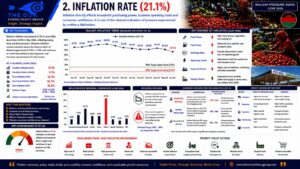
The scenario range demonstrates that Malawi’s growth trajectory remains highly sensitive to policy implementation, weather conditions, energy availability, fiscal management and external shocks.
This also means that maintaining the MPI at Moderate or, preferably, reducing economic pressure towards the Low category, will be important for sustaining the growth recovery.
The current Moderate MPI status on GDP growth rate provides Malawi with an important policy window. The country has not entered a high-pressure economic environment, according to the DCG framework.
This creates an opportunity for policymakers to address structural weaknesses before they intensify.
The objective should, therefore, be twofold:
* First, accelerate GDP growth towards 3–4% and beyond; and
* Second, simultaneously reduce the underlying economic pressures that could undermine the recovery.
This requires addressing the structural constraints that continue to weigh on the economy. The Five priorities for stronger growth and lower economic pressure for Malawi include:
* First, agricultural productivity and commercialization must be accelerated;
* Second, industrialisation and local value addition must be accelerated, using agriculture, mining and manufacturing as anchors for domestic value chains;
* Third, investment in critical infrastructure must increase, particularly energy, roads and irrigation;
* Fourth, access to affordable finance must improve, particularly for SMEs and productive businesses; and
* Fifth, policy consistency and investor confidence must be strengthened to mobilise domestic and foreign private investment.
These measures would not only support GDP growth; they would also help reduce the economic pressures captured by the MPI.

Advertisement
Don Consultancy Group’s assessment is that Malawi has entered a period of modest economic recovery, while remaining under Moderate economic pressure.
The increase from 1.7% in 2024 to 2.5% in 2025 is encouraging. The broad-based performance across mining, construction, manufacturing and services provides a stronger foundation for future expansion.
However, 2.5% growth is not yet a growth transformation, and a Moderate MPI reading should not be viewed as economic stability having been fully achieved.
The country needs to move from modest recovery and Moderate economic pressure towards stronger, sustainable and inclusive growth accompanied by declining economic pressures.
The scenario outlook demonstrates both the opportunity and the risk. With stronger reforms and improved economic conditions, GDP growth could reach 4.1% by 2027. Conversely, continued shocks and policy weaknesses could push growth down to 1.3%.
The strategic objective should, therefore, be clear, to move Malawi from Moderate economic pressure to Low pressure, while simultaneously moving GDP growth from 2.5% towards a sustained 4%+ growth trajectory.
That would represent a much more meaningful transition from economic recovery to economic transformation.
The Moderate MPI confirms that the economy continues to face meaningful pressures even as growth improves. The positive performance of mining, construction, manufacturing and services demonstrates that the foundations for stronger growth exist.
The priority now is to remove the structural constraints, particularly energy, infrastructure, access to finance and the cost of doing business, that prevent these productive sectors from reaching their full potential.
Malawi must use this period of Moderate pressure as a policy window to accelerate growth while reducing the underlying economic vulnerabilities.

Chifipa Mhango
* As Don Consultancy Group Executive Director of Economic Research & Strategy, Chief Economist Chifipa Mhango specialises in macroeconomic analysis, public policy, and governance across emerging markets, particularly in Africa. He is known for providing data-driven insights on economic trends, fiscal policy, and institutional accountability, with a strong focus on strengthening economic and governance frameworks.

Advertisement