
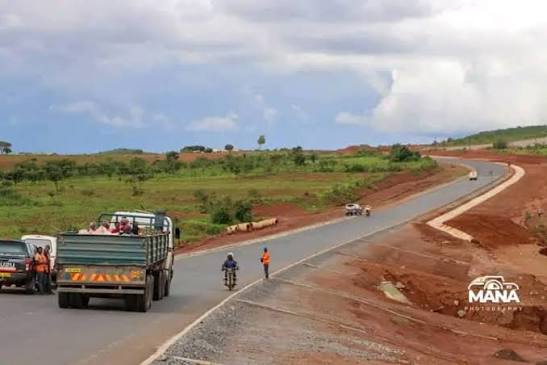
* President Mutharika’s remarks about his six-hour road journey between Blantyre and Lilongwe carry symbolic political significance
* The message reflects not merely personal inconvenience, but acknowledgment of the everyday hardships faced by millions of Malawians—DCG Chief Economist, Chifipa Mhango
By Duncan Mlanjira
President Arthur Peter Mutharika has been applauded for his commitment to ensure that the Blantyre-Lilongwe M1 Road will be fully rehabilitated by December 31, 2026, while at the same his administration has been encouraged to consider upgrading this most critical transport route into a dual carriageway.

Advertisement
After experiencing the poor condition of the M1 Road on Tuesday last week during his journey from Blantyre to Lilongwe that took nearly six hours due to potholes and damaged sections, President Mutharika reaffirmed government’s target to implement extensive nationwide road maintenance works.
In reacting to the President’s honest confession of the terrible state of the M1 and all other damaged roads across the country, Chifipa Mhango, the Chief Economist and Executive Director of Economic Research & Strategy at Don Consultancy Group (DCG), said “much as the matter was presented in his usual statesman’s sense of humour, the message resonated strongly with many Malawians who endure these transport difficulties daily and reignites a national discussion around leadership, infrastructure, and the lived realities of ordinary citizens”.
He emphasised that restoring Malawi’s strategic transport corridors “is not merely about repairing roads; it is about rebuilding economic efficiency, strengthening investor confidence, improving public safety, and reconnecting leadership with the people’s daily realities”.
“Leadership that suffers with the people often earns legitimacy because citizens value leaders who remain connected to their lived experiences rather than insulated from them. Ultimately, the six-hour journey between Blantyre and Lilongwe has become more than a travel experience — it has evolved into a national reflection on governance, infrastructure, accountability, and the urgent need to modernise Malawi’s transport network.
“If the commitments made translate into visible infrastructure delivery by the end of 2026, the moment may ultimately be remembered not only for highlighting national hardship, but for helping catalyse action toward meaningful change.
“Quality in rehabilitation of roads is imperative, however, let’s also state the fact that a dual carriageway is way overdue between Blantyre and Lilongwe,” said the DCG Executive Director of Economic Research & Strategy, who specialises in macroeconomic analysis, public policy, and governance across emerging markets, particularly in Africa.
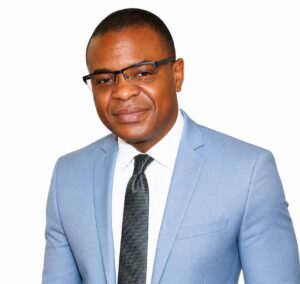
Chifipa Mhango
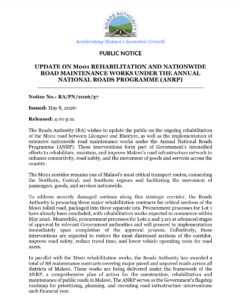
Two days after Mutharika’s statement, Roads Authority issued a public notice, entitled; ‘Accelerating Malawi’s Economic Growth’, which indicated that rehabilitation works will commence immediately on M1 as well as the implementation of extensive nationwide road maintenance works under the annual national roads programme (ANRP).
The notice indicated that the ANRP was officially launched on April 24, 2026 by Minister of Transport & Public Works, Jappie Mhango as part of Government’s intensified efforts to rehabilitate, maintain, and improve Malawi’s road infrastructure network to enhance connectivity, road safety, and the movement of goods and services across the country.
On commenting further on Mutharika’s statement, Mhango said: “In many developing economies, political leaders are often criticised for becoming detached from the experiences of the people they govern.
“The use of air transport and heavily protected mobility systems frequently distances leadership from the infrastructure challenges faced by ordinary citizens. However, when a leader chooses to travel on the same roads used by the population, experiencing the same delays, discomfort, and frustration, it sends a powerful message of solidarity and shared national experience.
“The Blantyre-Lilongwe route is one of Malawi’s most critical economic and social corridors, connecting the commercial capital with the administrative capital. The route supports trade, agriculture, logistics, tourism, and movement of labour.

Funds generated from toll gates at Chingeni and Kalinyeke are meant for road rehabilitation
“Yet, persistent deterioration of road infrastructure has increasingly become a burden on economic productivity and social mobility. Longer travel times raise transportation costs, increase vehicle maintenance expenses, reduce efficiency in the movement of goods, and heighten safety risks for motorists and public transport operators.
“Against this backdrop, President Mutharika’s remarks about his six-hour road journey carry symbolic political significance. The message reflects not merely personal inconvenience, but acknowledgment of the everyday hardships faced by millions of Malawians.
“Leadership becomes more credible when it is seen to physically encounter the same conditions experienced by the people. In this context, the journey represents a form of leadership visibility and empathy that many citizens perceive as increasingly absent in modern politics.”

Advertisement