
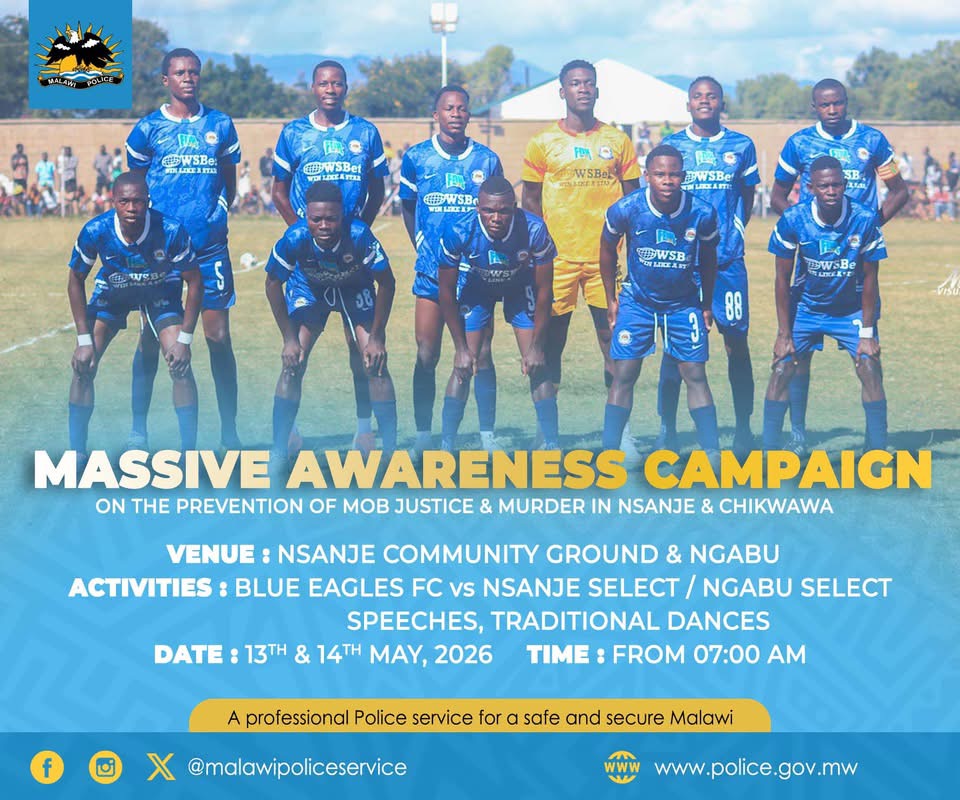
* On mob justice killings of innocent citizens suspected of involvement in the mysterious disappearance of body parts
* I condemn such mob justice in the strongest terms. No one has the right to take the law into their own hands
By Duncan Mlanjira
Member of Parliament (MP) for Nsanje South West, Walter Nyamilandu Manda has commended the Malawi Police Service for taking swift action against perpetrators of mob justice killings of people alleged to have been involved, in what was established to been false reports of ‘missing male private parts’ incidents in Nsanje and Chikwawa districts.

Advertisement
Nyamilandu, the revered leader in football administration in the country and internationally, wrote on his Facebook account that “Nsanje has recently made headlines for the wrong reasons, having experienced unjustified killings of innocent citizens suspected of involvement in the mysterious disappearance of body parts”.
“I condemn such mob justice in the strongest terms. No one has the right to take the law into their own hands. The rule of law must prevail if we are to build a just and peaceful society.”
He commend the Malawi Police, who also announced yesterday that it would conduct massive awareness campaign on the prevention of mob justice and murder in the two districts expected today and tomorrow, the Kamuzu Day public holiday.

Walter Nyamilandu
In support of Nyamilandu’s stance, Ng’onamo Francis expressed profound concerns, saying: “Where is our ‘UBUNTU’? Do you need to be educated to have ‘umunthu’?
“You see, our biggest problem is ‘lawlessness’ — which is a state of disorder, chaos, or confusion caused by the absence, disregard, or non-enforcement of laws.
“It refers to behavior that defies legal authority, violates established rules. It even looks like there are no established rules the way we go about business — examples are too numerous to mention.
“Can someone please tell me if there has been a victim who has lost their privates? Now, lives have been lost, fact, that we all know. What are we doing about it? To anyone who took part in beating up that man to death, how do you feel now?
“I saw children, yes, young people chanting and encouraging that ‘aphedwe’. Now that the man is no more, how do you feel? Listen to the crying of his relatives? Children, wife, brothers and sisters, nieces and nephews. What do you say to them?”

Advertisement
Emmanuel Bingala implored on Nyamilandu to do more in civic educating people in his area against the vice of lawlessness: “Dear Honourable, can you please adjust your volume. Because some people are still living with fear in various localities.
“I think rallies would definitely unite people. What if you visit Nsanje with your security officers and address the people physically. You know for sure some are illiterate there.
“Your voice can matter most if it will be that of physical voice with people of Nsanje,” emphasised Bingala, while two other responses, typical of just negativity that is embodied in mamjority of social media commentators, chose to rile Nyamilandu using fake names.
While the lawmaker was addressing the nation on this very serious topic, one commentator trending as MW Succec said: “Pitani kumudzi komko and do the civic education not condemning this on the social media.“
While Naffis Mwala said: “The culprits aren’t here on Facebook — they’re at your constituency. Please go and educate your people” — completely missing Nyamilandu’s purpose to enlighten the nation that mob justice is a serious violation of established rule of law.
Meanwhile, lawyer & and civil rights legal advocate, Reena Purshotam, shared her nasty experience on her own Facebook page on how she narrowly escaped being a victim of mob justice assault some years ago — attesting to that this increasingly taking the law into your own hands can spiral into lawlessness that would be lead of serious anarchy.

She wrote: “Thankfully, I was rescued before becoming a mob justice statistic. Tomorrow, you could become part of that statistic. Any of us could if lawlessness prevails.”
She narrated that fresh after graduating from the university, her first job was as a legal officer at Malawi Telecommunications Limited (MTL) in Lamya House at Maselema in Limbe, she got involved in her first car accident in the company of her aunt she had picked for home.
“When joining the main road near Toyota Malawi, I miscalculated the distance between my car and an oncoming cyclist,” she wrote. “Now, it’s bad enough to injure a fellow human being, but within minutes my concern was for myself and my aunt as well.
“At 5pm, workers from the factories around Maselema begin to pour out, and there’s nothing that Malawians love more than a good old accident. I had a few seconds to figure out whether to be a good citizen and check on the injured cyclist, or whether to potentially save my life and live to tell this story.
“I chose life. Now listen, my plan was not to do a ‘hit and run’ — my plan was to go to the police station and ask the police to come back with me to check on the cyclist.
“Before I could put my plan into action, a passing minibus stopped and blocked my exit. Within seconds, my car was surrounded by angry men. Some yelled at me; ‘amwenye oyipa inu — kufuna kuthiphera aMalawi” (bad Indians — you want to kill Malawians).
“Now, it was clearly not the time to argue that I too am Malawian and that it was not my plan to kill anyone,” said Purshotam, who is from Kasimu Village, Traditional Authority (T/A) Chowe in Mangochi.
“Our cyclist was there too, amidst the angry mob, carrying his damaged bicycle in his arms. My time to meet my Maker had clearly not yet arrived because I heard the miraculous sound of a police siren approaching.
“I’ve never been happier to see the police. Within minutes, the crowd lost interest in me and dissipated. The police lady that took down my details was the sweetest, most sympathetic person ever — I could have given her a hug.
“I assured her that I wasn’t trying to run away, but that I was afraid of the mob. After the detail-taking was finalised, she told me to take the cyclist to the hospital. I was shaking when I got back behind the wheel and I’m not sure how I made it all the way to Queen Elizabeth Central Hospital.
“There was a pool of blood on the ER floor when we arrived, and the clinician was not impressed by our cyclist’s scratches. In fact, he was a little mean to him, if I’m being honest. Anyway, the cyclist was fixed, I paid for repairs of the bicycle, paid a fine, and all’s well that ends well.
“So for those of you who question why I always advocate for upholding the rule of law; why it’s important to be a good citizen and avoid taking the law into our own hands; why it’s important for public officials not to go round slapping people even if they’re alleged criminals, well, this is partly why.”

Advertisement
Sukhi S. Sohal responded by sharing a similar happened to him some years ago on his visit to Malawi to pay his respects to his mother, who had passed away. He explained that his wife and sister-in-law were aggressively approached by a mob after an accident involving a cyclist.
He narrated that it was his “zero-nonsense tolerance towards the crowd changed their minds pretty quickly”, but a horror to his wife on her first visit to Malawi which happened within about an hour into the country.
He explained that they were in two cars, him and his brother in one and his wife and his sister-in-law (his brother’s wife) in the other, saying: “We drove out first from the cemetery then stopped waiting for his wife. As she came out, she didn’t see the cyclist zooming down and he hit the side of her car, right next to a minibus stop.
“So, of course, the mob saw two women and went ahead, trying to open their doors. All I saw was red,” he said, as an explanation that of his “zero-nonsense tolerance towards the crowd changed their minds pretty quickly”.
Malawi Communications Regulatory Authority (MACRA) has also weighed in on this subject by warning broadcasters against publishing unverified information regarding alleged ‘missing male private parts’, saying the reports have the potential to incite violence and public disorder.
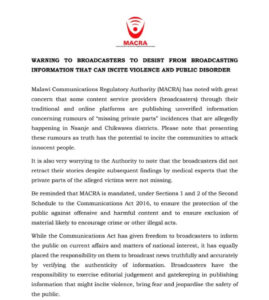
A statement released yesterday, May 12, by MACRA Director General Mayamiko Nkoloma, indicates that some broadcasters, through traditional and online platforms, were presenting rumours as truth despite medical findings showing that the alleged victims’ private parts were not missing, warning that such reporting could lead communities to attack innocent people.
MACRA thus reminds broadcasters that while they have freedom to inform the public on matters of national interest, they also have a responsibility to verify information and exercise editorial judgement to avoid content that may promote violence, fear and insecurity.
The media regulator further threatens that it will invoke regulatory sanctions against any broadcaster found breaching provisions of the Communications Act.—Additional reporting by Leah Malimbasa, Malawi News Agency (MANA)

Advertisement