

Warnings were issued before the strikes
* The Nigerian government has been fighting a complex network of jihadist groups, which includes Boko Haram and IS-linked splinter groups, for several years
* The Trump administration has previously accused the Nigerian government of failing to protect Christians from jihadist attacks and has claimed a “genocide” is being perpetrated
By Jaroslav Lukiv, BBC News
The US has launched strikes against militants linked to the Islamic State group (IS) in north-western Nigeria, where jihadists have long carried out an insurgency.

Advertisement
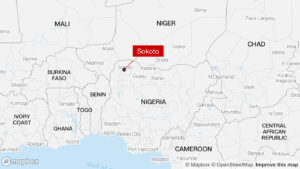
Camps run by the group in Sokoto state, which lies on Nigeria’s border with Niger, were hit, the US military said, adding that an “initial assessment” suggested “multiple” fatalities.
US President Donald Trump said the Christmas Day strikes were “powerful and deadly” and labelled the group “terrorist scum”, saying it had been “targeting and viciously killing, primarily, innocent Christians”.
Nigerian Foreign Minister Yusuf Maitama Tuggar told the BBC it was a “joint operation” and had “nothing to do with a particular religion”. Tuggar said the strikes had been planned “for quite some time” and had used intelligence information provided by Nigeria. He also did not rule out further strikes.
Referencing the timing of the strikes, he said they did not have “anything to do with Christmas, it could be any other day — it is to do with attacking terrorists who have been killing Nigerians”.
The Nigerian government has been fighting a complex network of jihadist groups, which includes Boko Haram and IS-linked splinter groups, for several years. The Trump administration has previously accused the Nigerian government of failing to protect Christians from jihadist attacks and has claimed a “genocide” is being perpetrated.
Trump has previously labelled Nigeria a “country of particular concern”, a designation used by the US state department that provides for sanctions against countries “engaged in severe violations of religious freedom”.
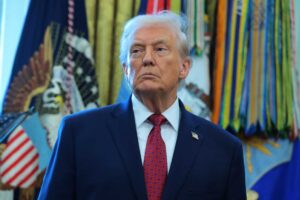
Donald Trump
The US military was ordered to prepare to intervene in Nigeria in November. At the time, an adviser to Nigerian President Bola Tinubu told BBC News that militants had targeted people “across faiths”, and said any US military action should be carried out jointly.
Groups monitoring violence say there is no evidence to suggest that Christians are being killed more than Muslims in Nigeria, which is divided roughly evenly between followers of the two religions.
In a social media post late on Christmas Day confirming the strikes, Trump said that he would “not allow Radical Islamic Terrorism to prosper”.
US Defence Secretary Pete Hegseth said on Thursday that he was “grateful for Nigerian government support & cooperation”.
The US Department of Defense later posted a short video that appeared to show a missile being launched from a ship.
On Friday morning, the Nigerian foreign ministry said in a statement that the country’s authorities “remain engaged in structured security co-operation with international partners, including the United States of America, in addressing the persistent threat of terrorist and violent extremism”.
“This has led to precision hits on terrorist targets in Nigeria by air strikes in the North West,” the statement said.

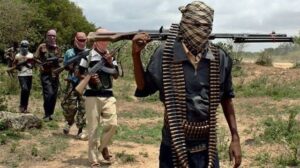
Jihadist groups such as Boko Haram and IS-linked offshoots have wrought havoc in north-eastern Nigeria for more than a decade, killing thousands of people. Most victims have been Muslims, according to Acled, a group that analyses political violence around the world.
Nigerian human rights lawyer and conflict analyst Bulama Bukati speculated that Thursday’s strikes had targeted a relatively new IS-aligned splinter group, which originated in the Sahel region and has recently moved its fighters to Nigeria.
The largest IS-linked group in Nigeria — Islamic State West Africa Province — operates in the north-east of the country, he told BBC World Service, while the smaller group — known locally as Lakurawa — has sought to establish a base in north-western Sokoto state.
He continued: “They started slipping into Nigeria in 2018 but over the past 18 months or two years they established camps in Sokoto state and Kebbi state. They have been launching attacks and imposing their social laws over people in Sokoto state over the past 18 months or so.”
According to BBC Monitoring, a pro-IS social media channel has been reporting on almost daily US reconnaissance flights in Sokoto, as well as in the north-western state of Borno, where the Nigeria’s largest IS-linked group has its stronghold.
In central Nigeria, there are also frequent clashes between mostly Muslim herders and farming groups, who are often Christian, over access to water and pasture.
Deadly cycles of tit-for-tat attacks have also seen thousands killed — but atrocities have been committed on both sides.
The Nigeria strikes are the second major US intervention targeting IS in recent weeks. Last week, the US said it had carried out a “massive strike” against IS in Syria.
US Central Command (Centcom) said fighter jets, attack helicopters and artillery “struck more than 70 targets at multiple locations across central Syria”. Aircraft from Jordan were also involved.
Those strikes were launched in retaliation for the killing of three Americans – two soldiers and a civilian interpreter — in an ambush launched by the group.
Analysts that CNN engaged this year, indicated that the reality on the ground is more nuanced than Trump’s characterisation suggests — as both Christians and Muslims – -the two main religious groups in the country of more than 230 million people — have been victims of attacks by radical Islamists.
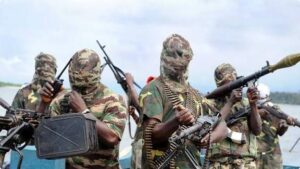
Boko Haram insurgents
Years of violence
Nigeria has grappled for years with deep-rooted security problems driven by various factors, including religiously motivated attacks.
The country has roughly equal numbers of Christians – predominantly in the south – and Muslims, who are mainly concentrated in the north. In 2012, the Islamist group Boko Haram issued an ultimatum, ordering Christians in the northern region to leave while calling on Muslims in the south to “come back” to the north. Most targeted killings in recent years have been in the north.
Security analysts said Lakurawa, a lesser-known group prominent in northwestern states, could have been the target of Thursday’s strikes. Lakurawa has become increasingly deadly this year, often targeting remote communities and security forces, and hiding in the forests between states, the news agency Reuters reported.
In January, Nigeria’s authorities declared the group a terrorist organization and banned its activities nationwide. Observers say other violent conflicts arise from communal and ethnic tensions, as well as disputes between farmers and herders over limited access to land and water.
“The region where the strike has actually taken place is dominated by criminal bandits, who have been tormenting rural villages and towns with some form of ISWAP (a Boko Haram breakaway group known as the Islamic State in West Africa Province) presence in that region, but not really specifically in Sokoto – where the where the strike by the US government has taken place,” Oluwole Oyewale, a Dakar-based African security analyst told CNN Friday.
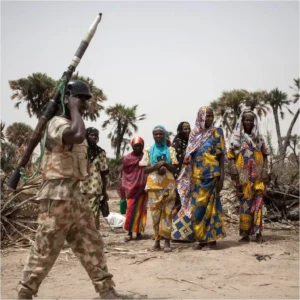
The US strike could “disrupt ISIS operations in the short term, but the long-term issues that surround violence in Nigeria are extremely complex,” said CNN military analyst and retired US Air Force Col. Cedric Leighton, pointing to the economic factors at play.
“The way most of these strikes work is that they need to be part of a larger campaign, and what we’re not seeing here is that larger campaign.”
John Joseph Hayab, a pastor who leads the Christian Association of Nigeria (CAN) in the country’s northern region, agrees with Trump’s claim of “systematic killings of Christians” in that area.
The scale of the killings has reduced in the last two years, he said. However, this year has seen a spate of high-profile attacks in predominantly Christian pockets of the north, which has drawn international attention and condemnation.
In April, gunmen believed to be Muslim herders killed at least 40 people in a mostly Christian farming village. Two months later, more than 100 people were massacred in Yelwata, a largely Christian community in the southeastern state of Benue, according to Amnesty International.

Advertisement
The killings have been seized upon among parts of the Christian evangelical right in the US. In August, Sen. Ted Cruz of Texas introduced a bill calling for sanctions against Nigeria for purported violations of religious freedom.
What about Muslim victims?
Muslims have also been victims of targeted attacks by Islamist groups seeking to impose their extreme interpretation of Islamic law.
At least 50 worshippers were killed in August when gunmen attacked a mosque in the northwestern state of Katsina, and many similarly brutal attacks have been carried out in Muslim communities by Boko Haram and other armed groups in the north.
“Yes, these (extremist) groups have sadly killed many Christians. However, they have also massacred tens of thousands of Muslims,” said Bulama Bukarti, a Nigerian human rights advocate specializing in security and development.
He added that attacks in public spaces disproportionately harm Muslims, as these radical groups operate in predominantly Muslim states.
What little data exists also does not support Trump’s claims that Christians are being disproportionately targeted.
Out of more than 20,400 civilians killed in attacks between January 2020 and September 2025, 317 deaths were from attacks targeting Christians while 417 were from attacks targeting Muslims, according to crisis monitoring group Armed Conflict Location & Event Data.
The organization did not include the religious affiliation of the vast majority of the civilians killed. Oyewale said that Trump’s “binary framing of the issue as attacks targeting Christians does not resonate with the reality on the ground.”
Nigeria is already divided along political and religious lines, Oyewale said, who added that the US president’s rhetoric “goes a long way to actually open the fault lines of division that already exist in the country.”
What have authorities said?
In November, Trump designated Nigeria a “Country of Particular Concern” under the US International Religious Freedom Act – which suggests his administration has found that Nigeria has engaged in or tolerated “systematic, ongoing, (and) egregious violations of religious freedom.”
But the Nigerian government rejected claims that it was not doing enough to protect Christians from violence. At the time, Nigerian President Bola Tinubu said that “the characterization of Nigeria as religiously intolerant does not reflect our national reality.”
However, several experts and analysts told CNN they believed the government needed to better protect all citizens – as people are being impacted by mass killings regardless of their religion or background.
Tinubu has not yet publicly commented on Thursday’s strike, but earlier in the day, had shared a Christmas message on social media.
“I stand committed to doing everything within my power to enshrine religious freedom in Nigeria and to protect Christians, Muslims, and all Nigerians from violence,” he wrote.—Additional reporting by Nimi Princewill & Jessie Yeung, CNN


Advertisement