

* Not every government delay is corruption. Some delays arise from inadequate resources, technology failures, procurement problems, electricity shortages, staff shortages or weak systems
* But when delays become persistent, predictable and concentrated around services that citizens urgently need, the distinction between administrative inefficiency and a corruption-enabling system becomes increasingly important
Analysis by Chifi Mhango, Chief Economist & Executive Director-Economic Research & Strategy, Don Consultancy Group
There is a difficult question that Malawi needs to confront more openly: what happens when inefficiency in the delivery of public services becomes economically valuable to those who control access to those services?

Advertisement
Not every government delay is corruption. Some delays arise from inadequate resources, technology failures, procurement problems, electricity shortages, staff shortages or weak systems.
But when delays become persistent, predictable and concentrated around services that citizens urgently need; and when people can obtain faster service through unofficial payments, intermediaries or personal connections, the distinction between administrative inefficiency and a corruption-enabling system becomes increasingly important.
This is the concern that Malawi should now examine in relation to passports, driving licences and other essential public services.

A passport is more than a document
The continuing difficulties surrounding passport issuance provide perhaps the clearest illustration.
On 2nd July 2026, the Office of the Ombudsman released a systemic investigation into the Department of Immigration & Citizenship Services.
The investigation identified delays in the issuance of passports and permits, weaknesses in procurement and contract management, poor inter-agency coordination, human-resource constraints and what it described as chronic corruption involving intermediaries, commonly known as ‘Madobadoba’.
The Ombudsman recommended, among other measures, compliance with service-charter timelines, reforms to passport procurement and a forensic audit of passport procurement contracts.

Ombudsman Grace Malera when she released her report

These findings are significant because they move the discussion beyond individual cases of bribery and towards the design and functioning of the system itself.
There are also documented individual cases. In February 2025, the Anti-Corruption Bureau (ACB) arrested an immigration officer after an investigation found that he had received K78,500 from a service seeker, without issuing a receipt, in connection with assistance in obtaining a passport.
“More recently, public complaints have continued. In September 2026, Parliament was reported to have received complaints about long queues, passport delays and allegations of improper payments.

Congestion at Immigration offices for passports

The economic problem is, therefore, not simply that a passport takes too long — the deeper problem is what happens when the delay itself creates a market for acceleration.
If the official system takes weeks or months, while an applicant with money or connections can somehow move through the system much faster, then scarcity of administrative capacity begins to acquire a monetary value.
The citizen is no longer simply paying the official government fee for a service. They may begin paying a second, unofficial price for time, and time can be extremely valuable.
A passport delay can mean a missed job opportunity, a postponed university programme, a lost business trip, a cancelled contract or an inability to respond to an international commercial opportunity.
The longer the official process takes, the greater the value of an unofficial shortcut becomes. That is the economics of an inefficiency-based corruption system.
Driving licences — when access becomes monetised
The same principle can apply to driving licences. The ACB has already documented a concrete case involving the Directorate of Road Traffic & Safety Services (DRTSS).

Situations at Directorate of Road Traffic & Safety Services

In March 2023, the Lilongwe Chief Resident Magistrate’s Court convicted a DRTSS data-entry clerk after an ACB investigation established that she had extorted K64,000 through an intermediary to assist an applicant in processing a category PG driving licence.
She pleaded guilty and received an 18-month sentence, suspended for 24 months.
This case is important because it demonstrates the mechanism very clearly: A public service → administrative control → delay or difficulty → intermediary → payment → accelerated or facilitated access.
Where such behaviour becomes widespread, the intermediary effectively becomes an unofficial service channel. This is why ‘madobadoba’ and other intermediaries deserve serious attention.

The problem is not merely that an individual citizen pays somebody to “help”. The more fundamental question is: Why should a citizen need an intermediary to obtain a service that government has already been mandated to provide?
When a person cannot easily navigate an official system, an unofficial market naturally develops around that system.
The “business model” of artificial scarcity
A useful way to understand the problem is through the economics of artificial scarcity. Suppose government provides a service for an official fee of K50,000 and promises delivery within a specified period.
If the system works efficiently, the citizen pays K50,000 and receives the service.
But suppose the service becomes unpredictable — applications disappear into queues; information is unclear; officials provide different explanations; systems repeatedly fail.
Applicants are required to make multiple visits. Telephone enquiries do not resolve the problem. A new economic opportunity emerges.
Someone who knows how to navigate the bottleneck can charge for access. The bottleneck has, therefore, become commercially valuable.
The unofficial operator does not necessarily need to create the original problem — they only need to benefit from its continuation.
This distinction is important. The existence of corruption does not automatically prove that every delay was deliberately created by corrupt officials. But where the same institutional weaknesses repeatedly create opportunities for unofficial payments, there is a strong case for asking whether the system has developed perverse incentives to remain inefficient.
That is the issue Malawi should investigate.

Advertisement
The citizen pays twice
Perhaps the greatest injustice is that the citizen can end up paying twice:
* First, through taxes and official fees, citizens finance the public institution responsible for delivering the service; and
* Second, they may incur the economic cost of navigating the inefficient system, transport, accommodation, repeated visits, lost working hours, missed opportunities and, in some cases, unofficial payments.
The poorest citizens are particularly vulnerable. A professional living in Lilongwe may be able to make several trips to a government office. A rural applicant may have to spend money on transport, food and accommodation simply to establish why an application has not progressed.
Consequently, administrative inefficiency functions like a regressive economic tax. It consumes a larger proportion of the resources of people who can least afford it.
The United Nations’ 2026 Malawi Common Country Analysis published on 1st April 2026, similarly notes that long queues for basic services and other service-delivery failures are contributing to declining institutional credibility and disproportionately affecting vulnerable groups — including rural users and small and medium enterprises.

Public awareness by the Ombudsman’s office
From passports to the wider public sector
The passport and driving-licence examples should not be viewed in isolation. The same risk can occur wherever government controls access to something that citizens urgently need.
These may include: business registrations; land transactions; construction approvals; vehicle registrations & ownership transfers; permits & licences; tax clearances; identity documents; public procurement processes; access to agricultural programmes; professional registrations; and other regulatory approvals.
The formula is broadly similar: Complex process + limited transparency + weak accountability + administrative discretion + delays = opportunity for rent-seeking.
This is why digitisation alone will not solve the problem. A dysfunctional process can simply be transferred from a paper file to a computer screen.
Digitisation must remove discretion, not digitise bureaucracy
Malawi’s government has recognised the importance of digital public services. In February 2026, His Excellency President Arthur Peter Mutharika called for a greater use of online platforms for essential services including passports, national IDs and driving licences.
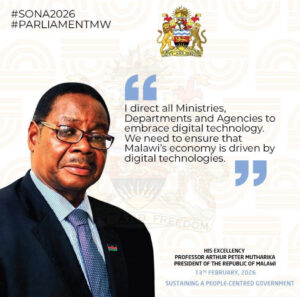
This is an important direction, and deserves an applause and support — however, digital transformation should go beyond putting application forms online.
A genuinely anti-corruption digital system should allow a citizen to see: application submitted → payment confirmed → verification → processing → approval → production → collection.
Each stage should have a responsible institution, a service standard and a timestamp. Where a case exceeds the prescribed timeline, the system should automatically flag it.
Where an official repeatedly handles applications that subsequently involve complaints or irregular payments, that pattern should be visible to internal audit and anti-corruption authorities.
Technology should, therefore, reduce informational asymmetry and administrative discretion. The citizen should not have to know somebody inside the institution to know what is happening to their application.
The real reform: make efficiency the default
The ultimate objective should not simply be to punish corrupt individuals after corruption occurs. It should be to redesign government systems so that corruption becomes harder to initiate and harder to monetise.
That means publishing service standards and measuring actual performance against them; it means tracking every application; it means separating payment from decision-making; it means reducing unnecessary human intervention.
And it means publishing queue-management information; establishing effective complaint and grievance mechanisms; rotating staff in high-risk functions where appropriate; conducting forensic reviews where procurement or contracting problems have contributed to service failures, and critically, it means measuring the cost of delay to citizens and businesses.

The Ombudsman’s investigation has already called for compliance with service-charter timelines, stronger grievance mechanisms, reforms to passport procurement and a forensic audit of passport procurement contracts.
These should not be treated simply as administrative recommendations — they are potentially important anti-corruption reforms.
Malawi needs to change the economics of corruption
The most effective anti-corruption strategy is not merely to tell citizens and officials not to take or pay bribes — it is to change the underlying economics.
If the official system is fast, transparent and predictable, there is little value in paying someone to bypass it.
If the official system is slow, opaque and unpredictable, the economic value of the intermediary increases. That is why efficiency is itself an anti-corruption instrument.
A government that delivers a passport within the promised period, issues a driving licence through a transparent process, processes a permit according to published timelines and allows citizens to track applications without repeatedly visiting offices, removes much of the market for unofficial access.
The objective, therefore, should be more ambitious than simply fighting corruption.
Malawi needs to design corruption out of public-service delivery. Because when inefficiency becomes predictable, when access becomes scarce and when somebody can charge money to overcome the bottleneck, inefficiency is no longer merely an administrative problem.
It can become a business model, and a state serious about economic transformation cannot afford to allow the delivery of basic public services to become another source of economic rent extraction from its citizens.

Chifipa Mhango
* Editor’s Note:
Chifipa Mhango is a Chief Economist & Executive Director-Economic Research & Strategy at Don Consultancy Group (DCG), who has more than 30 years of experience spanning economic research, macroeconomic and fiscal analysis, corporate strategy, financial services, development finance, trade policy, investment advisory and strategic planning across Africa.
He has held senior leadership roles in both the public and private sectors in South Africa, providing economic intelligence and strategic advice to businesses, government institutions and other decision-makers.
His work focuses on translating economic and policy developments into practical strategic insights that support informed decision-making,competitiveness and sustainable growth.

Advertisement