
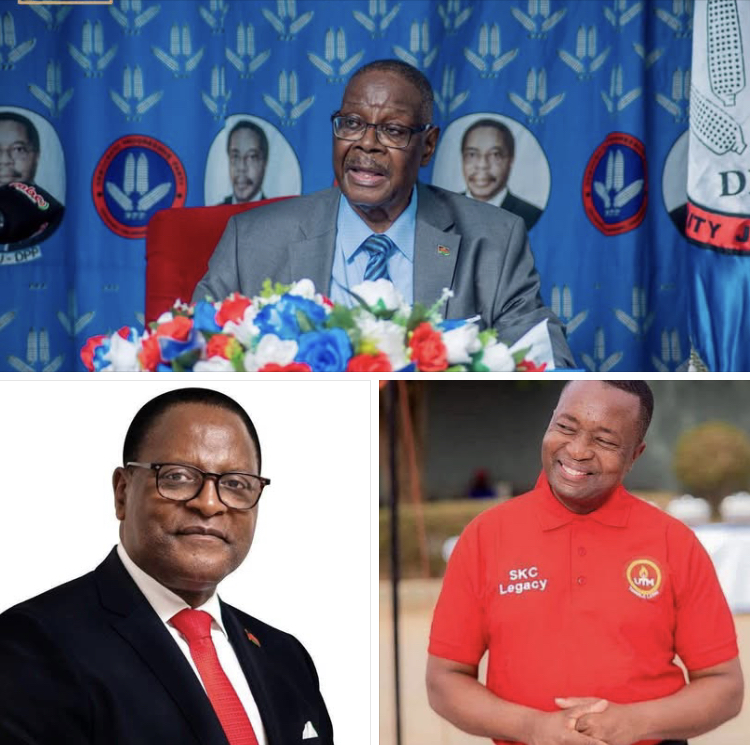
* The former Reserve Bank Governor was expected to command enough votes to prevent either of the two main rivals, MCP’s Lazarus Chakwera and DPP’s Peter Mutharika from crossing the majority threshold in the first round
* To the contrary, UTM hugely underperformed such that the presidential contest effectively became a two-horse race between MCP and DPP
* Kabambe polled only about 4.0% of the national vote, dashing expectations of a tight three-way contest and extinguishing any real chance of a runoff
By Innocent Manda, MANA
UTM’s poor showing in the presidential vote under Dalitso Kabambe failed to trigger the runoff many expected, and left the presidential race a straight fight between Malawi Congress Party (MCP) and Democratic Progressive Party (DPP) candidates.

Advertisement
The September 16 General Elections were widely billed as one of the most competitive races in Malawi’s democratic history, with analysts and opinion polls pointing to a possible runoff under the 50+1% system.
At the centre of these projections was the UTM Party, whose new leader, Kabambe — a former Reserve Bank Governor — was expected to command enough votes to prevent either of the two main rivals, MCP’s Lazarus Chakwera and DPP’s Peter Mutharika from crossing the majority threshold in the first round.
To the contrary, UTM hugely underperformed such that the presidential contest effectively became a two-horse race between MCP and DPP. Kabambe polled only about 4.0% of the national vote, dashing expectations of a tight three-way contest and extinguishing any real chance of a runoff.
The expectations on UTM stemmed from its past performance. In the 2019 tripartite elections, the party, led then by Saulos Klaus Chilima, surprised many by finishing third nationally with over one million votes.

Late Saulos Klaus Chilima
Though it did not win the presidency, UTM’s 20% share established it as a credible alternative to the long-entrenched parties and it was expected to provide a swing vote in the 2025 elections, if not clinching the presidency altogether.
Chilima’s showing energised Malawi’s youth and urban middle class, groups frustrated by corruption, economic stagnation, and what they saw as outdated political leadership.
His message of generational change and accountability; found ready ears — giving voters a sense that politics could be done differently. That momentum carried into the 2020 fresh presidential elections held after the courts annulled the 2019 results.
In those polls, UTM joined forces with MCP, under the Tonse Alliance, which convincingly defeated the DPP with 56% of the votes and analysts credited Chilima’s popularity for securing that landslide, as he brought both energy and numbers to the Alliance.

Signing the Tonse Alliance pact

Chakwera and Chilima on their campaign trail
It is against this backdrop that voters and analysts alike believed UTM would again shape the 2025 elections. With alliance talks with the DPP collapsing, many expected Kabambe to hold a decisive bloc of votes that could deny either major party an outright majority.
The reality was starkly different — instead of retaining Chilima’s 20% share, UTM collapsed to a paltry 4.0%, a steep erosion of support that essentially removed the party from the presidential contest.
Instead of forcing a runoff and shaping post-election negotiations, UTM’s poor showing simply smoothed the way for a first-round decision. Kabambe, a respected economist, campaigned on his reputation as an economic ‘doctor’ and presented himself as the man to reboot an economy that many believed was shutting down under MCP’s stewardship.
His campaign emphasised fiscal discipline, efficiency, and results-driven leadership with billions of money being invested in district councils, agriculture, mining, manufacturing and tourism.
He reminded voters of his record at the Reserve Bank, where he was credited with taming inflation and introducing reforms to stabilise monetary policy. His message promised competence and an end to what he called economic mismanagement.
But this technocratic approach did not resonate with the wider electorate that looked for leaders who connected directly with their struggles — rising food prices, access to farm inputs, and jobs.
Chilima, with his charisma and populist touch, had been able to inspire them in 2019 and 2020, but Kabambe struggled to replicate that connection. Nevertheless, despite its poor presidential tally, UTM made gains in parliamentary representation, increasing its tally from four MPs in the outgoing Parliament to, unofficially, eight MPs.
Political analyst Chimwemwe Tsitsi says this reflects UTM’s growth as an organisation even if it failed nationally: “Dr. Kabambe has tried his best as a newcomer to politics, though he hasn’t managed to match or exceed the 20% threshold previously attained by the late Dr. Saulos Chilima.”
Tsitsi added that the parliamentary growth gives UTM relevance in shaping legislative debates, ensuring that its ideas and policies remain visible. However, he acknowledged that the presidential collapse undermines the party’s broader ambitions.
UTM’s fortunes continue to be measured against the legacy of its founder, Saulos Chilima, whose sudden death left the party at a crossroads, robbing it of the charisma and mass appeal that had defined its rise.

Advertisement
Chilima’s ability to electrify crowds and communicate reformist ideals gave UTM its identity as a party of hope — while Kabambe, though highly competent as a technocrat, has not filled that gap.
His calm and technical style has been seen as a mismatch for the emotive world of Malawian retail politics. Largely, the sharp contrast between 2019/2020 and 2025 is telling.
In 2019, discontent with the DPP’s governance and a desire for fresh leadership propelled Chilima to nearly one in five votes. The 2020 rerun, energised by the Tonse Alliance, gave voters renewed faith in change, with many rallying behind a coalition seen as progressive and reformist.
But by 2025, that mood had shifted and frustration with the Tonse government’s unfulfilled promises eroded public trust in the very forces that had once inspired hope.

Advertisement
Many voters saw UTM under Kabambe as unable to rekindle Chilima’s magic and the choice narrowed back to MCP and DPP, casting the election as a runoff in all but name.
Tsitsi believes Kabambe still has room to grow: “His focus on evidence-based decision-making and fiscal discipline may resonate in the long term with voters fatigued by populist promises. But he must also demonstrate empathy and the ability to inspire trust across Malawi’s diverse electorate.”
For now, the verdict of the 2025 elections is clear — instead of being the kingmaker, UTM fell into the margins of the presidential race, handing the stage back to MCP and DPP.
As Malawi’s democracy evolves, Kabambe’s next moves will determine whether UTM remains a relevant force or whether it slips into history as a party that once gave hope but failed to deliver numbers.


Advertisement