

Chifipa Mhango
* Public policy is most successful when it addresses the root causes of a problem rather than applying broad restrictions that unintentionally affect compliant citizens
* In this case, the challenge is not that Malawians are travelling to South Africa; rather, it is that a proportion of travellers are violating immigration laws after arrival or circumventing legal migration processes altogether
* South Africa has not closed the borders for entry, and so action from Malawi to issue travel ban on its own citizens may not be valid
By Duncan Mlanjira
Chief Economist for Don Consultancy Group (DCG), Chifipa Mhango, maintains that the recommendation by the Parliamentary International Relations Committee that Malawi should consider a temporary travel ban to South Africa, needs serious economic consideration.

Advertisement
On Wednesday, the committee’s vice-chairperson, Frank Mwenifumbo recommended in Parliament that the Ministry of Foreign Affairs should impose temporary travel restrictions on Malawians seeking informal employment in South Africa, as government moves to contain the cost of repatriating citizens stranded in the country.
He reported that government had initially budgeted K25 billion to repatriate 15,000 Malawians but it has managed to beat its own budget by spending K7 billion to ferry in over 41,000.
Mhango agreed to the concerns on the high cost of repatriating the Malawian, saying “government has a responsibility to protect public resources and to address irregular migration”.
“However, while the objective is legitimate, a blanket travel ban may not be the most effective or practical policy response,” says the DCG Executive Director of Economic Research & Strategy in a statement.
“Public policy is most successful when it addresses the root causes of a problem rather than applying broad restrictions that unintentionally affect compliant citizens.
“In this case, the challenge is not that Malawians are travelling to South Africa; rather, it is that a proportion of travellers are violating immigration laws after arrival or circumventing legal migration processes altogether.

Mwenifumbo
“Importantly, South Africa has not closed its borders to Malawian citizens. A unilateral restriction imposed by Malawi on its own citizens could, therefore, raise questions about proportionality, implementation and effectiveness, while also affecting trade, education, tourism, medical travel and legitimate business activities between the two countries.
“A blanket restriction would inevitably penalize thousands of law-abiding Malawians who travel to South Africa for genuine reasons — business people, students, professionals, patients seeking specialised medical treatment, tourists and families visiting relatives would all be subjected to additional restrictions despite having no history of violating immigration regulations.”
However, Mwenifumbo did indicate that they were not proposing for a blanket ban — but rather “a ban for those who are going to South Africa to seek informal employment while undocumented, meaning they have not been issued a passport for them to legally enter, exit and enter South Africa”.
“Those are the ones that I mentioned that there must be a ban on,” said Mwenifumbo and Mhango observes that implementation “itself would become administratively expensive”.
“Immigration authorities would need to scrutinise virtually every traveller destined for South Africa, regardless of their background or travel history, to determine whether they should be permitted to leave the country.
“Such an approach would require additional personnel, increased border resources and significant administrative expenditure — potentially reducing the anticipated fiscal savings.”
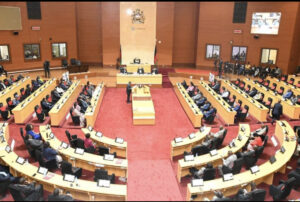
Mwenifumbo also did alluded to this challenge in Parliament when he reported that the Immigration Department admitted it faces difficulties in monitoring citizens who leave the country through undocumented channels.
The chief economist thus says: “Rather than adopting a one-size-fits-all policy, Government should recognise that the current migration challenge consists of three distinct categories — each requiring different interventions.
“The first category comprises individuals who legally enter South Africa on visitor visas but overstay beyond the permitted 30-day period.
“This is primarily a compliance problem that calls for improved pre-departure awareness, stronger monitoring and enhanced cooperation between Malawian and South African immigration authorities.”
He adds that the second category are those who overstay their visas and subsequently seek employment without the required work permits, saying: “This reflects both immigration compliance failures and domestic economic pressures that encourage irregular labour migration.
“Addressing this challenge requires strengthened labour migration agreements, improved access to legal work permit information and expanded employment opportunities within Malawi itself.
“The third category, and arguably most concerning, consists of individuals who leave Malawi and travel through multiple border points without valid passports or official travel documents.
“This is fundamentally a border security issue rather than a travel issue. It points to weaknesses in border management, document verification and cross-border law enforcement.

Advertisement
“Because these three challenges differ in nature, they require targeted rather than blanket interventions. Government should, therefore, prioritise strengthening border management systems, improving exit controls, enhancing intelligence sharing with neighbouring countries, introducing stronger penalties for organised illegal migration networks, and conducting nationwide public awareness campaigns on immigration compliance.
“In parallel, Malawi should continue engaging South African authorities to improve information sharing on visa overstays and facilitate the orderly return of individuals who violate immigration laws.
“Such targeted measures would directly address the underlying causes of irregular migration while preserving the constitutional rights of law-abiding citizens to travel for legitimate purposes.”
Mhango maintains that “good public policy distinguishes between those who comply with the law and those who do not” and thus the government “should avoid imposing unnecessary restrictions on compliant citizens while ensuring that enforcement mechanisms are sufficiently robust to deter illegal behaviour”.
“The objective should, therefore, not be to stop Malawians from travelling to South Africa — rather, it should be to ensure that those who travel do so legally, remain compliant with the conditions of their visas and return home in accordance with the law.
“Ultimately, effective migration policy is not measured by how many people it prevents from travelling, but by how successfully it promotes lawful migration while reducing illegal migration.
“By focusing on targeted interventions instead of blanket restrictions, Malawi can protect public resources, strengthen border security and maintain the important economic and social ties that exist between Malawi and South Africa.
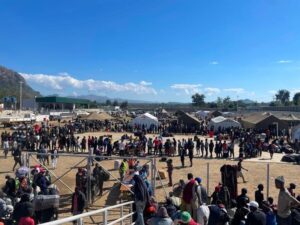
On arrival centre, the returnees are screened

Meanwhile, the International Relations Committee of Parliament also expressed concern that some Malawians continued travelling to South Africa despite the crisis, with others allegedly using government-funded repatriation arrangements to return home before going back to the rainbow nation.
Mwenifumbo also raised an alarm that nationals of other countries have been using Malawi’s repatriation exercise as a transit route to reach their own countries, at the expense of Malawian citizens the programme was designed to assist.

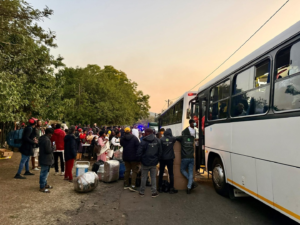
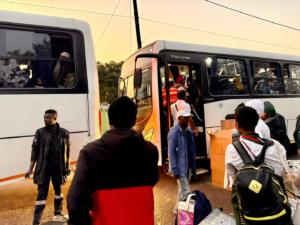
“What it simply means is that those that are not Malawians are depriving the bona fide Malawians of the opportunity to use the resources that government has provided, because they are not within the budget,” he said.
To address the problem, the committee directed immigration and transport officials to conduct background checks on passengers boarding buses destined for Malawi to confirm they are genuine Malawian citizens.
Beyond the proposed travel restrictions, the committee urged the Department of Immigration to tighten border controls and ensure that Malawians travelling abroad carry proper documentation, in a bid to reduce repeated repatriation costs and direct resources toward genuine cases of need.—Reporting from Parliament by Frank Humphreys, Malawi News Agency (MANA)

Advertisement