
Analysis by Chifi Mhango, Chief Economist and Executive Director at Don Consultancy Group
1. Introduction: Why growth is not translating into prosperity
For nearly a decade, Malawi’s economy has continued to grow, but not at the pace required to improve living standards significantly.
The challenge is not simply whether Malawi is growing, but whether that growth is productive and inclusive enough to lift households out of poverty.
The National Statistical Office (NSO) national accounts, sourced through the Reserve Bank of Malawi (RBM), reveal structural weaknesses from 2017 to 2025, with 2026 projections indicating only modest improvement.
This report compares actual sector shares in 2017 and 2025, while presenting the projected sector structure and growth for 2026 separately.
The central argument is that Malawi needs sustained real GDP growth above 5%, supported by productivity, investment, exports and institutional effectiveness.

Advertisement
2. Economic scorecard: How has Malawi performed?
Real GDP at constant 2017 prices rose from MK6.53 trillion in 2017 to MK8.14 trillion in 2025, an increase of approximately 24.6%. The 2026 projection is MK8.37 trillion, representing 2.83% annual growth.
Growth remained below 3% in every year from 2022 through 2025, with the same pattern projected for 2026.
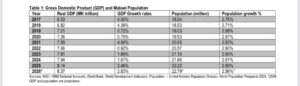
The 2017 baseline is economically important. Malawi grew by 4.00% that year, according to the World Bank and IMF, reflecting a recovery in agricultural production after earlier drought-related weakness.
Yet growth subsequently fluctuated sharply and remained below 3% from 2022 onwards. The contrast highlights why Malawi needs not merely occasional recoveries, but sustained growth that consistently exceeds population growth and raises real income per person.
Population dynamics reinforce the economic warning. UN Population Division estimates put Malawi at 18.04 million people in 2017 and 22.22 million in 2025, with 22.79 million projected for 2026.
This is an increase of about 4.18 million people (23.2%) between 2017 and 2025, while real GDP rose by approximately 24.6%.
As a result, real GDP per person increased by only about 1.2% across those eight years, equivalent to roughly 0.15% per year. Put simply, the economic cake grew, but so did the number of people sharing it.
This is not a direct measure of household income or poverty, but it demonstrates why modest national GDP growth has delivered little room for improvements in average material living standards.
The population growth rate has moderated gradually from approximately 2.75% in 2017 to 2.59% in 2025 and a projected 2.56% in 2026.
Yet with a larger population base, Malawi must generate enough additional output, jobs, school places, health services and food supplies every year simply to prevent living standards from falling.
In 2025, real GDP growth of 2.46% was slightly below population growth of 2.59%, implying a small decline in real GDP per person.
The 2026 projected GDP growth of 2.83% would exceed projected population growth of 2.56% by only a narrow margin.
This reinforces the case for sustained GDP growth well above 5%, alongside improvements in productivity and inclusive employment.
3. Economic structure: What changed between 2016 and 2025?
The sector comparison reveals gradual movement towards services, but little evidence of the manufacturing expansion required for industrial transformation.
Changes in shares are measured in percentage points (pp), not percentage growth.
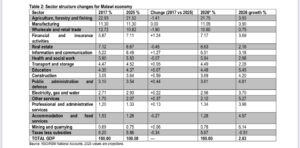
Agriculture, manufacturing and wholesale/retail trade jointly accounted for about 46.95% of GDP in 2017 versus 43.64% in 2025, a reduction of 3.31 percentage points.
Finance and information/communication together rose from 11.09% to 13.60%. The shift is not inherently negative, but manufacturing’s unchanged share raises questions about job-rich structural transformation.
A lower GDP share does not necessarily mean absolute output declined.
3.1 Agriculture: Still the backbone, but productivity remains a challenge
Agriculture, forestry and fishing contributed 22.93% of GDP in 2017 and 21.52% in 2025, with a projected 21.75% in 2026 and projected growth of 3.93%.
Crop production fell from roughly MK1.007 trillion in 2017 to MK936.4 billion in 2025 at constant prices. Even the projected MK986.2 billion in 2026 remains below the 2017 level.
By contrast, animal production increased from approximately MK397.8 billion to MK720.5 billion between 2017 and 2025 as per data sourced from RBM.
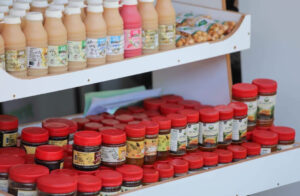
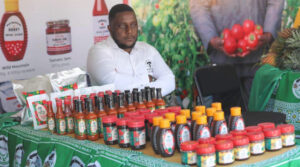
The response must move beyond seasonal production towards irrigation, commercial livestock, horticulture, storage, mechanisation, climate resilience and agro-processing.
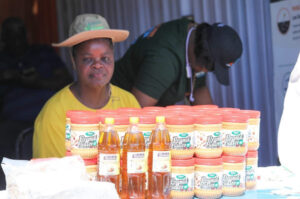
Processing groundnuts into packaged products, for example, creates opportunities in manufacturing, branding, transport and exports.
Agricultural success should be measured by economic value created, not only hectares cultivated.

3.2. Manufacturing: The missing engine of industrialisation
Manufacturing accounted for about 11.30% of GDP in both 2017 and 2025 and is projected to fall to 11.09% in 2026. Real growth was only 1.08% in 2025, with 0.90% projected in 2026.
The sector has failed to gain relative importance despite its role in industrial jobs, value addition and export diversification.
Policy must address electricity reliability, foreign exchange access for productive inputs, financing, logistics and skills.
Malawi should select commercially viable opportunities in agro-processing, packaging, construction materials, textiles, pharmaceuticals and selected industrial inputs rather than attempt to produce everything domestically.
3.3. Wholesale and retail: A warning about domestic demand
Wholesale and retail trade fell from 12.72% of GDP in 2017 to 10.82% in 2025, with 10.60% projected in 2026. The sector contracted in real terms during 2022–2024 and recorded only marginal growth in 2025.
This weakness is consistent with pressure on household purchasing power and business activity, although the national accounts alone cannot identify the relative impact of inflation, foreign exchange shortages or other causes.
3.4. Finance and the digital economy: Growth must support production
Financial and insurance activities increased from 5.87% of GDP in 2017 to 7.11% in 2025, while information and communication rose from 5.22% to 6.49%.
These gains are welcome if they strengthen productive lending, payments, market access and enterprise productivity.
The policy test is whether expanding finance and digital services translate into investment in farms, factories, mines and exporters.
3.5. Mining: Promising, but still small
Mining and quarrying grew from 0.69% of GDP in 2017 to 0.75% in 2025; its projected 2026 share is 0.78%, with growth of 6.14%. Strong percentage growth from such a small base has limited immediate influence on aggregate GDP.
Transparent licensing, geological information, environmental safeguards, mineral production reporting and domestic supplier development can build a larger mineral-based economy.
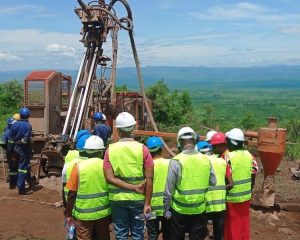
Mining at Kangankunde in Balaka
3.6. Construction: Turning infrastructure spending into domestic jobs
Construction increased its real GDP share from 3.05% in 2017 to 3.64% in 2025, with 3.69% projected for 2026 and growth of 4.20%.
This gain is encouraging, but building activity generates lasting economic value only when projects are well selected and completed.
Malawi should prioritise roads that connect farms to markets, irrigation works, industrial facilities and affordable urban infrastructure.
Procurement should be transparent, with local contractors and apprenticeships supported without compromising cost or quality.
3.7. Transport and storage: The cost of moving goods matters
Transport and storage represented 4.47% of GDP in 2017 and 4.52% in 2025, with 4.49% projected in 2026 and growth of 2.28%. The largely unchanged share conceals a major opportunity: every delayed shipment and damaged road raises the cost of doing business.
Better freight corridors, border clearance, rural roads, cold chains and warehouse facilities can make agriculture and manufacturing more competitive.
Transport policy should be judged by lower journey times, spoilage and logistics costs.

Advertisement
3.8. Electricity, gas and water: Essential foundations of production
This sector rose from 2.71% of GDP in 2017 to 2.93% in 2025, with a projected 2.96% share and 3.70% growth in 2026.
Its GDP share understates its strategic importance: a factory cannot operate efficiently without reliable power, and irrigation and public health depend on water systems.
Malawi should reduce technical and commercial losses, maintain existing networks, add cost-effective generation and improve water infrastructure. Reliability and affordability are as important as installed capacity.
3.9. Real estate: Growth must be linked to productive urbanisation
Real estate fell from 7.12% of GDP in 2017 to 6.67% in 2025; its projected share is 6.63% in 2026, with 2.16% growth.
The sector includes property-related economic activity, not simply new houses being built. Malawi needs planned urban expansion, secure land administration, serviced industrial and residential sites and predictable development approvals.
Better land use can reduce congestion and support enterprise growth, while speculative property development alone will not solve the jobs challenge.
3.10. Education: Converting a young population into productive skills
Education accounted for 4.30% of GDP in 2017 and 4.37% in 2025, with 4.48% projected for 2026 and 5.45% growth.
Education contributes directly to GDP through services, but its greatest economic return comes from a more capable workforce.
Malawi should strengthen foundational literacy and numeracy, technical colleges, apprenticeships and employer-linked training in agriculture, manufacturing, construction and digital services.
Outcomes such as completion, competencies and graduate employment should be monitored alongside expenditure.
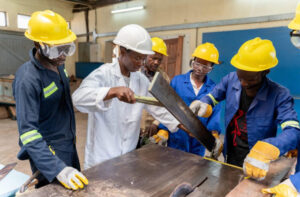
Vocational skills training by TEVETA
3.11. Health and social work: A productive economy needs healthy people
Health and social work represented 5.90% of GDP in 2017 and 5.83% in 2025; the projected 2026 share is 5.84%, with 2.98% growth.
A nearly unchanged share should not be mistaken for unchanged need. Preventable illness reduces working days, school attendance and household savings.
Strong primary care, maternal and child health, medicine supply systems, nutrition and sanitation are economic investments as well as social priorities.
Funding should be linked to service coverage and measurable health outcomes.
3.12. Public administration and defence: Better government, not simply bigger government
Public administration and defence rose from 3.10% of GDP in 2017 to 3.54% in 2025, with 3.61% projected for 2026 and 4.81% growth.
An expanding government-services share is not automatically evidence of stronger state capacity. What matters is whether public institutions collect revenue fairly, control procurement, deliver permits promptly and implement investment projects.
Malawi should strengthen audit follow-through, digital public services, transparent contracting and performance accountability so each kwacha spent supports public value
3.13. Accommodation and food services: Unlocking tourism and hospitality
Accommodation and food services declined from 1.53% of GDP in 2017 to 1.26% in 2025, with 1.28% projected for 2026 despite expected growth of 4.97%.
This small sector can nevertheless create jobs for young people and stimulate demand for food, transport, crafts and local services.
Malawi should improve destination access, visitor safety, hospitality skills, marketing and environmental protection, while encouraging tourism businesses to source more inputs locally.
Growth must translate into viable year-round enterprises.
3.14. Professional and administrative services: Supporting competitive businesses
Professional and administrative services increased from 1.20% of GDP in 2017 to 1.33% in 2025, with 1.34% projected in 2026 and growth of 3.98%.
Accountancy, engineering, consulting, business support and administrative services help firms operate efficiently and meet standards.
Their expansion should be connected to industrial development through quality certification, technical design, export compliance, digital bookkeeping and small-business advisory services.
These activities can also become tradable regional services.
3.15. Other services: Recognising the breadth of local enterprise
Other services rose from 1.70% of GDP in 2017 to 2.07% in 2025, with 2.12% projected for 2026 and growth of 5.27%.
This broad category contains varied activities, so its expansion should not be attributed to a single industry without more detailed data.
Policies should focus on practical enablers for small enterprises: simple registration, safe trading spaces, digital payments, basic skills and proportionate regulation.
Formalisation should deliver benefits to businesses, not just additional compliance costs.
4. Why Malawi needs growth above 5%
At 2.8% annual real growth, output expands by roughly 31.8% over 10 years. At 5.5%, the cumulative increase is 70.8%; at 7%, it is 96.7%.
Faster growth creates greater potential for investment, jobs and public revenue, but poverty reduction also depends on population growth, the distribution of income and whether employment-intensive sectors participate.

To achieve sustainable economic growth above 5% annually, Don Consultancy Group (DCG) proposes targeted growth ambitions across
Malawi’s key economic sectors, with particular emphasis on accelerating agriculture, manufacturing, mining, trade and other productive activities.
Table 4 compares the projected sectoral growth rates for 2026 with DCG’s proposed medium-term growth ambitions, illustrating the scale of economic acceleration required to strengthen productive capacity, generate employment, expand exports and support meaningful poverty reduction.
These ambitions are indicative policy targets rather than official forecasts and would require coordinated investment, productivity improvements and effective implementation.
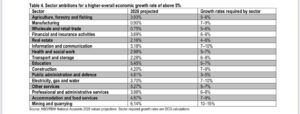
The proposed sectoral growth ambitions provide a strategic framework for accelerating Malawi’s economic transformation; they are policy objectives required as calculated by Don Consultancy Group, not official economic forecasts.
Their purpose is to show the scale of improvement needed to move beyond prolonged growth below 3% towards a sustainable rate exceeding 5% annually.
Achieving this requires more than setting ambitious targets: it requires productive investment, higher output per worker, reliable infrastructure, export competitiveness and stronger implementation capacity.
Not all sectors influence national growth equally. Their contribution depends on both their share of GDP and their rate of expansion.
Agriculture accounts for approximately 21.75% of projected GDP in 2026, compared with mining’s 0.78%. An acceleration in agricultural growth from 3.93% to 6% would, therefore, have a larger immediate direct effect on aggregate GDP than an acceleration of mining growth to 15%, all else equal.
Mining, nevertheless, remains strategically important for export diversification, foreign exchange earnings and future supply-chain development.
Manufacturing offers another major opportunity. With a projected GDP share of 11.09% and growth of only 0.90% in 2026, raising its growth towards the proposed 7-9% range could materially strengthen national output while creating jobs and demand for agricultural products, transport, energy and business services.
The lesson is that policy must consider both the economic weight of a sector and its wider linkages to employment, imports and exports.
These ambitions should be tested through a transparent, sector-weighted growth model incorporating investment needs, productivity assumptions, financing, electricity capacity, import requirements and realistic implementation timelines.
Sector growth rates cannot simply be added together to obtain national GDP growth: each sector contributes according to its relative economic weight, with taxes less subsidies also entering the GDP calculation. Nor should sector targets be mistaken for guaranteed results.
Each ambition must be converted into measurable commitments: higher yields and irrigation in agriculture; new productive capacity and dependable power in manufacturing; commercially viable projects and local supply chains in mining; and better logistics, financing, skills and digital connectivity across services.
Government should publish progress against these commitments and track whether output growth improves real income per person and reduces poverty.
Malawi cannot achieve sustained growth above 5% through isolated gains in a handful of activities. It requires coordinated expansion led by economically significant, job-creating and foreign-exchange-generating sectors.
The true measure of success will not be the attractiveness of the targets, but the country’s ability to mobilise investment, raise productivity, deliver reforms and improve household welfare.
Malawi must move from setting economic growth ambitions to building the productive capacity required to achieve them.

Advertisement
5. From strategy to implementation
Based on its analysis of Malawi’s economic performance, the DCG proposes a five-year economic transformation programme aimed at achieving sustainable GDP growth above 5% annually.
The proposed strategy prioritises macroeconomic stability through fiscal discipline, sustainable debt management, inflation containment and transparent foreign exchange allocation.
It further emphasises agricultural commercialisation, manufacturing expansion, export diversification and increased productive investment.
The DCG identifies reliable energy supply, efficient transport and border logistics, skills development and access to development finance as critical enablers of economic growth.
To ensure effective implementation and accountability, DCG further proposes a National Economic Transformation Scorecard to monitor sectoral performance, investment, exports, employment and productivity, supported by strengthened statistical reporting from the National Statistical Office.
The proposed programme would be implemented in three phases, as outlined below.

6. Conclusion: Transform how Malawi produces wealth
The 2017-2025 comparison reveals real economic expansion without sufficient productive transformation. Agriculture remains dominant, manufacturing has not increased its GDP share, and wholesale/retail trade has lost ground.
Finance and information technology have gained importance, but their growth must translate into productive investment and better livelihoods.
The 2026 projections suggest modest improvement rather than a decisive growth breakthrough. Malawi must produce more competitively, process a greater share of its resources, diversify exports and create sustainable employment.
The next decade should be judged not by strategies announced, but by investments realised, jobs created, real incomes raised and poverty reduced.

Advertisement