

* I would like to assure Malawians that we will succeed in restoring our lost glory. I do what I promise and I do not promise what I cannot do
* We found inflation at 28.7% in September, 2025 and we project to reduce it to less than 21 % in 2026
* We also found economic growth at 2.7% and we project it to rise to 3.8% in 2026 and 4.9% in 2027
* As I speak, most prices have already stabilised and some are in fact going down. For instance, the price of maize and cement have gone down
By Duncan Mlanjira, Maravi Express & Adson Nthenga, MANA
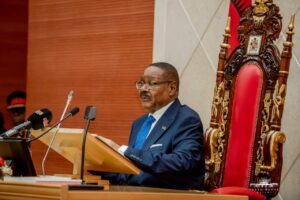
In his State of the Nation Address (SONA) made in Parliament yesterday, February 13, President Arthur Peter Mutharika reiterated that Malawi is economic crisis and tough and painful decisions need to be made, which will soon be offset by the expected gains.

Advertisement
He highlighted that his administration inherited inflation at 28.7% in September, 2025, which is projected to be reduce to less than 21 % in 2026 and the economic growth that was at 2.7% is projected to rise to 3.8% in 2026 and 4.9% in 2027.
“However, foreign exchange reserves remain below the desired three months import cover,” he announced. “My Government is, therefore, implementing strong measures to support forex generation.
“These include the ongoing review of foreign exchange regulations, increased gold purchases and its monetisation. My Government has also instituted austerity measures to save resources for improved service delivery.
“These include reducing fuel entitlements for Cabinet Ministers and Government officials; and also restricting local and foreign travel,” he said, while assuring Malawians that his administration “will succeed in restoring the lost glory”.
“I do what I promise and I do not promise what I cannot do. Mr. Speaker, Sir, as I speak, most prices have already stabilised and some are in fact going down. For instance, the price of maize and cement have gone down.
Delivered under the theme; ‘The Path to Economic Recovery: Delivering a People-Centred Development’, the President announced major interventions in the energy sector to boost electricity generation, expand access, and stabilise fuel supply as part of its economic recovery plan.

He noted that frequent blackouts and inadequate power generation have long hindered households, businesses, and public services: “We are determined to reverse these challenges and ensure that every Malawian has access to reliable power.”
He added that his administration had repaired generators at Tedzani Hydro Power Station, restoring 31 megawatts to the national grid, commissioned 10 megawatts at Raiply Biomass in Mzimba, and installed another 10 megawatts at the Nanjoka-Egenco Solar Plant in Salima, improving overall generation capacity.
“Our target is to raise generation capacity from the current 551 megawatts to over 1,000 megawatts by 2030,” he said, stressing that this will support industrial growth and economic development.
On addressing the fuel crisis, the President said government acted swiftly to restore supply, end long queues, and stabilize the sector.
“Going forward, the procurement of fuel will remain a priority, and we will double national fuel storage capacity from 60 million to 120 million litres by constructing new facilities in Blantyre, Lilongwe, and Mzuzu,” he said.
The President noted that energy reforms are central to creating jobs, improving service delivery, and attracting local and foreign investors. He reaffirmed government’s commitment to transparent and accountable management of energy projects, ensuring strict adherence to procurement laws and value-for-money principles.
He added that improved electricity and fuel supply will directly benefit households, businesses, and public institutions, helping to ease the economic hardships faced in recent years.
The initiatives form part of broader government efforts to lay a stable foundation for long-term economic transformation and to enhance Malawi’s competitiveness in the regional market.

Advertisement