
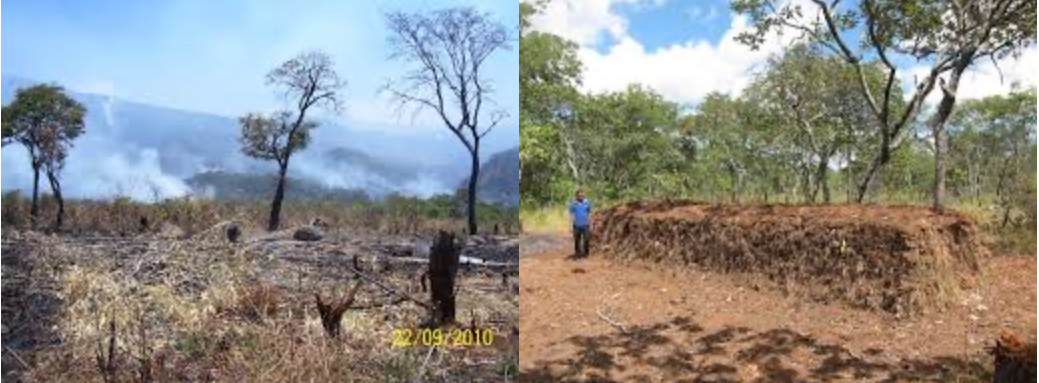
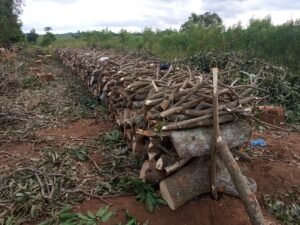
Massive deforestation happening on Mulanje Mountain for charcoal production
* We will continue to work with the communities, particularly in traditional authorities Njema and Sunganinzeru, to stop the illegal cutting down of trees
* We will soon implement a comprehensive project aimed at addressing deforestation in the mountain reserve
By Mirriam Bwanali, MANA
Mulanje Mountain Conservation Trust (MMCT), in collaboration with Mulanje Police Station, have strengthened collaboration between the law enforcers, community-based policing structures and other key stakeholders in addressing deforestation around Mulanje Mountain.

Advertisement
At a meeting held this week, MMCT Executive Director, Carl Bruessow emphasised that there is an urgent need for collective action to protect the forest and reduce environmental degradation resulting from deforestation.
“We will continue to work with the communities, particularly in traditional authorities Njema and Sunganinzeru, to stop the illegal cutting down of trees,” he said. “We will soon implement a comprehensive project aimed at addressing deforestation in the mountain reserve.”
Officer in charge of Mulanje Police Station, Assistant Commissioner of Police Moses Chibwe, commended MMCT for its ongoing and upcoming initiatives and reaffirmed Mulanje Police’s commitment and that of community policing members to work hand in hand with MMCT in dealing with environmental malpractices that threaten biodiversity in and around the mountain.
He stressed that the police will intensify mass awareness campaigns on forest conservation and ensure that those involved in charcoal production, illegal logging and other non-environmental friendly human practices are brought to justice.
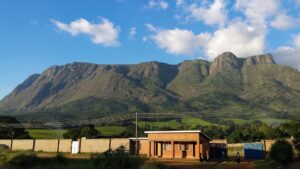


Established in 2000, the MMCT is an environmental endowment trust whose goal is to ensure sustainable management of the Mulanje Mountain’s biodiversity apart from doing research and monitoring, co-management and sustainable livelihood, environmental education and communication.
Environmental conservation stakeholders like MMCT are doing their part but there is the need for law enforcement agencies to walk their talk and enforce the amended Forestry Act, which Parliament passed last month, amendment Bill of Forestry Act that will empower forestry rangers to use firearms against forest produce poachers.
It also empowers the participation of other law enforcement agencies such as Malawi Police, Road Traffic Department, MDF MRA, Immigration Department, Malawi Defence Force (MDF), Malawi Revenue Authority, Department of Immigration, Department of Road Traffic & Safety Services, Department of Fisheries— on top of Department of National Parks & Wildlife, and Malawi Environmental Protection Authority (MEPA).
The other Government agencies and departments are enforcement officers empowered to do specific acts such as inspection, search and seizure of forest produce.

Advertisement
This is in order to iron out operational challenges that was being met in the administration of the Forestry Act, and the amendment was private member motion by Chitipa South Constituency MP Werani Chilenga, who is chairperson of Parliamentary Committee of Natural Resources & Climate Change.
The Bill proposed to amend sections 2, 6, 46, 68, 74, 82 and 83 of the Act and inserts new sections 9A and 13A which empowers the participation of the other law enforcement agencies.
In moving the motion, MP Chilenga said the operational challenges include lack of appropriate regulation of the use of firearms by forest officers; inadequate enforcement of key provisions of the Act by the Department of Forestry due to, among others, inadequate personnel and omission.
An officer exercising powers granted under section 13 of this Act, may use firearms against any person where the person is escaping or attempting to escape; who, by force, rescues or attempts to rescue, a person under lawful custody; and who, by force, prevents or attempts to prevent, his own lawful arrest or the lawful arrest of any person.

An officer shall not resort to the use of a firearm as authorised under unless the officer has reasonable grounds to believe that he cannot otherwise prevent the escape and unless the officer has given warning to such person that he is about to use the firearm against the person and that such warning is unheeded.
They shall also not resort to the use of a firearm as authorised unless the officer has reasonable grounds to believe that he or any person is in danger of grievous bodily harm and that he cannot otherwise effect the arrest or prevent the rescue.
And as far as possible, use a firearm to disable and not to kill and an officer, shall, after using a firearm, make a report in the prescribed form to the Director.
The use of firearms was considered after concerns of the perilous dangers that forest ranger face in their line of duty and in 2024 alone, a total of eight forest rangers got killed in separate incidents while in the line of duty — as according to Ministry of Natural Resources.

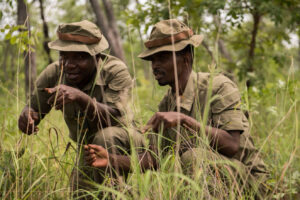
Just as in Mulanje, many forest reserves faces community the hostility from illegal charcoal producers and loggers, which at times forced the Ministry of Natural Resources to engage the MDF and Malawi Police Service to crack down on the illegal operation — but that became costly since the other two law enforcement agencies had to be paid for the task.
Secretary for Ministry of Natural Resources, Yusuf Nkungula told the media last month that currently, the forestry department has 806 guards deployed to forest reserves and plantations, way below the 4,772 forest guards which the department requires — and that the department also struggles to equip even these few guards due to inadequate funding.


Advertisement
According to Nkungula, since 1998, not in a single year has the department received half of its budget requirement and that the 2024-25 financial year was the worst, as Treasury disbursed only 30% of the budget for the department.
“On average, 40% of the budget has been accessed annually in the previous 5 years. The shortfall adversely affects the operations of the department at all levels, resulting in failure to achieve some important targets.”
Notable challenges resulting from such financial shortfalls include failure to properly develop plantation forestry, fight increased forest fires, bust increased illegal charcoal production and exacerbate corruption, the Ministry told Italy-based Inter Press Service (IPS) news agency.—Additional reporting by Duncan Mlanjira, Maravi Express
