
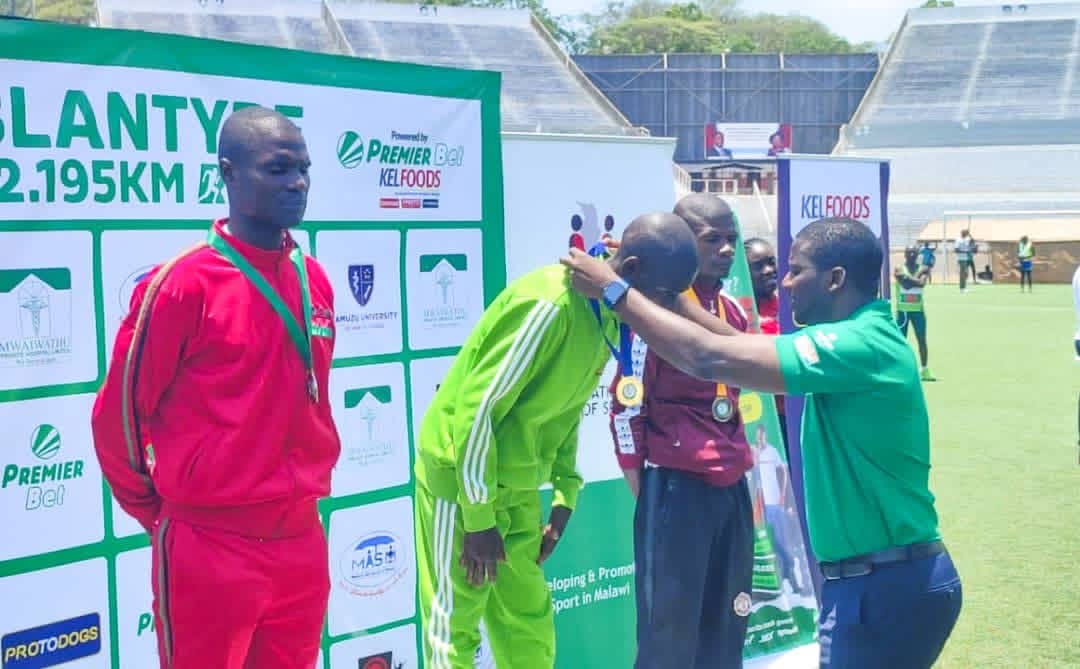
* McDonald Maganizo finishes this year’s Men’s Blantyre 42.195km Race in 2:31:29 hours while Mercy Malembo came out in 3:05:08 in women’s category
* Against men’s Olympic Games official qualifying times of 2:08:10 for men and 2:26:50 for women
* Olympic Games record is 2:06:26 set by Tamirat Tola in 2024 and 2:22:55 set by Sivan Hassan in 2024 for women
* Men’s world record is 2:00:35 set by Kelvin Kiptum at the 2023 Chicago Marathon and 2:17:01 in women’s by Mary Keitany at the 2017 London Marathon
Analysis by Duncan Mlanjira
Athletes from around the world represent their countries at the prestigious Olympic Games after meeting qualifying standards through their respective National Olympic Committees (NOCs) and for the 42.195km marathon, the official qualifying time is 2:08:10 for men and 2:26:50 for women.

Advertisement
For a long time Malawi, the finishing time of 2:18:40 set by Henry Moyo in 2003 for Blantyre Marathon stood unbroken for 20 years until it was retired after the race evolved into the Blantyre 42.195km Race in 2023 with a new route altogether.
Henry Moyo’s personal best and a record for Malawi was not anything near the Olympics qualifying time of 2:08:10 as well as the record of 2:26:58 that was set for the inaugural Blantyre 42.195km Race in 2023 by the champion Mphatso Nadolo.
Nadolo went on to claim his personal best at 2:22:05 done in the 2024 edition, which has not been broken as Saturday’s men’s Blantyre 42.195km Race champion McDonald Maganizo finished in 2:31:29.

McDonald Maganizo on his final lap and crossing the finish line

In women’s category, Mercy Malembo came out in 3:05:08 against 2023 champion, Nalicy Chirwa’s time of 2:57:02 — who had defended her title in 2023 in a personal best having finished in 3:00:07 in the inaugural edition.
Men’s Olympic Games marathon record is at 2:06:26 set by Tamirat Tola in 2024 and 2:22:55 set by Sivan Hassan in 2024 for women — while the world record is 2:00:35 set by Kelvin Kiptum at the 2023 Chicago Marathon and 2:17:01 in women’s by Mary Keitany at the 2017 London Marathon.

Tamirat Tola in 2024
A National Olympic Committee is invited to enter a maximum of three qualified athletes in each individual event of the Olympic Games if all of them meet the entry standard during the qualifying period of November to April preceding the event that takes place every four years.
This should be food for thought for Athletics Malawi, the Malawi NOC and the athletes themselves that they have a lot of work cut out for them if they can dream of participating at the prestigious Olympic Games, which athletes worthy of their capabilities around the global always envy to achieve.
Finishing as runner-up to McDonald Maganizo was seasoned marathoner, Kefasi Kasiteni, who came out 2:34:00 with Austin Sukali settling for third 2:34:38 while in women’s second place, another experienced runner, Teleza Master clocked 3:07:16 with Fostina Mbemba in 3rd third (3:07:25).

Malembo approaching Kamuzu Stadium main gate
There was a controversy in the women’s category as the race’s finish management officials, doubted that Malembo could outrun the seasoned marathoners and publicly announced that she had been unofficially disqualified.
This was being announced as Teleza Master was on her final lap along the athletes track of Kamuzu Stadium, declaring her the front runner — but being a seasoned and professional athlete, Teleza declined the title, confirming that Malembo was indeed the winner as she had been in front for a long distance.
This was happening as Malembo was being attended to by professional medics since she collapsed from fatigue as soon as she crossed the finish line. Teleza’s act of honesty and sportsmanship was highly commended — albeit without being made public just like the fanfare that disqualified Malembo.

Teleza Master
Organised by the Malawi National Council of Sports and the Athletics, over 200 local and foreign runners took part in the Blantyre 42.195km Race, marking another exciting chapter in Malawi’s premier marathon event — celebrated under the theme; ‘Embrace the Challenge’.
The 7th edition brought together professional athletes, fitness enthusiasts, scores of volunteers, which was spiced by free of charge aerobics exercises at the Kamuzu Stadium.


The organisers were supported by sponsors, Kelfoods Malawi (who invested K10 million), Premier Bet Malawi (K15 million) while Kamuzu University of Health Sciences (KUHeS) and Medical Aid Society of Malawi (MASM) contributed medical support — mounting a medic bed tent and a roving ambulance throughout the 42km route.
Malawi Police also supported the event whose officers were lined along the route together with volunteers. However, the organisers need to go back to the drawing board for Blantyre City Authorities and the police to bring to some control and sanity to motor vehicle traffic.
The athletes were only protected at junctions where there were traffic police officers and volunteer wardens but on straight stretches, they had to negotiate on their own from vehicle traffic, since some motorists weren’t in consideration of the significance of the event.
The atheletes were being ignored for right of way and even one athlete reported that they were hit by a mirror as a motorist drove too close to them — thus the need to bring vehicle traffic sanity for the hours of the race to highly protect the athletes, who pay a huge fee for the participation and the right of way.


Advertisement
Salute and learn from the Malawian marathon champions! In the race on November 1st, the Malawian athletes have already performed exceptionally well—considering the scorching on-site temperature reached as high as 21-34°C that day, which greatly affected athletic performance. In the comfortable environment of 14-17°C in China, I can run a time of 3 hours and 24 minutes, but yesterday in the high temperatures of Malawi, I only managed to finish in 4 hours and 6 minutes. This fully proves that rising temperatures significantly lead to slower times, and it also serves to highlight the extraordinary effort and strength of the Malawian athletes who competed under harsh conditions—they are truly worthy of our sincere learning!