

Chifipa Mhango
* Calls on the new Malawi Government administration under President Arthur Peter Mutharika to act decisively in the new year of 2026
* Through firm policy coordination, clear regulation, and visible law enforcement, as basic commodity hoarding undermines macroeconomic stability
By Duncan Mlanjira
South Africa’s Don Consultancy Group’s Chief Economist, Chifipa Mhango has issued a strong warning on the growing practice of hoarding basic commodities in Malawi, describing it as a major threat to monetary policy effectiveness, price stability, and household welfare.

Advertisement
He has thus called on the new Malawi Government administration under President Arthur Peter Mutharika to act decisively in the new year of 2026 “through firm policy coordination, clear regulation, and visible law enforcement, as basic commodity hoarding undermines macroeconomic stability”.
This follows recent sugar scarcity in the country that is cunningly being perpetrated by a cartel of distributors through hoarding the commodity in order to inflate prices.
Mhango, who is also DCG’s Director of Economic Research & Strategy takes note that it is not only sugar is the “artificial scarcity” but other essential goods such as maize, cooking oil, fuel-related inputs, and selected medicines, “that has increasingly distorted market signals”.

Sugar, one of the main basic commodities that is being deliberately withheld from the market and illegally exported by a cartel of distributors
“When commodities are deliberately withheld from the market, prices rise for reasons unrelated to fundamentals,” he emphasises in a statement issued on New Year’s Day. “This weakens the transmission of monetary policy, fuels inflation expectations, and undermines public confidence in both markets and institutions.”
The Chief Economist — who had constantly offered economic advice to the immediate past Malawi Congress Party (MCP) administration but fell on deaf ears — emphasises that “hoarding in Malawi over the past few years has exacerbates cost-push inflation by creating supply-side shocks that interest rate adjustments alone cannot correct”.
“As a result, the Reserve Bank of Malawi (RBM) is often forced into overly tight monetary conditions, which then suppress productive investment, credit to SMEs, and job creation — without addressing the root cause of price pressures.”

The Reserve Bank of Malawi
Commenting on the macroeconomic consequences, Mhango warned that commodity hoarding is directly undermining Malawi’s monetary policy framework: “When basic commodities are deliberately withheld from the market, inflation is no longer driven by demand but by artificial supply shortages.
“This severely weakens the effectiveness of interest rate policy,” said Mhango, adding that such distortions force the RBM to maintain higher policy rates for longer periods, raising borrowing costs across the economy and crowding out productive investment.
“Hoarding fuels speculation and rent-seeking, not productivity,” he said. “The result is persistent inflation, weakened macroeconomic stability, and a disproportionate burden on low-income households who spend most of their income on basic necessities.”
According to the DCG Chief Economist, the cumulative effect is rising poverty, widening inequality, and declining public confidence in both markets and economic institutions — and thus urges the new Government administration “to confront commodity hoarding as a national economic and welfare threat, rather than a routine market irregularity”.
“This is not a peripheral issue, it is central to inflation control, monetary policy credibility, and social stability. The Government must respond decisively in 2026 with coordinated policy action and visible enforcement,” he emphasises.

In his usual recommendation mood, Mhango outlined the following six priority measures for the current Government administration:
1. Strengthen and enforce competition and consumer protection laws, empowering authorities to investigate, prosecute, and impose deterrent penalties on hoarding and collusive practices;
2. Rebuild and professionally manage strategic grain and fuel reserves, alongside regular public disclosure of stock levels to improve market transparency and reduce panic-driven speculation;
3. Enhance inter-agency coordination through a dedicated task force involving the Ministry of Trade, Ministry of Finance, the Reserve Bank of Malawi, law enforcement agencies, and local authorities to monitor supply chains in real time;
4. Deploy targeted technology and strengthen border controls to track key commodities and curb smuggling and cross-border stockpiling that drains domestic supply;
5. Ensure swift and visible law enforcement, with timely and public prosecutions to restore confidence that the state protects consumers and compliant businesses;
6. Support ethical traders and producers, combining enforcement with incentives such as faster licensing, access to affordable finance, and predictable import regimes.
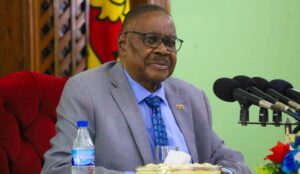
President Mutharika
He emphasises that “monetary policy cannot succeed in isolation” and that “without firm market regulation and law enforcement, inflation will remain structurally high, regardless of interest rate decisions”.
He concludes by stressing that restoring market integrity requires leadership and resolve: “Monetary policy cannot carry the burden alone. Fiscal discipline, market regulation, and law enforcement must work together.
“If hoarding is decisively addressed, Malawi will see lower inflation volatility, improved policy credibility, and better protection for ordinary citizens, to ensure a stable and inclusive economic recovery in 2026 and beyond.”


Advertisement