
* The MCP government left behind an economy characterised by unsustainable debt, chronic fiscal deficits, depleted foreign exchange reserves, and a loss of investor confidence
* Furthermore, public finances were in disarray, revenues were stagnant, and key sectors were neglected
* The kwacha had sharply depreciated against major trading foreign currencies and inflation had eroded household incomes
By Duncan Mlanjira
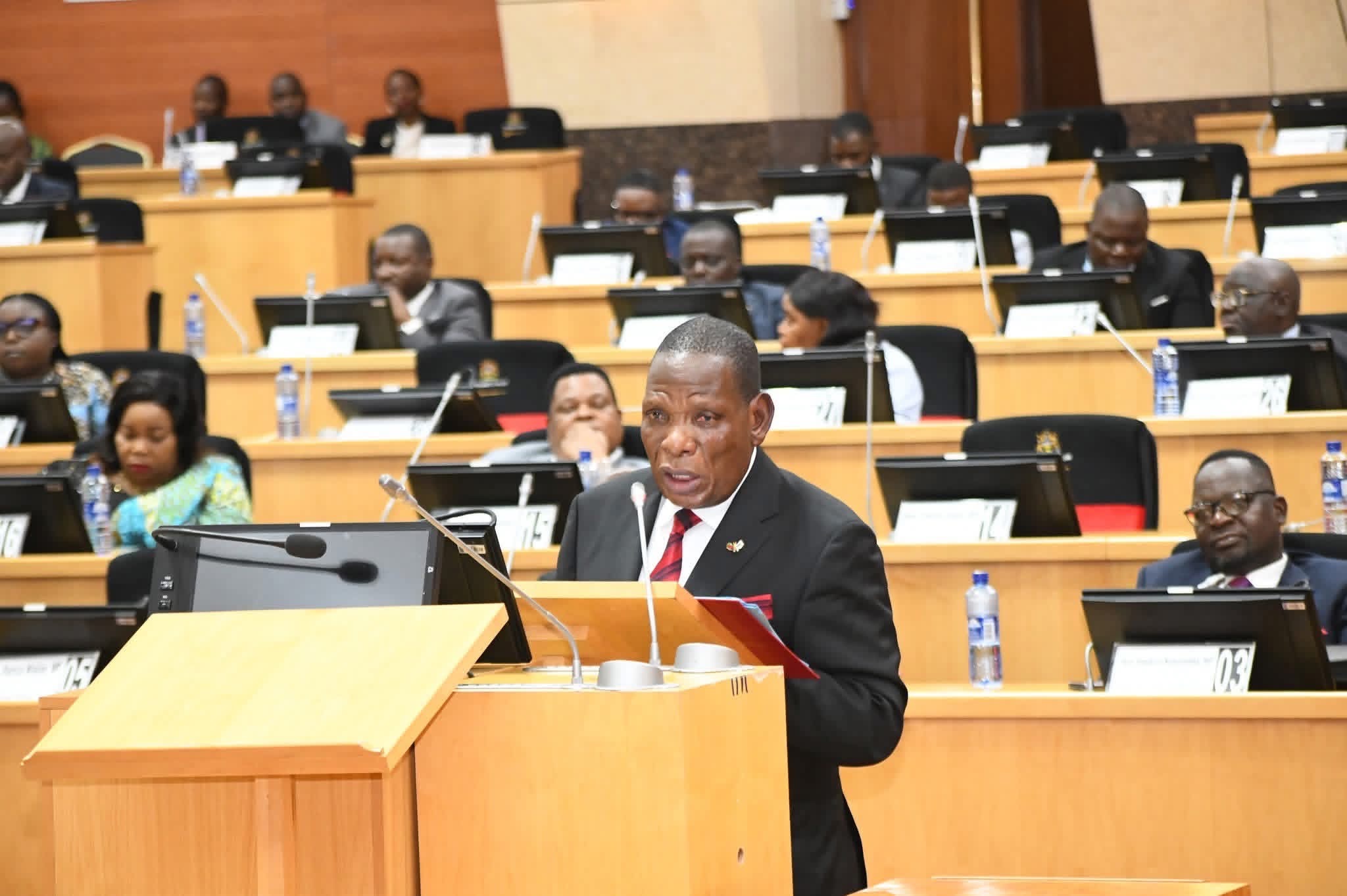
The Mid-Year National Budget review which Minister of Finance, Economic Planning & Decentralisation, Joseph Mwanamvekha presented in Parliament today, outlines several levies as part of revenue enhancement measures on tax and non-tax revenue for the remainder of the year and beyond.

Advertisement
The Minister highlighted that the measures have been instituted to stabilise public finances and rebuild fiscal space, saying the President Arthur Peter Mutharika administration “found the economy in an exceptionally fragile state”.
“The Malawi Congress Party (MCP) Government left behind an economy characterised by unsustainable debt, chronic fiscal deficits, depleted foreign exchange reserves, and a loss of investor confidence.
“Furthermore, Mr. Speaker Sir, public finances were in disarray, revenues were stagnant, and key sectors were neglected. The kwacha had sharply depreciated against major trading foreign currencies and inflation had eroded household incomes.
“The fiscal space was effectively closed, leaving Government unable to meet even the most basic obligations without resorting to borrowing. It is within this challenging context that this administration has been compelled to take decisive action, not out of choice, but out of need to restore stability, rebuild credibility, and place Malawi on a sustainable path of growth.”
He thus implored on fellow Members of Parliament, religious organisations, NGOs, civil society, the private sector and all the citizenry to support the measures “to secure a more resilient and prosperous Malawi”.
Income Tax Measures
* Bank transfer levy: a modest 0.05 bank transfer levy to be applied on all bank transfers both within or across banks, and will be paid by the sender.
* Mobile money transfer Levy: 0.05% levy to be applied on the transaction amount on mobile money transfers of above K100,000 to be paid by the sender.
The limit of K100,000.00 has been applied to ensure that the low-income earners are protected. This levy exists in other countries including Uganda, Zambia and Zimbabwe.
Mobile money transactions
* Limits and cash-out limits have been increased from K750,000 to K5 million per day and from K750,000 to K1 million per day, respectively. Holding limits for individuals have been raised from K1 million to K5 million.
* For merchant accounts, both the wallet holding limit and the daily mobile money transaction limit have been increased from K25 million to K50 million.

Advertisement
Pay-as-you-earn (PAYE) structure
* The zero-rate threshold increases from a monthly income of K150,000 to K170,000, thereby shielding low-income earners.
* The 25% bracket has been removed. The 30% rate will now apply on monthly incomes between K170,000 and K1.57 million.
* The 35% rate will now apply to monthly incomes from K1.57 million to K10 million, and a new 40% rate will apply to monthly incomes above K10 million per month.
Those who earn more must contribute more
* To continuing with the philosophy of ensuring that those who earn more must contribute more, the threshold for supernormal profit tax for companies will be reduced from K10 billion to K5 billion. This means company profits below K5 billion will continue to be taxed at the standard rate of 30%, while profits of K5 billion and above will be taxed at 40%.
Broadening the tax base and raising additional revenue
* The K100,000 and K500,000 thresholds for applying withholding tax on betting and lottery winnings are removed, meaning all winnings will now be taxed;
* The withholding tax rate on gambling winnings will increase from 10% to 15%; and
* The 15% excise tax applicable on gross lottery revenues will be fully enforced especially for radio stations and television stations.
Minimum Alternate Tax (MAT)
Government has also observed that some companies perpetually declare losses yet continue to operate. To ensure fairness:
* A MAT of 0.5% on turnover is being introduced. Companies will pay, either normal corporate income tax levied at 30% on profit, or 0.5% of turnover, whichever will be higher.
* To protect start-ups and small enterprises, the MAT will apply only to companies with turnover of more than K5 billion that have been operating for more than three years.
* Further, whatever amount is paid above the minimum alternative tax will be treated as a credit to be offset with future tax obligations.

Capital gains tax on shares
Previously, capital gains tax on shares held for more than one year was not being applied. However, trading in shares has become a significant income generating activity for companies and individuals.
To ensure fairness, capital gains tax will now apply on all share disposals, regardless of how long they have been held.
Landlords withhold tax enforcement
Government has observed that many residential property owners, particularly in the cities of Mzuzu, Lilongwe, Zomba, and Blantyre, collect significant rental income without paying taxes.
There is withholding tax on rental income. However, due to implementation challenges, residential property owners have not been remitting the tax to the Malawi
Revenue Authority (MRA), while most commercial property owners have been complying. Consequently, Government has directed the MRA to immediately enforce the collection of rental income tax on residential property, including a comprehensive registration exercise of landlords.
To ensure that this directive is followed without delay, ESCOM, all the Water Boards, the Malawi Housing Corporation, the City Councils and the Ministry of Lands to cooperate with the MRA in providing the necessary information pertaining to the owners of residential properties in low density areas.
Cement
Cement importation
Government is reinstating the surcharge on importation of cement at the rate of 20%.
Value added tax (VAT) measures
To strengthen revenue mobilisation and ensure that the fiscal deficit is reduced in the medium term, Government has reviewed the VAT rate. In doing so, Government took into consideration VAT rates in other countries such as Morocco and Madagascar which is at 20% and Tanzania, which is at 18%.
Accordingly, Government has decided to adjust Malawi’s VAT rate from 16.5% to 17.5%, thereby reverting to the rate that prevailed when VAT was introduced in the country.
Administrative measures on VAT
Government has noted with great concern the increasing tendency by many shops and businesses to avoid issuing VAT receipts when customers purchase goods or services.
Thus the Government will apply a heavy penalty against any shop owners or businesses found not issuing VAT receipts on their sales or services.
Tax waivers
Government has also noted with concern the growing number of requests from Government Ministries, Departments, and Agencies (MDAs), including parastatal organisations and NGOs seeking tax waivers on their procurements.
Government operates on a tax-inclusive budget and in this vein, unless a tax waiver request relates to a donation or a donor-funded project or procurement, such requests from MDAs will not be allowed.
Non-tax measures
* Motor Vehicle Accident Fund: A levy will be collected at the rate of 2% on motor vehicle insurance that will be ring-fenced to provide additional financing for the Ministry of Health.
* Visa free access to Malawi: is being revoked with immediate effect and visa application fee will apply on a reciprocity basis;
* Revenue remittance: Government will strictly enforce remittance of revenue collected by MDAs. All proceeds from asset disposal including motor vehicles should be deposited with the Treasury.
* Dividend and surplus remittance: Government will with immediate effect strictly enforce the remittance of dividend and surplus from state-owned enterprises (SOEs).


Advertisement