A conference of IMF gurus
* He contends that the IMF didn’t impose conditions on Malawi — but rather negotiated and needed assurance from the MCP-led Government on areas of fiscal discipline, among other terms
* President Lazarus Chakwera then signed up to an agreement in 2023 because they were desperate for forex and donor confidence — and thus the same Chakwera administration cannot blame IMF on not meeting targets of the very terms it agreed to
By Duncan Mlanjira
The statement that has been circulated widely on social media, purportedly coming from Malawi Congress Party (MCP)-led “propaganda machinery” around the suspension of the extended credit facility (ECF), has been observed as clearly demonstrating State authorities’ “love for power against the wishes of the nation”.

Advertisement
This is contended by South Africa-based Malawian Chief Economist, Chifipa Mhango in reaction to the statement issued yesterday, that claimed it was the decision of the Malawi Government “to mutually suspend the ECF with the International Monetary Fund (IMF)” saying it “is not just a technical economic shift [but] a bold and people-centered policy stance”.
The statement commended Minister of Finance, Simplex Chithyola Banda, saying it was his “steady leadership and principled negotiation have ensured that Malawi does not bow to pressure that undermines the dignity and welfare of its citizens”.
“This is a clear signal that the Malawi Congress Party (MCP)-led government is prioritising the needs of Malawians over the demands of external financiers whose conditions often hurt more than they help,” said the statement.
“Contrary to alarmist narratives pushed by some opposition figures, Malawi has now run eight months without the ECF, and the sky has not fallen. In fact, we are witnessing the gradual stabilisation of key sectors, renewed focus on domestic revenue mobilization, and a deliberate effort to protect vulnerable citizens from the economic pain that IMF conditions had inflicted.
“The opposition’s claims that suspending the facility is a sign of economic mismanagement are not only misleading — they lack logic and historical honesty.”

But the Chief Economist, who is Director of Economic Research & Strategy for South Africa’s Don Consultancy Group (DCG), contends that the IMF “didn’t impose conditions on Malawi — but rather negotiated and needed assurance from the MCP-led Government on areas of fiscal discipline, among other terms”.
He added that President Lazarus Chakwera “then signed up to an agreement in 2023 because they were desperate for forex and donor confidence — and thus the same Chakwera administration “cannot blame IMF on not meeting targets of the very terms it agreed to”.
“It better to admit that the administration of President Chakwera has failed dismally in the implementation of right policies to support forex generation, among others, but also fiscal discipline, with excessive expenditure patterns.

Revered Chief Economist Chifipa Mhango
“Countries like Rwanda went through tough IMF reform and achieved the targets well. President Chakwera could have borrowed a leaf of lessons from the Kagane administration and fix the economy of Malawi.
“It takes fiscal discipline to manage an economy and not political propaganda machinery. It’s not easy to dispute credible data with slang tones.
“Even the propanda launched is terribly misplaced, for it’s then clear — the Chakwera administration has opted for short-term politics over long-term economic stability, and continued suffering of Malawians.
“It’s the most shameful statements to even back up — and even data cannot support such a misinformed position,” said Mhango.

Advertisement
The statement that circulated blamed the Democratic Progressive Party (DPP) administration, with Dalitso Kabambe as Reserve Bank Governor, “that the IMF was deceived with doctored figures”.
“These manipulated numbers gave a false sense of macroeconomic stability, but they masked deep structural problems that Malawians felt every day. In contrast, the current MCP-led government under President Lazarus Chakwera has chosen transparency over deception, and integrity over illusion.
“It has taken the harder, more honest path — to face the IMF with clean data and unvarnished economic realities — even if it meant walking away from conditional aid.”
The statement further accused the IMF of “not just placing tough economic conditions — it was constantly shifting its goalposts and opposing Malawi’s sovereign development agenda”.

It highlighted as that:
1. The IMF told the MCP Government to devalue the Kwacha, which it did and “the impact was devastating — prices soared and inflation deepened. But that still wasn’t enough for them”;
2. They wanted fuel prices adjusted — “we said no. Our government stood firm because Malawians were already suffocating under high transport costs;
3. They demanded electricity tariff hikes — “we said no. Raising electricity bills would have hurt both poor households and small businesses;
4. They wanted civil servants’ salaries slashed — “we said no. A government that values its people cannot punish its teachers, nurses, police officers, and other frontline workers;
5. They wanted us to freeze public recruitment — we said no. The MCP government believes that our youth deserve opportunities — not rejection;
6. They opposed key national development projects like the Magwero Industrial Park and the Lilongwe-Salima Water Project. These projects are essential for job creation, water security, and industrial transformation — but the IMF saw them as fiscal liabilities.
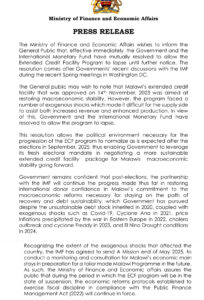
“How can we partner with an institution that sees progress as a threat, and sovereign development as a problem?” said the statement, adding that “Malawi’s break from the ECF is not a rejection of fiscal prudence, but a demand for a more humane and citizen-focused path to economic recovery.
“For once, the government has prioritised the lived realities of its people over the spreadsheets of foreign technocrats. The MCP-led government deserves credit for not taking the easy path of deception.
“Instead of ‘cooking figures’ to appease international partners — as was done under the DPP — it has been honest, accountable, and willing to own up to economic challenges.


Advertisement
“It is this integrity-driven leadership that will form the bedrock of sustainable development. We must not go back to the days of artificial statistics and cosmetic macroeconomic wins that mean nothing to the ordinary Malawian.”
The MCP-led government contends that “Malawi is not turning its back on international cooperation — it is turning its face toward its people”.
“This suspension is a reset — a chance to define our own path, embrace local solutions, and reform in a way that uplifts everyone, not just the elite.