
* Why Malawi must read South Africa’s Madlanga Commission as a warning, not a drama
Opinion by Nkhuzana Kamoto, African Politics
In Pretoria, a retired Constitutional Court justice sits in a quiet hall as a nation watches its criminal justice system unravel in public. Day after day, the Madlanga Commission of Inquiry has dragged into the light what most South Africans long suspected — that the rot in their police, their prosecution service, and even tendrils of their judiciary runs far deeper than political corruption alone.
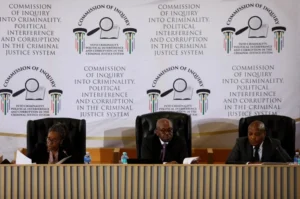
It runs through organised crime, contract killings, drug syndicates, paid-for tenders and missing dockets. And too many of the senior officers paid to fight that rot are, in fact, paid by it.
For Malawians, this should not be entertainment — it should be a mirror.
What South Africa has just exposed
The Commission was set up in late 2025 after KwaZulu-Natal Police Commissioner, Lt-Gen Nhlanhla Mkhwanazi, did the unthinkable: he held a press briefing and accused the then–Minister of Police, senior officers and intelligence officials of colluding with a criminal cartel he labelled the ‘Big Five’.
He produced documents. He produced communications. He named names. What followed has been a slow-motion exposure of a captured state.
Crime Intelligence boss, Lt-Gen Dumisani Khumalo, confirmed that organised criminal networks based in Gauteng have wormed themselves into drug trafficking, hijackings, tender fraud and contract killings — and into the very structures meant to police them.
Suspended Mpumalanga Police Commissioner Lt-Gen Daphney Manamela later went public with allegations that politicians and businessmen manipulate investigations, move dockets illegally and bribe officers.
A businessman named Vusimuzi ‘Cat’ Matlala, awarded a R360 million SAPS health-services tender in June 2024, was found to be paying off senior police officers — including a brigadier in SAPS Quality Management, who received gifts and money from him while she fast-tracked his invoices. In March 2026, 12 senior police officers were arrested over that single tender.
The most damning revelation may be the simplest. Testimony in February 2026 disclosed that 121 dockets from the KwaZulu-Natal Political Killings Task Team were quietly moved to Pretoria for what Justice Madlanga himself described as a “nonsensical” audit — and many never came back.
Cases stalled. Suspects walked. Witnesses died. Drug dealing. Cash heists. Ill-gotten contracts. Missing dockets. Whistleblower tampering. Murder; this is not the plot of a Netflix series — it is the testimony of senior officers, under oath, in a presidential commission of inquiry.

Advertisement
The Malawi mirror
Now turn to Lilongwe. In August 2025, the Malawi Human Rights Commission published the findings of a months-long inquiry into access to justice. Its language was cautious; its substance was not: “There is a widespread perception,” the report concluded, that corruption is common in the judiciary and the Malawi Police Service. It described bribes for police bail to influence outcomes, the manipulation of case scheduling, and “the stalling of cases through the disappearance of case files”.”
Specific names of suspected corrupt judicial officers were given to the inquiry. To this day, no judge has ever been disciplined for any of them.
Read that again, slowly, with South Africa in mind. Bribes to influence outcomes. Cases stalled through disappearance of files. Sound familiar?
Malawi already lives with the reality South Africa is only now confronting. Our court files do not merely vanish in low-profile matters; the Kafantayeni resentencing project, which dealt with over 150 prisoners on death row, found that the majority of their court files were missing or incomplete.
Susan Musa Namangale, a citizen who lost her driver in a 2010 road accident, has just filed yet another reminder to the Deputy Chief Justice in 2026 — fifteen years after the hearing concluded — asking, simply, for judgement to be delivered.
The young lawyer Alexious Kamangila has openly described the responsible judge as “very lazy.” That is not corruption in the dramatic sense. It is corruption in the slow, quiet, soul-killing sense — the corruption of the citizen’s ability to ever get a hearing finished.

Lawyer Kamangila
On the prosecution side, in February 2026, the Director of Public Prosecutions, on the direct instruction of the Attorney General, discontinued the K4.6 billion ESCOM prosecution against former board chair Jean Mathanga — within months of accused officials being elevated back into senior public posts.
Eleven state witnesses had already testified. The optics were unmistakable. The substance was worse.
On procurement — the most fertile ground for corruption in Malawi by the Anti-Corruption Bureau’s own admission, accounting for over 70% of all the cases the Bureau handles — companies linked to the British-Malawian businessman Zuneth Sattar, who is awaiting trial in the United Kingdom for orchestrating bribes to Malawian officials — have continued to surface in government tenders.

Zuneth Sattar
In November 2025, NOCMA proposed engaging Savari Energy DMCC, a Sattar-linked company, in a single-source US$25 million fuel deal. Single source. Twenty-five million dollars — to a company linked to a man facing trial for bribing Malawi’s own officials.
If that does not make you angry, your patriotism is asleep.
On whistleblowers, Malawi has no comprehensive Whistleblower Protection Act in force. About 80% of Malawians, by the ACB’s own surveys, are afraid to report corruption for fear of retaliation.
The country’s most prominent corruption fighter of the last decade, former ACB Director General Martha Chizuma, was herself arrested in December 2022 over a leaked recording in which she said senior figures were trying to block her work on the Sattar case.
Her contract was not renewed. Over a hundred cases she investigated may never be resolved.

Martha Chizuma
On political interference, the Malawi Law Society warned in January 2026 that politically linked arrests had quadrupled in a year, with around 60% of detainees in Lilongwe waiting more than six months for trial.
We are not five steps behind South Africa. We are perhaps two.
Why this matters for Malawi now
South Africa’s tragedy is that the rot was allowed to compound for two decades while citizens dismissed each scandal as someone else’s problem. Malawi’s opportunity — and it is closing — is that we still have the chance to act before the Big Five becomes a Malawian sentence.
The architecture of capture is already built here. We have a procurement system riddled with single-source awards. We have an ACB whose Director General is hired and fired by the State President.
We have a DPP empowered to discontinue prosecutions of the politically connected and answerable only after the fact, to a parliamentary committee. We have a police service whose own commissioners have been arrested for corruption — the Northern Region Commissioner of Police was himself charged by the ACB in March 2025.
We have a judiciary whose record-keeping is so weak that files vanish without consequence. And we have no Whistleblower Protection Act on the statute book.
What is still missing, for now, is the cartel-level violence that has made the South African case so terrifying. But the conditions for it — political party financing through tender kickbacks, weak witness protection, a culture of impunity for senior officials, a judiciary public servants no longer believe in — are all present.
South Africa shows us with terrible clarity what those conditions produce when they are left to mature.

Advertisement
What patriotism now demands
This is where the call to action begins, and it begins with us — not with government, not with donors, not with the next press release from the Office of the President.
To Parliament: pass the Whistleblower Protection Bill before this calendar year ends. Amend Section 99 of the Constitution so that a political party cannot discontinue a serious prosecution without prior judicial review.
Make the appointment of the ACB Director General subject to a transparent, parliamentary confirmation process insulated from executive whim.
To the Judiciary: digitise. Every file. Every court. Every district. Botswana did this 20 years ago through its Court Record Management System; Zambia digitised over 113,000 files in three cities by 2015 and the complaints of missing records dropped sharply.
Operationalise the Independent Judicial Complaints Committee. Discipline a judge — even one — to break the myth of untouchability.
To the ACB, DPP, PPDA, FIA and MRA: stop the turf war. Coordinate. Publish a joint annual report on cases referred, charged, prosecuted and concluded — with the names, the values, and the outcomes. Sunlight, as the saying goes, is still the best disinfectant.
To the media — Maravi Express, Nyasa Times, Times Group, Zodiak, MBC, the Platform for Investigative Journalism, the Centre for Investigative Journalism Malawi: keep naming. Keep linking. Keep counting the days a case has been pending — South Africa’s Mkhwanazi did what he did because journalists had been laying the timber for years.
To the citizen — to the teacher in Mzimba, the mechanic in Limbe, the nurse in Mzuzu, the contractor reading this on WhatsApp from a Botswana site: your patriotism is needed now — report the bribe demand at the roadblock; demand the receipt at the registry; refuse to pay the ‘facilitation fee’.
Ask your MP, in writing, what they have done about the Whistleblower Bill. Vote with your eyes open in 2030 — or earlier, if our democracy demands it.
The Madlanga Commission, in the end, is not really about South Africa — it is about what happens to any African state that allows the line between the criminal and the law enforcer to dissolve.
South Africa is paying that price now — in commissions, in billions of rands, and in a generation of lost public trust.
We can choose differently. But only if we choose now.
* Nkhuzana Kamoto writes on governance, accountability and public policy in Malawi and the-wider-African-region.

Advertisement