* The company would be allowed to resume activities but with stricter conditions this time around to avoid a relapse
* Nonetheless, presently certain activities for addressing the environmental management concerns are being carried out on the site and should not be mistaken for the company’s work resuming
By Duncan Mlanjira
Malawi Environmental Protection Authority says some notable undertakings by Presscane Ltd, demonstrate the ethanol manufacturing company’s commitment to meeting the requirements laid out in the operational Stop Order it issued in January, following environmental violations due to spillage of effluent waste from its evaporation ponds.

Advertisement
MEPA ordered the Chikwawa-based company to stop its operations due to the environmental injustice it affected the environment and people’s livelihoods around its factory at Dyeratu — in violation of Section 7 of the Environment Management Act of 2017.
In response to Maravi Express’ follow up if the conditions that were laid out in the Stop Order were fulfilled, and have been allowed to proceed with its operations, MEPA Director General, Dr. Wilfred Kadewa said Presscane has addressed all except the issue of compensation to the effluent discharge-affected households.
He indicated that “a multisectoral compensation assessment has just been conducted but the report/findings are yet to be shared with Presscane and the affected persons, as this is awaiting high level scrutiny”.
“The company is yet to receive the compensation report and would be allowed to resume activities but with stricter conditions this time around to avoid a relapse.
“Nonetheless, presently certain activities for addressing the environmental management concerns are being carried out on the site [and] should not be mistaken for the company’s work resuming.
“One of the crucial ones of this is pre-testing of the zero liquid cum fertilizer production system, which will ensure very reduced wastewater flows to the ponds as mostly the effluent will be converted to organics fertilizer.”

Dr. Wilfred Kadewa
The Stop Order also directed PressCane to submit a comprehensive Effluent Management Plan, which Director General Kadewa said was done in February, 2026 — along with structural assessment and rehabilitation of the effluent containment dams.
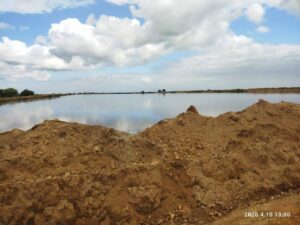
He also indicated that the directive to replace all degraded and ton pond liners has been done on the majority of the evaporation ponds, adding that the removal of accumulated sludge and stagnant effluent from the ponds, has been on-going, “but the incessant rains in the month of March affected progress”.
Also done is the directive to implement routine maintenance, establish and maintain adequate buffer zone with proactive vegetation and that other management undertakings are still underway in the evaporation ponds because of the rainfall experienced last month and “the very slow evaporation rate of the vinasse”.

Current state of some of the evaporation ponds

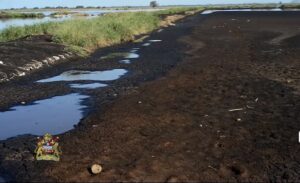
Meanwhile, Minister of Agriculture, Irrigation & Water Development, Roza Fatch Mbilizi, who rushed to the scene of the effluent spillage soon after it happened in January along with MEPA and National Water Resources Authority (NWRA), made an impromptu visit to the company a few days ago to check on how Presscane is responding to the Ministry’s instructions.
She told the media that while the company is addressing the issue to control spillage, expressed-deep-health-concerns-over-the-potassium-rich-ash-dust-coating-roofs-of-houses-at-Dyeratu-still-from-Presscanes-sludge-waste-evaporation-ponds, saying much as she is not a scientific health expert, if the house roofs and walls can be coated in black from the potassium ash dust being blown from the evaporation ponds, it is very likely people are inhaling the same into their bodies.

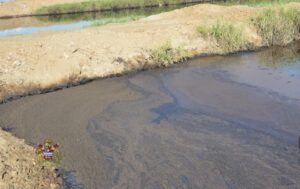
She indicated that she was also appraised by the company that the evaporation ponds are being decommissioned and that future sludge waste will be converted into compost fertilizer, since PressCane-Limited-is-in-final-stages-of-commissioning-its/fertilizer-manufacturing-plant after investing multi-billions of kwacha for Bio-digester, which is to be commissioned in June 2026.
Mbilizi applauded the company that it is in the process of turning the liquid waste it generates from the production of ethanol as a strong measure of managing the environment and at the same time providing a solution to assist Malawian farmers to access affordable farm inputs.
But she was also deeply concerned that, meanwhile, the sludge in the evaporation ponds is expected to dry up naturally through the sun’s heat in two to three years — saying that’s too long a period for people to continue suffering from the pungent smell.
She thus said she directed the company to solve the environmental crisis with speed and not wait until the natural heat from the sun to dry up the evaporation ponds; but to find the best solution to control the situation, which has affected farmers’ crops, the environment, and people’s health.