
* Basically, Section 19 of the Environmental Management Act protects members and employees of Malawi Environmental Protection Authority (MEPA) from personal liability for acts done in good faith while carrying out their official duties
* It does not mention private companies; it does not provide blanket immunity for licensees — the protection is limited to regulators acting in good faith
* It appears the wording of Section 19 of the Environmental Management Act might have been misapplied by treating it as if it shields licensed businesses from lawsuits unless bad faith is proven
Analysis by Duncan Mlanjira
PressCane Ltd, which was sued by 58 people alleging that effluent spills from its ethanol waste ponds in Chikwawa polluted their sorrounding communities’ agricultural land and damaged crops, is interpreted to have escaped the K6.6 billion compensation lawsuit based on the wording of Section 19 of the Environmental Management Act.

Advertisement
In his ruling on April 9, 2026, Justice Allan Hans Muhome indicates that Dr. Steve Kazima, Langton Benjamin and 56 others, filed a lawsuit alleging violation of their environmental rights under common law and the Environmental Management Act 2017 “but without prior proof of bad faith in the spillage”.
Section 19 of the Act states that: ‘Legal proceedings shall not be brought against a member of the Malawi Environmental Protection Authority (MEPA), the Director General or other officer of the Authority, a lead agency, an inspector, an analyst, or any other person duly authorised by the Authority, the Director General, inspector or analyst to do anything authorised under this Act, in respect of anything done in good faith in accordance with the provisions of this Act’.
The argument — according to the Judge, is “whether the conditional statutory immunity provided for under Section 19 of the Act extends to private entities such as PressCane as already held in the ‘Lastone Matthews Cases’ and by extension, whether the Lastone Matthews Cases were decided erroneously as the Court therein did not consider the ejusdem generis rule in the interpretation of section 19 of the Act”.
It was observed that “the true and correct interpretation of Section 19 of the Act is the one that was adopted in the Lastone Matthews Cases applying the Supreme Court decision (State (ex parte Aero Plastic Limited) v The Director of Environmental Affairs MSCA Civil Appeal Number 19 of 2019) to PressCane herein as private enterprise duly authorised by the Authority to do things under the Act”.
The Judge observed that the doctrine of precedent requires that court decisions remain consistent and also quoted other cases similar in nature (Verijina Lobi v Village Headman Kagwera Land Cause No. 213 of 2022; Friday Jumbe and Others v Electoral Commission Judicial Review Cause Number 38 of 2014; and Royal International Insurance Holdings v Gemini Holdings; Maunsell v Olins [1975] AC 373).
But a legal analyst observed that it appears the quoted statute might be misapplied and since the current case indicates that the doctrine of precedent requires that court decisions remain consistent, the clause should have been amended in Parliament for the law to clearly.

“What the law actually says in Section 19 of the Environmental Management Act is clear: it protects members and employees of Malawi Environmental Protection Authority (MEPA) from personal liability for acts done in good faith on behalf of the Authority.
“It does not mention companies or licensees,” says the analyst, who asked not to be identified. “Courts are bound to apply the law as written, not as they think it should have been drafted.
“What has happened in this case is that the Judge extended Section 19’s protection to PressCane Limited, a licensed private business. That interpretation goes beyond the text and spirit of the statute.
“Even if one believes the law was ‘poorly framed’, the role of the Court is to apply the statute as enacted, not to rewrite it. On the suggested ‘correct wording’ to cover inspectors, analysts, or even licensed businesses, that is a policy argument — Parliament could amend the Act to include such wording.
“But until then, the courts must apply the law as it is,” said our source, but added that in short, Section 19 of the law, in its current form, only covers MEPA officials.

“Putting it that it was ‘wrongly framed’ would not be a legal justification for expanding its scope in a judgment. That’s a matter for legislative amendment, not judicial interpretation as it has happened in this case.”
Another legal mind concurred with our analyst, saying basically, Section 19 of the Act “does not mention private companies; nor does it provide blanket immunity for licensees — the protection is limited to regulators acting in good faith.
He thus observes that in this court case, “the interpretation extends immunity beyond MEPA officials to private operators, the judge struck out claims of environmental harm because there was no ‘prior proof of bad faith’”.
“Why is this problematic; the wording of Section 19 is clear — it applies only to MEPA staff. Extending it to companies is a judicial expansion not supported by the text. If upheld, this precedent could make it harder for communities to hold businesses accountable for environmental damage, since proving ‘bad faith’ is a very high bar.”
“From the wording of Section 19, the application to a private company looks inconsistent with the law’s intent,” says our source, with a takeaway: “The spirit of Section 19 is to protect regulators, not businesses. The judgment, as reported, appears to misapply the law by extending immunity to PressCane Limited.”
The Court ruling thus bars communities that were affected by effluent spills that took place in January, which prompted protests from CSOs, intervention by the Ministry of Agriculture, MEPA and National Water Regulatory Authority (NWRA).
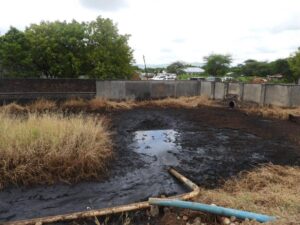

Demonstrations and a visit by Agriculture Minister Roza Mbilizi



In response, PressCane attributed the collapse of its evaporation ponds due to natural phenomenon; the persistent rains from December throughout into January that compromised the structural integrity of the ponds.
Going forward, the company announced that the liquid waste it generates from the production of ethanol will be fed into the https://multi-billion-kwacha-Bio-digester-fertilizer-manufacturing-plant-it-has-built-in-chikwawa/ — as a strong measure of managing the waste, at the same time providing a solution of bio-fertilizer to farmers in Malawi
In an interview with Maravi Express in February, PressCane’s Chief Executive Officer (CEO), Bryson Mkhomaanthu explained that the company has historically managed its liquid waste through evaporation ponds covering approximately 26 hectares.
He noted that the recent incident occurred after a section of one pond embankment failed following unusually heavy rainfall experienced in Chikwawa District and before that the evaporation ponds were being decommissioned.

CEO Mkhomaanthu
After the court ruling, CEO Mkhomaanthu told The Nation newspaper that the judgement provides clarity on the application of the environmental protection law “in circumstances involving licensed operations undertaken in good faith”.
“For PressCane, the ruling is encouraging in that it reinforces confidence in the legal framework within which regulated industries operate and affirms the importance of balancing environmental protection with lawful industrial activity, a principle the court expressly addressed.
“That said, the ruling should not be interpreted as diminishing our responsibility regarding the January 2026 environmental incident, which is a separate matter.
“Our focus remains firmly on raising the bar on compliance, remediation, rebuilding stakeholder trust and completing all actions required by regulators to support a safe and responsible return to operations,” Mkhomaanthu is quoted as saying by The Nation.

Advertisement