

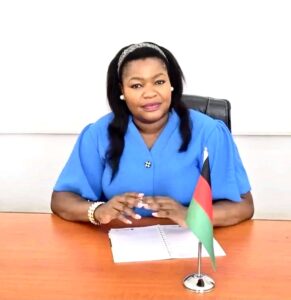
Minister Baloyi
* The inertia of the government bureaucracy is heavy; changing it’s dynamics is a Sisyphus task — you roll the boulder up the hill, only for it to roll back
* One day, the Minister should attend a work shift at a hospital, take notes of the challenges she will face as a healthcare provider and see what her Ministry can do to mitigate those problems
* Her Ministry should stop blaming healthcare professionals for what they are not doing because it’s the Ministry that is responsible for providing the same poor services
By Duncan Mlanjira
Disguised as a patient, Minister of Health, Madalitso Baloyi went undercover at Bwaila Hospital in Lilongwe on Saturday, where she experienced first hand the challenges faced by majority of poor Malawians when seeking medical services.

Advertisement
These challenges, as exposed to the Minister, include “long waiting times, alleged corruption, poor patient handling, and lack of privacy” as reported in today’s The Nation newspaper in which Baloyi is quoted as saying the findings from the visit will help inform the Ministry of Health’s efforts “to improve service delivery in public health facilities across the country”.
The public has applauded Baloyi’s effort, in which she endured what could be an agonising long wait by a genuine patient seeking immediate attention as she arrived at around 09h00 but was only attended to around 13h00.
Social media influencer Onjezani Kenani posted on his Facebook account a digital copy of The Nation’s front page and the responses were spontaneous — with Druwen Maulidi commenting: “This is good but what matters most is what happens next”, to which Golden Mwangulube responded: “The inertia of the Government bureaucracy is heavy; changing it’s dynamics is a Sisyphus task — you roll the boulder up the hill, only for it to roll back”.
Another observer indicated that “what the Minister experienced is not just happening at Bwaila, its across most hospitals in this country and getting worse. It’s very important the Minister has exposed this but what do the hospital and Ministry administration think they should be doing? We do not need a Minister to go undercover or else she has to fire the entire management.”
Indira Chikomoni suggested that the Minister should one day attend a work shift at a hospital, take notes of the challenges she will face as a healthcare provider and see what her Ministry can do to mitigate those problems.
She hinted that her Ministry should stop blaming healthcare professionals for what they are not doing because it’s the Ministry that is responsible for providing the same poor services; “Re-direct your focus, madam Minister — the hospital needs adequate health personnel and infrastructure which will in turn yield positive patient experience
“Your Ministry is responsible for providing training to healthcare professionals on customer care. If you don’t train your employees, don’t come complaining — you are the employer, don’t blame the employee,” observed Chikomoni.
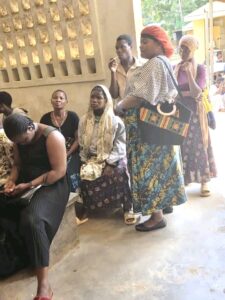
The Minister in disguise at Bwaila Hospital
The Minister is quoted in The Nation as saying her experience at Bwaila Hospital gave her valuable insight into what many Malawians go through when seeking healthcare services in public hospitals.
She disguised herself as a regular patient wearing a red head wrap (duku), a simple dress with a chitenje, and poor woman’s shoes, Sofia, in order to blend in with other patients arriving at the facility.
Upon arrival at the hospital gate, The Nation reports, a security guard asked “in the usual aggressive informal tone patients often encounter” and when informed that she had visited to seek medical help, “the guard handed her a piece of paper with the number 205, indicating her position in the queue”.
According to the Minister, the guard allegedly suggested that if she wanted to be attended to more quickly without waiting in line, she could pay K10,000, which she reportedly declined and proceeded through the normal process.
At the reception desk, the receptionist asked her to buy a health passport since the Minister indicated she did not have one. She proceeded to buy the health passport, registered it under the name Mercy Banda, indicating she was born on October 12, 1986 and lived in Kandikole, Area 36 in Lilongwe.
After registration, she joined the queue to see a clinician and while she was waiting, she observed several concerning practices — “that some clinicians were speaking harshly to patients, while others were reportedly allowing certain individuals to jump the queue after paying K10,000”.
“In one instance, a patient who complained of not being treated right was told: “ngati mukuzimva kulemera, mupite ku Mwaiwathu (visit a private hospital if you believe you have extra money to spend”).

Advertisement
The Minister also expressed concern to The Nation “about the lack of privacy in consultation rooms, explaining that up to 10 patients were brought in at the same time and asked to explain their medical problems in front of one another”.
“According to her observations, the clinician was often writing prescriptions or notes before patients had fully explained their symptoms. In her own case, she said that before she could fully describe her condition, which involved stomach pains, the clinician had already written a request for a malaria test.”
The Minister thus indicated to The Nation that the experience at Bwaila — the long waiting times, alleged corruption, poor patient handling, and lack of privacy — “will help inform efforts to improve service delivery in public health facilities across the country”.
In response to Kenani’s post, Davis Mbisa Silavwe observed that since Minister Baloyi was registered as patient No. 205 at 9:00am and was only attended to after 1:00pm, the solution is to “employ more staff and create more prescription rooms”.
Otherwise, he observed, having over “200 patients against 1 clinician is too much for him or her [to handle]” and that good quality service cannot be expected from such huge number of patients in the out-patients department (OPD).
He indicated that it means the clinician first has to record every patient’s medical history before conducting physical examination, referring for lab investigation and later diagnosis. This process can take up to one hour per patient, which means and that over 205 patients is over 205 hours.
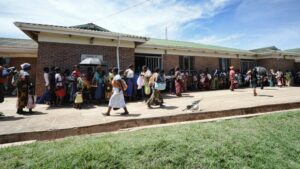
Congestion at a health facility
Melos Magulula opined that the Minister’s investigation “is biased — she never [first] explored the challenges health workers are facing” because 1 heath worker cannot be expected to handle over 200 patients, each with a different story and expected to give them equal service — “she should address shortage of staff, increase infrastructure, promote health workers training, and even the equipment itself”.
Pangani Lapani observed that “each health facility has a catchment population as defined by the National Statistical Office (NSO), which helps estimate targets for services such as OPD and guides the allocation of resources, including health workers”.
“However, while some facilities face real resource shortages, others may actually have adequate resources but struggle due to poor planning, weak supervision, low motivation, or inefficient use of staff and systems.
“These gaps often lead to overcrowding, long waiting times, and practices that can compromise ethical standards of care. It is, therefore, important for the Ministry of Health to also review and strengthen facility-level management, accountability, and patient flow systems so that available resources are effectively used to meet the demand.
“Overall, the Minister appears to be on the right track, but improving operational efficiency at facility level will be key to achieving better service delivery,” said Lapani.
Olivia Oreanor agreed to this, adding that the solution is to provided adequate medical staff and supplies in government facilities alluding to that the Minister’s undercover visit can be construed as “witch hunting” which cannot “bring good services in public facilities [but] actually worsen it than doing in a direct approach”.
Charity Malinda also observed this undercover tactic as being “all games and play until [the Minister] does something about it”, while asking: “Are they going to employ more people? Are they going to construct more consultation rooms to provide for the privacy?”
Bright Gondwe did not believe the Minister should be applauded for her approach, saying this is not news “for any true Malawi who has walked the paths of the commoner. The trend has been there since time immemorial — The Minister justed wanted to prove a point”.
Michael Nkhwazi observed that the problem is that government staff are never disciplined them when they underperform yet these personnel “apply for the jobs they now hold — it’s not like government begged them to provide their services,” he said, while indicating that these are the same employees who go on demonstrations when the government does not create jobs for them.
Itayi Claude Chidzero described Minister Baloyi’s patience as amazing, saying waiting for that long indicates “she has a heart to change things indeed”, while Alain Kay suggested that it would be efficient to “just install cameras in all public institutions — that’s one way Rwanda delt with corruption in public service delivery”.
William Chirwa further suggested that the Anti-Corruption Bureau (ACB) can take a leaf of Minister Baloyi’s undercover tactic by infiltrating in government contracts’ biddings with covert law enforcement agents to monitor how corruption is systematically organised.

Advertisement