
* As SADC’s emergency operations centre amplifies preparedness and response for anticipated associated heavy rains
* Member States at risk are Madagascar, Comoros and Mozambique and indirectly Malawi, Zimbabwe and Zambia
* Malawi’s DoDMA also issues precautionary measures for reducing remnants of CHIDO’s impact
By Duncan Mlanjira
SADC’s Humanitarian & Emergency Operations Centre (SHOC) has amplified preparedness and response for Tropical Cyclone CHIDO that has developed on the Indian Ocean, alerting that the system has intensified further to an intense tropical cyclone of category 4 from a scale of 1 to 5’.

Advertisement
In an advisory issued yesterday, December 12, SADC-SHOC says based on the analysis of the tropical cyclone and heavy tainfall advisory (TC-Advisory Number 03) issued by the SADC Climate Services Centre, for the Southwest Indian Ocean, Cyclone ‘CHIDO’ was progressing westward over the South Western Indian Ocean basin.
“The system is currently located approximately 700km off the coastline of Madagascar,” says the statement, adding that at 0600 UTC yesterday, TC ‘Chido’ has recorded maximum sustained surface winds of 190km/h with gusts of up to 240km/h.
Thus it has intensified further to an intense tropical cyclone (category 4 from a scale of 1 to 5).

“Further analysis depicts that TC Chido is expected to directly affect Northern Madagascar, Comoros and later Mozambique. Heavy to very heavy rainfall, strong winds, rough to very rough seas and storm surges are expected.
“Other parts of the SADC region also expected to receive heavy rainfall associated with this system that includes Malawi, Zimbabwe and Zambia. On the other hand, Angola, Botswana, DRC, eSwatini, southern parts of Tanzania and northern western parts of South Africa are also expected to receive heavy rainfall due to other weather systems within the period.”

Advertisement
The SADC-SHOC thus urges Member States on:
Risk monitoring: to closely monitor official weather updates and bulletins from their national meteorological and hydrological centres and relevant authorities;
Public awareness campaigns: Appropriately package and disseminate timely and accurate information to different stakeholders for decision making and the public through official channels to keep communities informed and well prepared;
Infrastructure resilience: Strengthen infrastructure resilience in vulnerable areas, including reinforcing shelters and critical facilities;
Emergency communication protocols: Members States are encouraged to review and reinforce emergency communication protocols to ensure efficient information flow during critical times.
Anticipatory measures
Early evacuation planning: National Disaster Management Authorities and Coastal Agencies are encouraged to activate their evacuation plans, ensuring efficient and safe evacuation procedures are in place;
Preposition emergency supplies: Member States are encouraged to stock essential emergency supplies and ensure readiness to provide timely assistance to populations likely to be affected;
Emergency communication: Members States are urged to ensure communities at risk are well informaed of the immediate danger due to the forecasted event(s).
Community training and drills: National Disaster Management Authorities are encouraged to conduct community training and drills to enhance public readiness and response capabilities.
On Transboundary Early Warning Systems, the SADC-SHOC also expects Member States to share information and feedbacks “to improve the coordination of early warning systems and ensure timely and accurate information dissemination across borders”.
Next update from the Humanitarian & Emergency Operations Centre will be issued “as and when there is an evolution of the tropical system over the South-Western Indian Ocean basin”.
Meanwhile, in a statement issued today, Malawi Department of Disaster Management Affairs (DoDMA) emphasised that it is treating with urgency the warning from the Department of Climate Change & Meteorological Services (DCCMS).
The DCCMS issued alerts right from when tropical storm CHIDA was developing in the Indian Ocean on Tuesday and yesterday also issued an update that CHIDO had developed into a severe tropical cyclone.
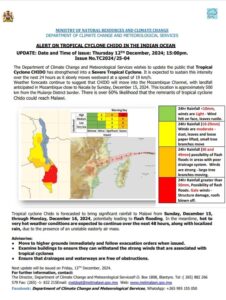
DCCMS reported yesterday that CHIDO was moving westwards at a speed of 19km/h and is expected to make landfall on Sunday, December 14 near Nacala in Mozambique — slightly over 500km from Mulanje border.
There is a 60% likelihood that the cyclone’s remnants could reach Malawi and trigger heavy rainfall and floods in some parts of the country from Monday, December 15-16.
In view of the foregoing, DODMA is advising the general public to take the following precautionary measures to save lives:
1. Move to safer and higher areas as a matter of urgency;
2. Follow weather updates through various communication channels and platforms;
3. Avoid crossing flooded rivers and walking through running water;
4. Stay away from power lines and electrical wires and report about fallen power lines to authorities;
5. Do not attempt to save personal property at the expense of lives;
6. Move and store essential property in safe higher grounds; and
7. If you can manage, provide first aid treatment to the injured, those in shock and call for medical help.

Advertisement
DoDMA assures the public that they treating the Cyclone CHIDO warning with urgency and apart from alerting District Councils, DoDMA “has activated all clusters (sector working groups) for swift preparatory and anticipatory actions”.
“DoDMA has also made standby arrangements for the deployment of a search and rescue team comprising the Malawi Defence Force (MDF), the Marine Department of the Malawi Police Service (MPS) and the Malawi Red Cross Society.
“The department is also working with DCCMS and councils in disseminating early warning messages and raise awareness on the looming cyclone.
“Councils in disaster-prone areas have been called upon to alert area and village disaster risk management committees to further alert and assist vulnerable communities to move to nearby evacuation centres. “Councils are further advised to alert the department at the earliest opportunity in the event that communities are affected by the storm,” said the statement issued today by DoDMA’s Commissioner for Disaster Management Affairs, Charles Kalemba.
And for more information, the public is encouraged to contact DoDMA’s Principal Information Management and Public Relations Officer, Chipiliro Khamula on 0999 043 228 or 0884 572 844, email, info.dodma@dodma.gov.mw.


Advertisement