

US Secretary of State Marco Rubio
* Any disruption to the supply of oil would have profound consequences for the world economy
* China in particular is the world’s largest buyer of Iranian oil and has a close relationship with Tehran
* Oil prices rose following the US attack on Iranian nuclear sites, with the price of the benchmark Brent crude reaching its highest level in five months
By Adam Hancock, BBC News & John Liu and Chris Isidore, CNN
US Secretary of State Marco Rubio has called on China to prevent Iran from closing the Strait of Hormuz, one of the world’s most important shipping routes.

Advertisement
His comments came after Iran’s state-run Press TV reported that parliament had approved a plan to close the Strait but added that the final decision lies with the Supreme National Security Council.
Any disruption to the supply of oil would have profound consequences for the economy. China in particular is the world’s largest buyer of Iranian oil and has a close relationship with Tehran.
Oil prices rose following the US attack on Iranian nuclear sites, with the price of the benchmark Brent crude reaching its highest level in five months.
“I encourage the Chinese government in Beijing to call them [Iran] about that, because they heavily depend on the Straits of Hormuz for their oil,” Rubio had said in an interview with Fox News on Sunday.
“If they [close the Straits]… it will be economic suicide for them. And we retain options to deal with that, but other countries should be looking at that as well. It would hurt other countries’ economies a lot worse than ours.”

Gas pumps
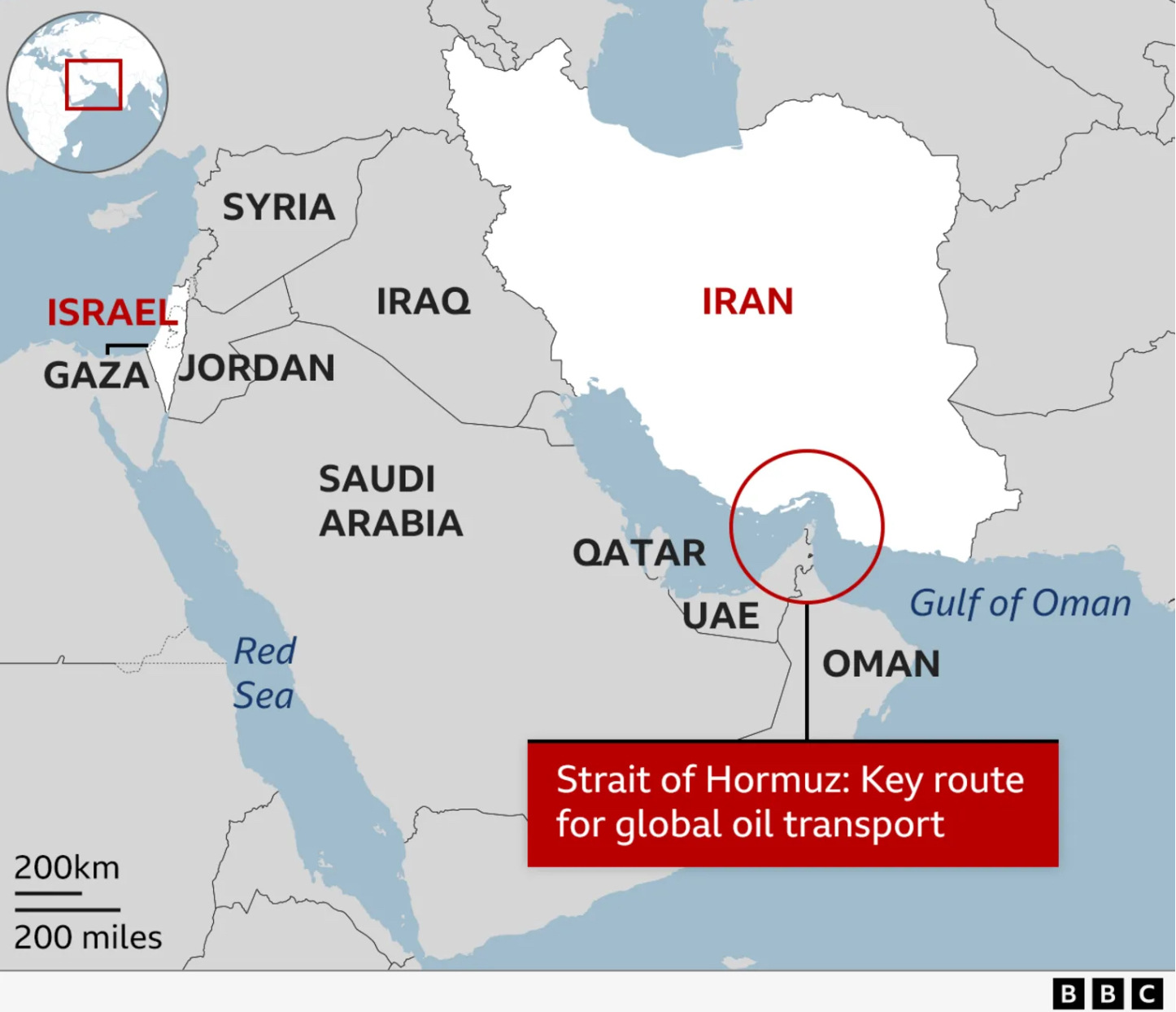
Around 20% of the world’s oil passes through the Strait of Hormuz, with major oil and gas producers in the Middle East using the waterway to transport energy from the region — and any attempt to disrupt operations in the Strait could send global oil prices skyrocketing.
Oil prices jumped briefly when trading began today, with Brent climbing to US$81.40 a barrel. However, it then slid back to around US$76.30, below where it had started the day.
In a post of his Truth Social platform today, US President Donald Trump said: “EVERYONE, KEEP OIL PRICES DOWN. I’M WATCHING! YOU’RE PLAYING RIGHT INTO THE HANDS OF THE ENEMY. DON’T DO IT!”
President Trump
Saul Kavonic, head of energy research at MST Financial, said: “The US is now positioned with an overwhelming defence posture in the region to be prepared for any Iran counter-attacks. But the risk for oil prices is the situation could escalate severely further.”
The cost of crude oil affects everything from how much it costs to fill up your car to the price of food at the supermarket. China in particular buys more oil from Iran than any other nation — with its imports from Iran surpassing 1.8 million barrels per day last month, according to data by ship tracking firm Vortexa.
Other major Asian economies, including India, Japan and South Korea, also rely heavily on crude oil that passes through the Strait.
Energy analyst Vandana Hari has said Iran has “little to gain and too much to lose” from closing the Strait: “Iran risks turning its oil and gas producing neighbours in the Gulf into enemies and invoking the ire of its key market China by disrupting traffic in the Strait,” Hari told BBC News.

US’ Operation Midnight Hammer
The US joined the conflict between Iran and Israel over the weekend, with President Trump saying Washington had “obliterated” Tehran’s key nuclear sites.
However, it is not clear how much damage the strikes inflicted, with the UN’s nuclear watchdog saying it was unable to assess the damage at the heavily fortified Fordo underground nuclear site. Iran has said there was only minor damage to Fordo.
Trump also warned Iran that it would face “far worse” future attacks if the country did not abandon its nuclear programme.
On Monday, Beijing said the US strikes had damaged Washington’s credibility and called for an immediate ceasefire.
China’s UN Ambassador Fu Cong said all parties should restrain “the impulse of force… and adding fuel to the fire”, according to a state-run CCTV report.

In an editorial, Beijing’s state newspaper Global Times also said US involvement in Iran “had further complicated and destabilised the Middle East situation” and that it was pushing the conflict to an “uncontrollable state”.
From the perspective of the global economy, there are few places as strategically important — the waterway, located between the Persian Gulf and the Gulf of Oman, is only 21 miles wide at its narrowest point.
It’s the only way to ship crude from the oil-rich Persian Gulf to the rest of the world, which Iran controls its northern side.
About 20 million barrels of oil, about one-fifth of daily global production, flow through the strait every day, according to the US Energy Information Administration (EIA), which called the channel a “critical oil chokepoint.”
According to Refinitiv data, this the first time that Brent crude, the global benchmark, briefly surged above US$80 per barrel since January following US air strikes on the three of Iran’s nuclear facilities. Before the conflict, prices had largely hovered between US$60 and US$75 a barrel since August 2024.

But in Monday trading in European and US markets, both Brent and US benchmark WTI were down more than 6%, falling below US$71, following an Iranian attack on US bases in Qatar and Iraq that appeared to result in no casualties.
Whether oil prices will climb further now depends on Iran’s response. Rob Thummel, senior portfolio manager at energy investment firm Tortoise Capital, told CNN that a potential disruption to the Iran-controlled sea route would cause oil prices to surge toward US$100 per barrel.
That would be the highest price for oil in about three years, since soon after the start of sanctions on Russia following its attack on Ukraine.
President Donald Trump does not want to see a similar the spike in oil and gasoline prices as the one that occurred after Russia’s 2022 invasion of Ukraine. He has frequently bragged about oil prices since he took office, and the even lower price for oil during his first term, although the latter was largely caused by the pandemic crashing demand for oil.
A prominent adviser to Iran’s supreme leader, Ayatollah Ali Khamenei, has already called for the closure of the Strait, saying a functioning Strait of Hormuz is “absolutely essential” to the health of the global economy.

Supreme Leader Ayatollah Ali Khamenei
“Following America’s attack on the Fordow nuclear installation, it is now our turn,” warned Hossein Shariatmadari, the editor-in-chief of the hardline Kayhan newspaper, a well-known conservative voice who has previously identified himself as a “representative” for Khamenei.
Geographic leverage over global shipping gives Iran the “capacity to cause a shock in oil markets, drive up oil prices, drive inflation, collapse Trump’s economic agenda,” Mohammad Ali Shabani, an Iran expert and editor of the Amwaj news outlet, told CNN.
In addition, Iran’s Parliament approved a motion to close the Strait. But a final decision on the matter rests with the nation’s Supreme National Security Council.
White House Press Secretary Karoline Leavitt on Monday warned Iran against closing the Strait of Hormuz: “I can assure you, the administration is actively and closely monitoring the situation in the Strait of Hormuz, and the Iranian regime would be foolish to make that decision,” she said.

The United States already produced a world record amount of oil last year, about 13.2 million barrels a day on average. But it doesn’t have the ability to fill the gap if 20 million barrels a day can no longer flow through the strait.
Two supertankers, each capable of hauling about 2 million barrels of crude, headed through the Strait of Hormuz at the mouth of the Persian Gulf, having performed U-turns in the past 24 hours, according to a report from Bloomberg that was confirmed by CNN — but most traffic appears to be moving normally for now.
The Joint Maritime Information Centre, a global maritime body, issued an alert Monday, saying that ships are already being hit by “persistently higher levels of electronic interference,” affecting satellite navigation systems.
“Some vessels have chosen to sail through the SoH during daylight hours,” said the alert. “Furthermore, JMIC has observed increasing ship congestion near Dubai and in the southern Gulf of Oman, most likely due to waiting for orders.”
Maersk, one of the world’s largest shipping lines posted a statement early Monday saying that “at the moment, we continue to deem sailing through the Strait of Hormuz possible, but we monitor the situation closely and have contingency plans in place should the situation change in the near future”.

US-Israel relation
When it comes to moving oil, the Strait is actually much narrower than its 21-mile official width. The navigable shipping lanes for massive supertankers are only about two miles wide in each direction, requiring vessels to pass through both Iranian and Omani territorial waters.
China, the largest buyer of Iranian oil, sourced 5.4 million barrels per day through the Strait of Hormuz in the first quarter this year, while India and South Korea imported 2.1 million and 1.7 million barrels per day, respectively, according to the EIA’s estimates.
In comparison, the US and Europe imported just 400,000 and 500,000 barrels per day, respectively, in the same period, according to the EIA — but crude oil is a globally traded commodity, and price changes in one place affect prices everywhere.


Advertisement
At a regular Foreign Ministry press conference on Monday, China stressed the importance of the Persian Gulf and its surrounding waters for international trade, saying that maintaining security and stability in the region serves the common interests of the international community.
“China calls on the international community to step up efforts to promote de-escalation of the conflict and to prevent regional turmoil from exerting a greater impact on global economic development,” Foreign Ministry spokesperson Guo Jiakun said.
On Sunday, India’s Minister for Petroleum and Natural Gas Hardeep Singh Puri sought to reassure jittery investors on X that the country has “diversified” its oil supplies in the past few years.
“A large volume of our supplies do not come through the Strait of Hormuz now. Our Oil Marketing Companies have supplies of several weeks and continue to receive energy supplies from several routes,” he said. “We will take all necessary steps to ensure stability of supplies of fuel to our citizens.”—Additional reporting by John Towfighi, Nadeen Ebrahim & Rhea Mogul, CNN; edited by Maravi Express
