
* Under theme: ‘Do Not Turn Away the Stranger’—Leviticus 19:33-34
* Takes a swipe at the South African government that from every grievance the citizens attribute to the attacks on foreign nationals, there is a single thread: the absence of the State
By Duncan Mlanjira
South African Council of Churches (SACC) has issued a Pastoral Letter condemning “the aggression and attacks against foreign nationals, many of whom are Africans” and appeals to Christian faithful and the whole citizenry “for a compassionate heart”.
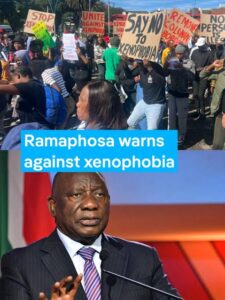
“Across our land; in KwaZulu-Natal, in Gauteng, in the Free State and in the Western Cape, a wave of hostility, intimidation, and violence has risen against our brothers and sisters from other countries living among us,” the letter in preamble.
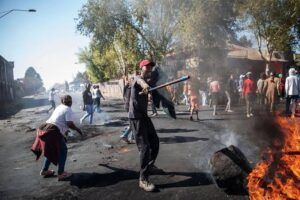
“What began as growing tension and organised protest has, in some instances, resulted in injury and the tragic loss of life, drawing concern from across the African continent.
“As the Church of Jesus Christ in this country, drawn from many traditions but united in one Lord, we cannot keep silent. We are compelled by the Gospel to speak and to act, and we draw our appeal from the Word of the Lord: ‘The foreigner residing among you must be treated as your native-born. Love them as yourself, for you were foreigners in Egypt’. — Leviticus 19:34.
The Council indicates that it has received numerous reports from church leaders brought together from across the provinces, highlighting “a troubling and consistent picture” that emerges.
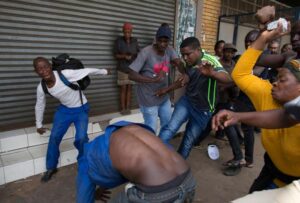
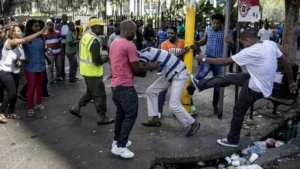
“Since the middle of April, organised hostility has spread from province to province; first becoming visible in KwaZulu-Natal, then in Pretoria and Johannesburg, and reaching Cape Town and other centres.
“Movements that style themselves as defenders of citizens have mobilised marches, raids, shop closures, and so-called citizens’ arrests against those they brand as ‘undocumented’.
“Much of this has been driven by a widely circulated and inflammatory public rhetoric, arbitrary deadlines, misinformation and panic.
“The human cost is already grave. In KwaZulu-Natal alone, our leaders reported some 2,000 affected migrant families, hundreds displaced and homeless, and around a thousand local families whose livelihoods have also been harmed.”
The Pastoral Letter further highlights that foreigners have been driven from their homes, their shops raided and they lack food, blankets, shelter, clean water, medical care — including treatment for chronic conditions such as HIV, high blood pressure, and diabetes and trauma counselling.

Advertisement
Listening before we speak
The Church Council explains it has taken long to react to what is happening in that country, saying: “It would be easy, and it would feel righteous, to condemn those who march and call on them to say no more — but we have come to believe that this is not enough and may even be a failure of pastoral charity.
“If we denounce the anger without listening to the reasons given for it, we shall not be heard by those who hold it.
“We must also remember that many who march and protest are not strangers to us, but members of our own congregations, who worship with us on Sundays and who raise genuine concerns that weigh heavily on their lives.
“To dismiss their grievances unheard is to drive them further into the arms of those who hide behind that anger to mask their own dereliction of duty, and who exploit it for political gain.
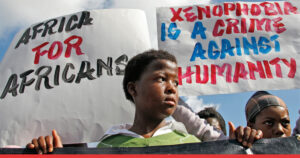
“Such grievances against foreigner nationals, some of them supported by evidence, include drug-pushing, questionable shops that sell food of poor quality and doubtful safety, (sometimes leading even to the death of children), traders who operate without permits, and the concern that money earned in the community does not stay in it.
“In the context of poor service delivery in health and education by the government, the situation is made worse with foreigner nationals also competing for the limited services available.
“Given the high rate of unemployment, there is also a perception that foreign nationals take whatever few job opportunities exist. In some areas, residents feel overtaken, with certain parts of big cities such as Johannesburg and Cape Town perceived as ‘in the hands of foreigners’ — causing anxiety and tension as communities grapple with what this means for local identity and economic security.”
The Council thus takes note that “these are not imaginary troubles — they are the daily experience of communities already stretched to breaking point, and those who raise them deserve to be heard with respect rather than lectured from a distance”.
“We acknowledge the deep frustration, exclusion and sense of abandonment experienced by many communities who feel their concerns have gone unheard for too long.

Advertisement
“Yet, having listened, we must say with equal honesty that a real grievance does not make a violent remedy right, nor a false culprit true.
“To feel genuine pain is one thing; to lay that pain at the wrong door, and then to take the law into one’s own hands, is another.”
On reflecting on the concerns and arguments raised that led to the xenophobic response, the Council took cognizance that in 2022 it made a call for a ‘National Dialogue on Foreign Nationals’, which have “neither disappeared nor diminished”.
“Through engagement with our member churches, communities, civil society organisations and affected persons across the country, we have gained a deeper appreciation of both the legitimate grievances expressed by South Africans and the complex realities facing foreign nationals living among us.
“While not every concern is supported by evidence, neither can these concerns simply be dismissed. It is, therefore, necessary to engage honestly and carefully with some of the most common arguments that continue to shape public sentiment on this matter.”
The Council thus highlights the concerns raised that include:
Foreigner nationals take our jobs — “This is a misnaming of our troubles. Our unemployment, which stands above 40%, is not the work of migrants who labour at the very margins of our economy.
“It’s true causes lie elsewhere, and we must name them in their proper order:
* First, an education system that does not equip our young people with the skills to create work for themselves, but trains them only to wait for jobs that do not exist;
* Second, the corruption that squanders the very resources and opportunities by which jobs and businesses might be created. As public money is stolen, institutions are hollowed out, and services collapse because those entrusted with them are not held to account; and
* Third, businesses that exploit foreign nationals for cheap labour, paying them a pittance precisely to avoid fair wages and labour obligations. In doing so, such businesses and employers deny decent work to locals and foreigners alike, while fueling the very resentment that turns to violence.
“To blame the stranger is to let these true culprits escape scrutiny, and to turn against the powerless an anger that ought to be directed at the powerful,” contends the Council.

Advertisement
Foreigner nationals commit crimes and push drugs — “Crime has no nationality. Where anyone, foreigner or citizen, commits a crime, let him be dealt with according to the law, as a criminal and not as a foreigner.
“But it is a slander to brand a whole people criminal for the deeds of a few, when the great majority have come among us only to live honestly and in peace. Where such crimes as drug-dealing do occur, they are very often committed hand-in-hand with our own citizens and shielded by corrupt officials.
“The answer to crime is justice applied to the guilty, never violence visited upon the innocent because of where they were born.”
Their shops sell unsafe goods, and they trade unlawfully — “Where this is true, it has a lawful remedy. Unsafe food and unlicensed trading are matters for health inspectors, licensing authorities, and municipalities, whose duty it is to enforce the regulations fairly upon every trader — citizen or foreigner.
“But none of this is answered by burning a shop or driving a family from their home; it is answered by officials doing the work we pay them to do.
“When communities are forced into the streets because the authorities have abandoned their posts, the failure belongs first to those authorities.”
The elephant in the room
The Council observes that in analysing every one of the grievances, there is “a single thread: the absence of the [South African] State”.
“Where government does not communicate clearly about who may lawfully be here and how, where borders are poorly managed, where laws and by-laws go unenforced, and corruption goes unpunished, a vacuum is created and into that vacuum step those who would turn neighbour against neighbour.
“We must also recognise that migration does not occur in isolation. Across our region, conflict, political instability, economic hardship, unemployment, environmental pressures and the search for opportunity continue to drive people from their countries of origin in search of safety and livelihood elsewhere.
“While South Africa has a responsibility to manage its borders effectively and enforce its laws fairly, it cannot sustainably address migration solely at the point of arrival.
“Unless greater attention is given to the factors that push people from their home countries and pull them toward South Africa, the pressures that communities are experiencing today will continue to recur.
“This reality calls for regional cooperation, honest dialogue among African states, and a shared commitment to addressing the root causes of migration across our continent.
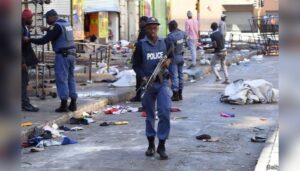
“While we welcome the recent intervention by the President and the commitments announced by government, communities remain concerned by what they perceive as a delayed and insufficient response across all spheres of government.
“We welcome commitments to strengthen border management, improve immigration administration, combat corruption, enforce labour laws and protect all who live within our borders.
“These commitments now require urgent and visible implementation if public confidence is to be restored and retained.”
The church leaders thus highlights what the Word of God their judgment in the xenophobic attacks is not their own but given to them “by the Word of God, which speaks with one voice across our traditions”.

“The Scriptures return again and again to the stranger, the sojourner, the one far from home and who commands not suspicion but love. Israel was taught to treat the foreigner as native-born, remembering its own slavery in Egypt.
“Our Lord Himself was a refugee, carried into Egypt as a child to escape the sword of Herod. He has told us, plainly and without escape, where He is to be found: ‘I was a stranger, and you welcomed me… Truly I tell you, whatever you did for one of the least of these brothers and sisters of mine, you did it for me’ — Matthew 25:35, 40.
“To attack the stranger, then, is not only to wound a fellow human being made in the image of God; it is to raise our hand against Christ Himself, who identifies with the rejected and the homeless of every age.
“No grievance, however genuine, can stand against this Word. We may be angry at our poverty; we may not make the foreigner the scapegoat for it. We may demand justice; we may not become a mob.
“As Christians in Southern Africa, we must also remember that the borders that now divide our nations are largely the product of history and colonial administration; they are not boundaries established by God.
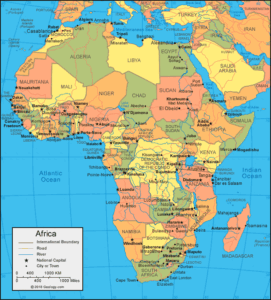
“Long before many of these borders existed, African peoples lived, traded and shared life across the continent. Even today, many of our member churches are themselves living witnesses to this reality, with congregations, dioceses, synods and members that span several countries of our region.
“The Body of Christ does not begin or end at a border post. Our shared faith reminds us that while nations may be separated by political boundaries, we remain bound together by our common humanity and by our identity as children of God.
“Pope Francis of blessed memory, who gave so much of his ministry to the cause of migrants and refugees, drew the distinction that we too must draw. He acknowledged that fear of the newcomer is a natural human feeling and not in itself a sin, but he warned us where the sin truly lies — aggression.
The Council quotes Pope Francis as he said in ‘World Day of Migrants and Refugees’ (2018), that: “The sin is to allow these fears to determine our responses, to limit our choices, to compromise respect and generosity, to feed hostility and rejection”.
The Council thus reaffirms its call to government “to move with haste in implementing the solutions outlined by President Cyril Ramaphosa”, adding that where necessary, the church leaders were ready to engage directly with the President and the relevant government departments.
“We call upon authorities to do their plain duty: to protect every person who lives within our borders, and to address the true causes of our people’s anger — unemployment, failed delivery, and corruption.
“Wage the war against lies. So much of this hatred is fed by false information spread through social media: rumours, fabricated messages, manufactured deadlines, and panic. Let us teach our people to test what they are told, to refuse to pass on what inflames, and to seek the truth.
A Word of hope
“Beloved, the scarcity in our land, bred by corruption and by the failures of leadership and management is real, and the resulting suffering of our people is real. But hardship must never drive us to react from the basest of our instincts.
“We are a resurrection people, and we are called, even in want, to respond in a manner that is humane and Christian. The stranger at our gate is not our enemy; he is our neighbour, and in him we meet our Lord.
“Finally, given that most of the foreign nationals we are turning against are fellow Africans, and that several African countries have reacted with ‘indignation’, to borrow the word of Matthew 20:24, let us ask ourselves the question that should make us think deeply and not take matters at face value: Who benefits when Africans turn upon Africans, and when the children of one continent are set against one another?
“Let us refuse to be made instruments of any division, whatever its source, that serves interests other than the Kingdom of God. Let us instead be peacemakers and so be called the children of God.”
The Pastoral Letter concludes with a verse from the Holy Bible: ‘Blessed are the peacemakers, for they will be called children of God’. — Matthew 5:9

Advertisement