

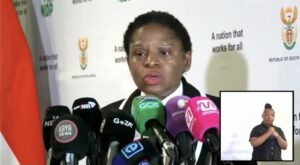
The South African government official in the video clip
* Describes the repatriation process as a humanitarian crisis not initiated by the South African government but Malawi’s
* As a Malawian national falls ill and dies on board a repatriation bus 10km from Musina processing centre
By Duncan Mlanjira
A video clip has is widely circulating that captures a South African government official in the department of communication and information addressing a press briefing, blaming Malawi High Commission of not being committed enough to help in repatriation processing.

Advertisement
The official describes the repatriation process as a humanitarian crisis not initiated by the South African government but Malawi itself, which — through the High Commission appealed for support to assist Malawians who were stranded due to xenophobic violence.
She put it on record that the repatriation was initiated by governments of affected people that included Nigeria, Ghana and Mozambique and such a process could not be completed by the foreign nations alone but in collaboration with their citizens’ host nation.
Such a process includes the protection of the rights and safety of children, saying there were instances that some of the children were born in South Africa, thus making them South African citizens.
She also indicated that some children were not being accompanied by their biological parents and could not be allowed to leave the country as per international law.
She further disclosed that citizens from the other countries were gathering at their embassies or consulates where they were being processed but Malawians gathered enmasse at South Africa’s Foreign Affairs offices.
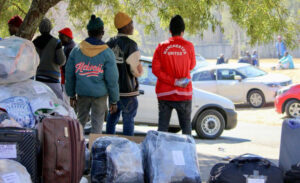
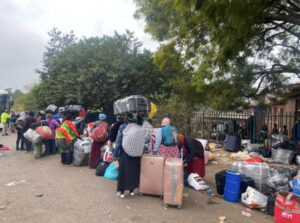
As the numbers kept rising, they were being transferred to a repatriation centres the South African government created at Musina — but officials from the Malawi High Commission were leaving the camps to go back home to sleep while their South African immigration officers kept working 24/7.
She also indicated that some of the Malawians did not have proper travel documentation and were being issued with a “collective passport” by the High Commission to allow for passage through South Africa and Mozambique.
Thus she emphasised that they had to make the clarification that the South African government did not initiate the repatriation and that while they are willing to assist in the process as smoothly as possible “to give the Malawians some decency”, they are being “hamstrung” by the slow pace of the Malawi High Commission.
“We are only responding to humanitarian crisis not of our own making but initiated by the Malawi Government,” said the official.
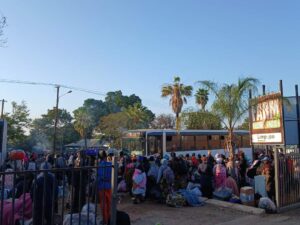
Meanwhile, South African media reported that a Malawian national fell ill and died on board a repatriation bus 10km from the Musina processing centre.
Government spokesperson William Baloyi is quoted as saying the sudden death prompted the bus driver to return to the processing centre where members of the South African Police Service (SAPS) conducted the required forensic and investigative procedures in accordance with protocols governing sudden and unexplained deaths.
“Once these processes were completed, the bus was cleared to continue its journey, allowing the remaining passengers to travel home,” Baloyi is quoted as saying.
“Government wishes to reassure the family of the deceased, the Malawian authorities and the public that all necessary processes were undertaken with the utmost professionalism, dignity and respect for the deceased.”
He added that South Africa would communicate the circumstances surrounding the death to the Malawian government through the appropriate diplomatic channels and remained ready to provide any assistance required by the deceased’s family.
The South African media report that thousands of undocumented Malawian nationals have been repatriated “as part of a nationwide immigration crackdown” and out of the 33,000 sent back to their home countries, Malawians accounting for about 90% of them — with over 7,000 Malawians were repatriated from Durban alone — quoting their country’s Home Affairs Minister Leon Schreiber.
In Johannesburg, it is reported that the Malawian consulate’s parking lot has become a shelter where repatriates sleep under the open sky with children, waiting for transport to the Lindela Repatriation Centre.

Advertisement
In his ministerial statement in Parliament on the status of repatriation of Malawians, Minister of Foreign Affairs & International Cooperation, George Chaponda reported that the sustained engagement with the South African Government has helped deportation of Malawians in South Africa to be changed to voluntary repatriation.
MBCDigital reports that according to the minister, the Department of Disaster Management Affairs (DoDMA) indicates that at least 30,000 Malawians have been repatriated as of July 6.
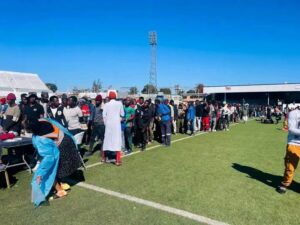
Arrival centre was Kamuzu Stadium before adding Joyce Chitsulo Stadium in Mwanza
Chaponda also indicated that the number of people who want to return home in recent weeks continue to rise and Government is steadfast to ensure every Malawian returns home safely.
At a press briefing in Lilongwe on Friday, DoDMA Commissioner Wilson Moleni indicated that more than 5,000 Malawians were staying at a camp in South Africa awaiting transport back home.
Moleni further disclosed that the Malawi authorities are also engaging the Government of Zimbabwe through relevant diplomatic channels to facilitate the return of Malawians who are stranded while transiting through that country.
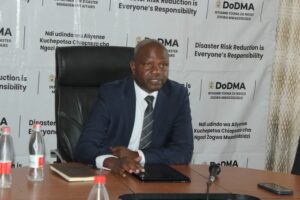
Wilson Moleni
He appealed for patience among Malawians still in South Africa, assuring them that the government remains committed to ensuring their safe return despite logistical and financial constraints.
“We ask our fellow Malawians to remain calm and patient. The government has not abandoned them. We are committed to bringing everyone home safely despite the challenges we are facing, including the unfortunate disturbances witnessed at Mwanza,” Moleni said on Friday — as reported by Malawi News Agency (MANA).
Upon arrival in Mwanza, the returnees are also processed and provided with transport assistance to their respective home districts, with those from the Southern Region receiving K70,000, the Central Region K100,000, and the Northern Region K150,000.
The government launched the voluntary evacuation programme on June 3, 2026 following rising safety concerns in South Africa, deploying free transport services to assist affected Malawians to return home safely.—Reporting for MANA by Innocent Manda

Advertisement