

* The 50+1% to take effect for the September 16, 2025 Presidential Election of the valid votes cast through direct, universal and equal suffrage
* Where such majority is not obtained by any candidate in the first poll, a second poll must be held within 60 days after the declaration of the result
* In which the candidates who obtained the highest votes cast in the first poll shall be the only candidates
By Duncan Mlanjira
Following the re-run of the Presidential Election in 2020 that disturbed the electoral calendar in which Members of Parliament (MPs) have served for six years instead of five, the Electoral Laws were amended and one part is the dissolution of the National Assembly that stands on the 23rd day of July in the fifth year after its election.

Advertisement
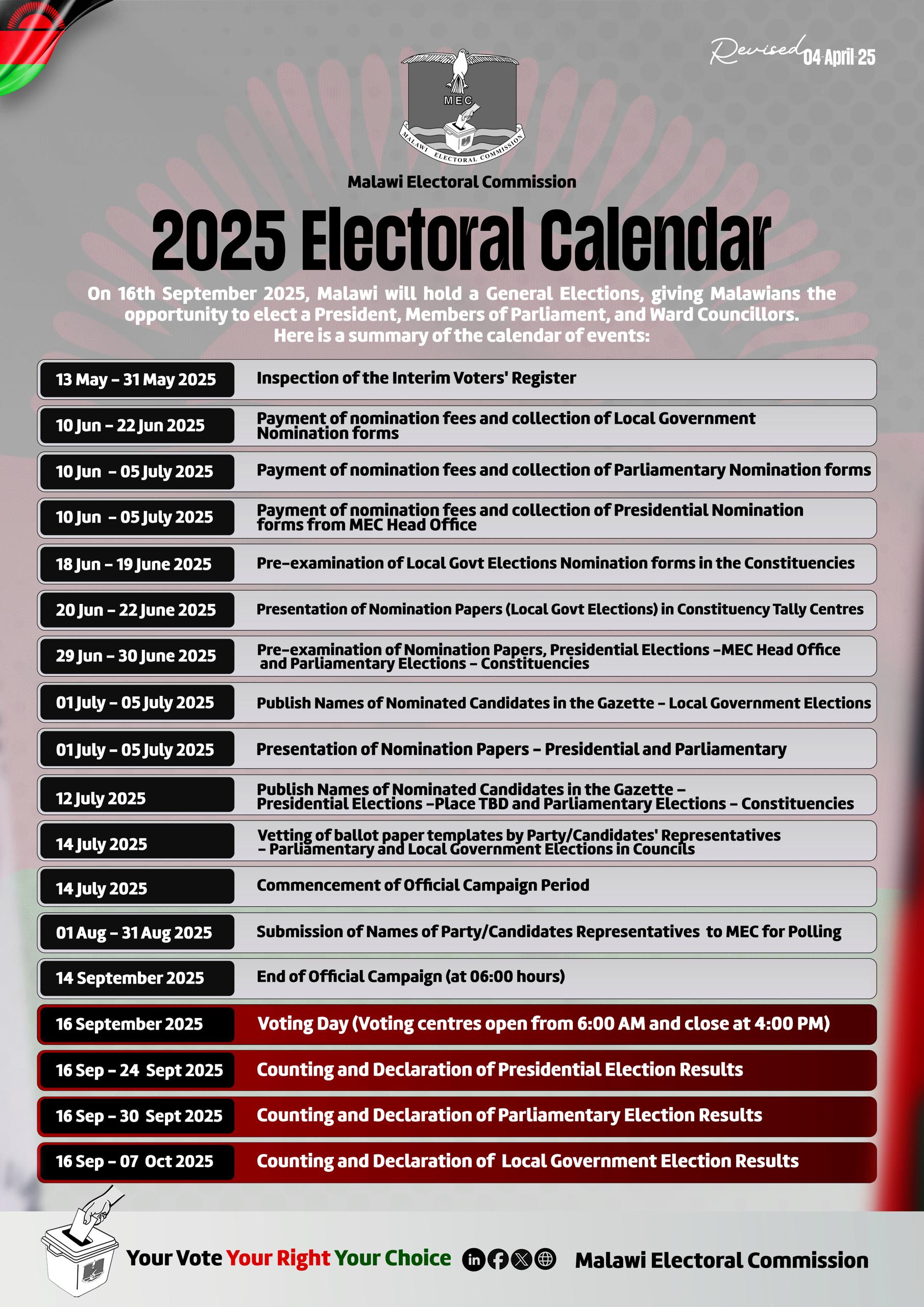
The polling day for the general elections is officially Tuesday in the third week of September of the fifth year — and meanwhile, the 50+1% of the valid votes cast through direct, universal and equal suffrage stands as official in the amended Electoral Laws for the September 16, 2025 Presidential Election.
And where such majority is not obtained by any candidate in the first poll, a second poll will be held within 60 days after the declaration of the result in which the candidates who obtained the highest votes cast in the first poll shall be the only candidates.
At a press briefing on April 30 at Bingu International Convention Centre (BICC), MEC chairperson, Justice Annabel Mtalimanja said while funds for holding a second election is not in the budget allocated for the September 16 elections, there is an assurance that the money — proposed at K97.9 billion — will be provided by the relevant offices involved.

Advertisement
The official campaign period for these general elections — of no longer than 60 days and closing 48 hours before the opening of the poll — shall start from July 14 and will close on September 14 at 06h00.
This period permits candidates and political parties to freely canvass for votes, in accordance provisions of the Political Parties Act and the rules and regulations set by Malawi Electoral Commission (MEC) in accordance with the existing electoral laws.
Also amended is the process of swearing in the elected President and First Vice-President — that they “shall not be sworn into office until after the expiry of seven days but before the expiry of 30 days from the date the election result is declared”.

Chakwera as he was being sworn in June, 2020
“A person appointed to be First Vice-President or Second Vice-President in accordance with the provisions of this Constitution, shall be sworn into office within 14 days of being appointed.”
Parliament shall make provision for holding by-elections to fill any vacancy that shall occur to be held in the next quarter of the calendar year after the seat of the member becomes vacant, or if the circumstances do not so permit, then as expeditiously as possible, but a by- election shall not be held where a vacancy occurs within 12 months before the holding of a general election.

Advertisement
The status and membership of MEC is also amended in that:
* The President shall, subject to section (75) of the Constitution and in accordance with subsections (2), (3) and (4), appoint suitably qualified persons to be members of the Commission on such terms and conditions as the Public Appointments Committee of Parliament shall determine;
* Leaders of political parties represented in the National Assembly which secured more than one tenth of the national vote in election to that Parliament, shall submit to the President a maximum of three persons as the political parties nominees as members of the Commission provided that where the President notes that all nominees used for such adequate number as is required under subsection (3), are not qualified under the Constitution for this Act to hold office as a Commissioner, the President shall return the names to nominating political parties within a reasonable time and in any event before appointing the members of the Commission and the nominating political party shall resubmit a final list of nominees within seven days of receipt of such notification;
* Upon receipt of the nominees, as provided under subsection (2), the President shall appoint members of the Commission from the nominees in proportion to the nominating political parties’ representation in the National Assembly as determined by the previous General Elections;


* In the event a vacancy in the membership of the Commission before the expiry of the term of a commissioner, the President shall notify the political party that nominated the commissioner whose office has fallen vacant to submit a minimum of three names within 14 days of the notification and the President shall appoint a Commissioner from those names within a reasonable time, provided that proviso to subsection (2), shall apply to this subsection mutatis mutandis.
* The remuneration and any allowance of a member of the Commission may not be reduced during his period of office without his consent, and may be increased at such intervals as the Public Appointments Committee of Parliament may determine.
* Subject to the Constitution, a member of the Commission may be removed from office on the grounds of (a) incompetence; (b) incapacity; (c) bankruptcy; and (d) where the member is so compromised to the extent that his or her ability to impartially exercise the duties of his or her office is seriously in question.
* A person shall not qualify for appointment as a member of the Commission under subsection (1) unless the person possesses a minimum educational qualification of a bachelor’s degree obtained from an institution recognised or accredited under the National Council for Higher Education Act.


Advertisement
Also amended is that MEC shall establish mechanisms for the provision of continuous voter education, and cause to be prepared a voter education curriculum and that a person shall not conduct voter education without being accredited by the Commission in accordance with this Act.
Any person, other than a registered political party, may apply to the Commission in the prescribed manner for accreditation to provide voter education to the general. public for or in respect of any election.
The Commission shall, in consultation with the Minister, by notice, publish in the Gazette, a code of conduct for persons accredited to provide voter education for or in respect of an election.
Where a person accredited to provide voter education fails to comply with the conditions of accreditation or the code of conduct specified in section 21 C, the Commission may, after having given the person the opportunity to be beard, cancel the accreditation concerned or suspend the accreditation until the conditions are met.
