
* While this does not imply that the economy is in crisis, it signals that macro-economic conditions remain under significant stress
* And that coordinated policy interventions are required to strengthen resilience and reduce vulnerabilities
Maravi Express
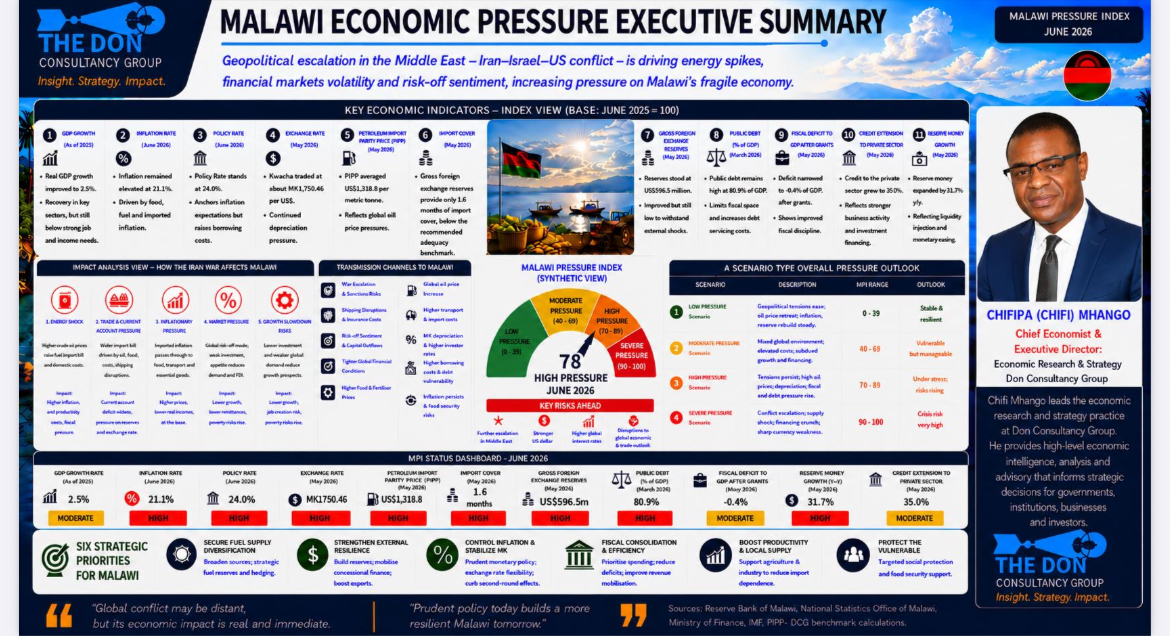
The new Malawi-Pressure-Index (MPI), which has been developed by South Africa’s Don C onsultancy Group (DCG), has been released, which indicates that Malawi has recorded a high MPI high-pressure reading of 78 — signaling rising macro-economic stress amid global uncertainty.

Advertisement
It has been developed under the leadership of Chifipa ‘Chifi’ Mhango, the DCG Chief Economist and Executive Director-Economic Research & Strategy, who reports as follows:
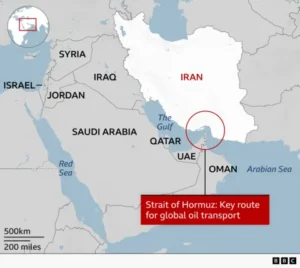
The global economy is entering one of its most uncertain periods in recent years. The escalation of geopolitical tensions in the Middle East, particularly the conflict involving Iran, Israel and the United States, has once again demonstrated how rapidly international events can transmit economic shocks across the world.
Although Malawi lies thousands of kilometres away from these events, its economy remains highly exposed through imported fuel, global commodity prices, exchange rate movements, financial markets and international trade.
Against this backdrop, DCG is proud to officially launch the Malawi Pressure Index (MPI), a new composite economic indicator designed to measure the overall level of economic pressure facing Malawi at any given time.
The inaugural MPI for June 2026 records a reading of 78, placing Malawi firmly within the High-Pressure category.
While this does not imply that the economy is in crisis, it signals that macro-economic conditions remain under significant stress and that coordinated policy interventions are required to strengthen resilience and reduce vulnerabilities.
Unlike traditional economic indicators that measure only one aspect of the economy, the MPI brings together multiple macroeconomic variables into a single, easy-to-understand measure that reflects the cumulative pressure facing the economy.
The objective is to provide policymakers, businesses, investors and development partners with a practical early-warning system capable of identifying emerging risks before they evolve into full-scale economic crises.

Advertisement
The June 2026 MPI reading reflects the interaction between domestic macroeconomic conditions and an increasingly volatile global environment.
Although Malawi continues to demonstrate resilience in several important areas, numerous indicators suggest that the economy remains vulnerable to both internal structural weaknesses and external shocks.
One of the key indicators is real GDP growth, which stood at 2.5% in 2025. This indicates continued economic activity and recovery across key productive sectors.
However, while positive growth is encouraging, the pace remains below what is required to generate the level of employment, household income growth and investment needed to transform Malawi’s long-term economic trajectory.
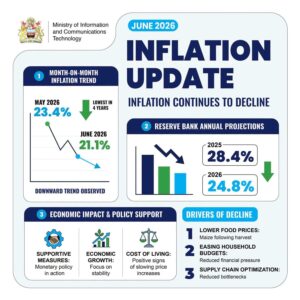
Inflation continues to be one of the most significant contributors to economic pressure. At 21.1% in June 2026, consumer prices remain elevated, reducing household purchasing power while increasing production costs across virtually every sector of the economy.
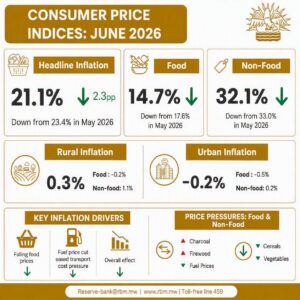
Higher food prices, fuel costs and imported inflation continue to affect businesses and consumers alike, reinforcing the need for sustained macroeconomic stability.
The Reserve Bank of Malawi (RBM) has maintained a Policy Rate of 24.0%, reflecting its commitment to containing inflationary pressures and preserving monetary stability.
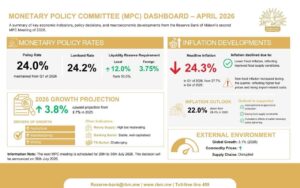
While higher interest rates are necessary to anchor inflation expectations, they simultaneously increase borrowing costs for businesses and households, potentially slowing investment, consumption and broader economic expansion.
External sector pressures remain equally significant. The Malawi Kwacha traded at approximately MK1,750.46 per US Dollar in May 2026.
Continued depreciation pressure increases the cost of imported goods, particularly fuel, industrial machinery, pharmaceuticals and agricultural inputs.
Given Malawi’s dependence on imported commodities, exchange rate movements have become an important transmission channel through which global shocks feed directly into domestic inflation.
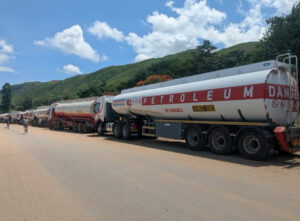
Energy prices remain another major source of economic pressure. Petroleum Import Parity Price (PIPP) averaged approximately US$1,318.8 per metric tonne in May 2026, reflecting continued pressure in global oil markets.
Higher fuel prices have direct consequences for transport costs, manufacturing, agriculture, electricity generation and virtually every supply chain within the economy.

These effects ultimately translate into higher prices paid by consumers and increased costs faced by businesses.
Malawi’s external position also remains constrained. Gross Foreign Exchange Reserves stood at approximately US$596.5 million in May 2026, providing only 1.6 months of import cover.
While reserves remain an important buffer against external shocks, the level of import cover remains below the recommended adequacy benchmark.
Limited reserves reduce the country’s ability to absorb external shocks, support exchange rate stability and finance essential imports during periods of heightened global uncertainty.
Public finances present a mixed picture. On one hand, public debt remains elevated at 80.9% of GDP as of March 2026, limiting government’s fiscal flexibility and increasing debt-servicing obligations.
High debt levels reduce the capacity of government to respond aggressively to future economic shocks while placing continued pressure on public finances.
On the other hand, the fiscal position has shown encouraging improvement. The fiscal deficit after grants narrowed to approximately 0.4% of GDP in May 2026, reflecting stronger fiscal discipline and improved fiscal management.
Although this represents a positive development, maintaining fiscal sustainability will require continued expenditure efficiency, enhanced domestic revenue mobilisation and prudent public financial management.
Monetary conditions also require careful monitoring. Reserve money expanded by 31.7% year-on-year in May 2026, reflecting significant monetary expansion within an environment of elevated inflation.
At the same time, credit extension to the private sector grew by 35.0% in May 2026.
Increased private-sector credit is generally supportive of investment, business activity and economic growth. However, continued monitoring remains important to ensure that credit and monetary expansion remain consistent with broader macroeconomic and financial stability objectives.
The current geopolitical environment has significantly amplified these domestic vulnerabilities. The conflict involving Iran, Israel and the United States has introduced additional uncertainty into international energy markets, global shipping routes and financial markets.
Rising oil prices, higher freight and transport costs, stronger United States Dollar conditions, tighter international financial markets and renewed supply-chain disruptions are all increasing the cost of doing business worldwide.
For Malawi, these developments are particularly significant because the economy remains highly dependent on imported fuel, fertilizer, machinery, pharmaceuticals and industrial inputs.
Every increase in international energy prices can eventually feed into domestic transport costs, food prices, manufacturing costs and inflation, creating a cascading effect throughout the economy.
The MPI identifies five principal impact channels through which these global developments can affect Malawi: energy shocks; trade and current-account pressure; inflationary pressure; market pressure and growth slowdown risks.
These are reinforced by shipping disruptions, higher transport and import costs, risk-off sentiment in global capital markets, exchange-rate depreciation, higher international interest rates, higher borrowing costs, food and fertilizer price pressures and tighter global financial conditions.
An MPI reading of 78, therefore, represents an economy operating under High Pressure. The MPI framework classifies readings of 0-39 as Low Pressure, 40-69 as Moderate Pressure, 70-89 as High Pressure and 90-100 as Severe Pressure.
Malawi’s current score of 78, therefore, places the economy within the High-Pressure range, but importantly remains below the Severe-Pressure threshold.
The reading reflects the combined impact of elevated inflation, high borrowing costs, exchange-rate pressure, high petroleum import costs, foreign-exchange constraints, limited import cover, significant public debt and monetary expansion — alongside heightened exposure to global geopolitical and financial shocks.
While the economy continues to function and demonstrates areas of resilience, the margin for policy error has narrowed considerably.
Without appropriate interventions, additional external shocks could further increase macroeconomic stress.
The MPI is, therefore, intended not merely as a statistical measure, but as a practical decision-making tool.
Its sources include the National Statistical Office of Malawi, Reserve Bank of Malawi, Ministry of Finance and International Monetary Fund — complemented by PIPP-DCG benchmark calculations.

Reserve Bank of Malawi
The MPI enables policymakers to monitor evolving risks, helps investors assess macroeconomic conditions, supports financial institutions in evaluating systemic risk and provides businesses with an integrated view of the broader operating environment.
Looking ahead, six strategic priorities deserve immediate attention in Malawi:
* First — securing fuel supply and diversification should remain a national priority through broader sourcing, strategic fuel reserves and appropriate hedging mechanisms;
* Second — strengthening external resilience requires continued efforts to rebuild foreign-exchange reserves, mobilise concessional finance and boost exports;
* Third — controlling inflation and stabilising the macroeconomic environment requires prudent monetary policy, exchange-rate flexibility and measures to curb second-round inflationary effects;
* Fourth — fiscal consolidation and efficiency should remain focused on expenditure efficiency, deficit reduction where appropriate and improved domestic revenue mobilisation;
* Fifth — boosting productivity and local supply requires stronger support for agriculture and industry to reduce excessive import dependence; and
* Sixth — protecting vulnerable households requires targeted social protection and food-security support to shield vulnerable communities from persistent inflation and economic pressures.

Advertisement
The introduction of the MPI represents an important contribution to economic policy analysis in Malawi.
As global uncertainty becomes increasingly frequent and interconnected, policymakers require timely, integrated and evidence-based indicators capable of identifying emerging risks before they become crises.
The MPI seeks to fill that gap by providing a comprehensive measure of economic pressure that complements existing macroeconomic statistics.
An MPI reading of 78 should, therefore, be interpreted neither as cause for alarm nor as a signal for complacency. Rather, it serves as an independent evidence-based assessment that the Malawian economy is currently operating under significant pressure but retains the capacity to improve through sound policy implementation, stronger institutions and sustained structural reforms.
Ultimately, prudent decisions taken today will determine whether future editions of the MPI record declining pressure and increasing resilience.
The challenge before Malawi is not merely to respond to today’s shocks, but to build an economy capable of withstanding tomorrow’s uncertainties.
That is precisely the purpose of the MPI — to provide a clear, objective and forward-looking guide for strengthening economic resilience and supporting sustainable national development, while also allowing for informed policy debate and serving as a public economic education tool.

Chifipa Mhango
* As Don Consultancy Group Executive Director of Economic Research & Strategy, Chief Economist Chifipa Mhango specialises in macroeconomic analysis, public policy, and governance across emerging markets, particularly in Africa. He is known for providing data-driven insights on economic trends, fiscal policy, and institutional accountability, with a strong focus on strengthening economic and governance frameworks

Advertisement