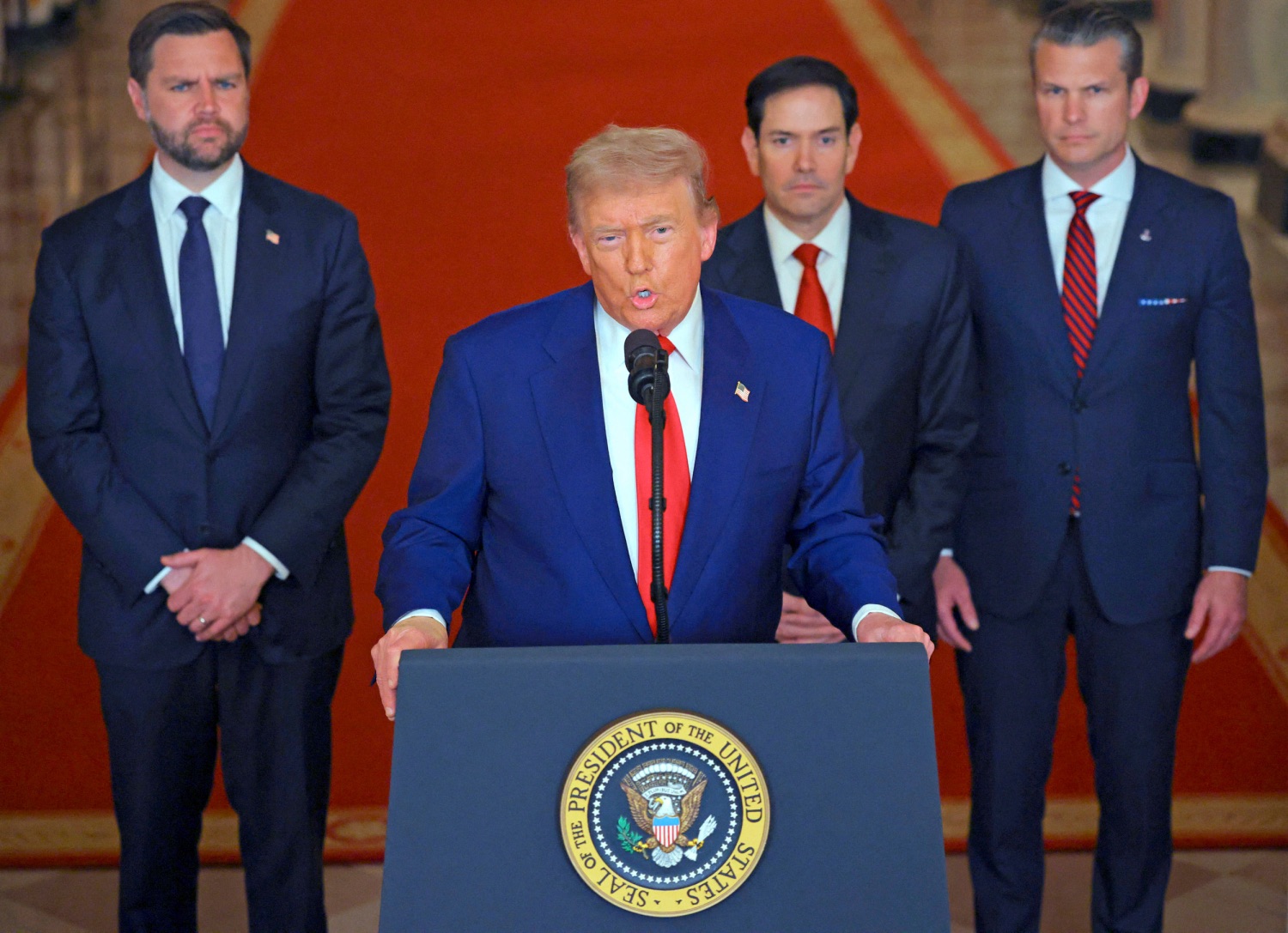
Trump addressing the media
* US attack ‘Operation Midnight Hammer’ involved more than 125 aircraft and the use of some B-2 bombers that were deployed over the Pacific as a “decoy”
* Iran’s foreign minister accused the US of crossing a “very big red line” and said he does not know how much “room is left for diplomacy”
By CNN & Al Jazeera
US Defense Secretary Pete Hegseth and the chairman of the Joint Chiefs of Staff claim operation ‘Operation Midnight Hammer’ “obliterated” Iran’s nuclear ambitions.

Advertisement
The attack involved more than 125 aircraft and the use of some B-2 bombers that were deployed over the Pacific as a “decoy,” according to US officials adding that other B-2s dropped more than a dozen massive “bunker buster” bombs on Iran’s Fordow and Natanz facilities, while Tomahawk missiles were fired at a facility in Isfahan.
President Donald Trump warned in a White House address last night that the US will make more strikes if Iran does not make peace but Iran’s foreign minister accused the US of crossing a “very big red line” and said he does not know how much “room is left for diplomacy”.
Other Iranian leaders are downplaying the strikes’ impact, with one lawmaker saying they were “superficial” as the world awaits an official response from Supreme Leader Ayatollah Ali Khamenei.

US Chairman of the Joint Chiefs of Staff Gen. Dan Caine offered a timeline of the US strikes on Iranian nuclear facilities, an effort codenamed ‘Operation Midnight Hammer’, which began overnight Friday into Saturday morning, Caine said at a Pentagon news conference.
As B-2 bombers launched from the US, some headed west as a decoy while the rest “proceeded quietly to the east with minimal communications throughout the 18-hour flight.”
Around 5pm ET, Caine said a US submarine “launched more than two dozen Tomahawk land attack cruise missiles against key surface infrastructure targets” at the Isfahan nuclear site in Iran.
As the B-2s entered Iranian airspace, the US “employed several deception tactics, including decoys, as the fourth- and fifth-generation aircraft pushed out in front of the strike package at high altitude and high speed, sweeping in front of the package for enemy fighters and surface-to-air missile threats,” Caine said.

He added that upon approach of the Natanz and Fordow facilities, the US employed “high-speed suppression weapons” with fighter aircraft to “ensure safe passage” of the B-2 bombers.
Around 6:40pm ET, the lead B-2 bomber launched two massive “bunker-buster” bombs at Fordow nuclear site, Caine said, and the “remaining bombers then hit their targets”. Those additional targets were struck, Caine said, “between 6:40p.m. ET and 7:05 p.m. ET.”
That places the timing of these attacks around 2:10 a.m. local time in Iran on Sunday and in total, Caine said, 16 GBU-57 Massive Ordnance Penetrators were dropped — two from the lead B-2 on Fordow, and 14 more from the remaining bombers against the two other sites.
The US military then “began its return home,” Caine said, noting that no shots were fired by Iran at the US on the way in or out.
President Donald Trump described the US forces attack on three Iranian nuclear sites as a “very successful”, adding that the heavily fortified Fordow nuclear facility is “gone”.
Trump’s decision on Saturday to join Israel’s military campaign against Iran represents a major escalation of the conflict: “We have completed our very successful attack on the three Nuclear sites in Iran, including Fordow, Natanz, and Isfahan,” Trump posted on Truth Social, adding that the military planes were now on their way home. “NOW IS THE TIME FOR PEACE!” he added.
Later, in a televised Oval Office address that lasted just more than three minutes, Trump said Iran’s future held “either peace or tragedy”, and that there were many other targets that could be hit by the US military: “Iran’s key nuclear enrichment facilities have been completely and totally obliterated.”
In response, Iranian Foreign Minister Abbas Araghchi accused the US of breaching international law: “The United States, a permanent member of the United Nations Security Council, has committed a grave violation of the UN Charter, international law and the NPT by attacking Iran’s peaceful nuclear installations,” Araghchi said in a social media post.
“The events this morning are outrageous and will have everlasting consequences. Each and every member of the UN must be alarmed over this extremely dangerous, lawless and criminal behavior” adding that Iran “reserves all options to defend its sovereignty, interest, and people”.
CBS News reported that the US reached out to Iran diplomatically on Saturday to say the strikes were all it planned and that the US did not intend on regime change efforts.

The strikes came as Israel and Iran have been engaged in more than a week of aerial combat, with deaths and injuries in both countries.
Israel launched the attacks on Iran on June 13, saying that it wanted to remove any chance of Tehran developing nuclear weapons. Israel itself is widely assumed to have nuclear weapons, which it neither confirms nor denies.
Iran says its nuclear programme is for peaceful purposes only. Iranian officials have repeatedly said they do not plan to develop nuclear weapons but will pursue its right to nuclear energy and research.
Trita Parsi, executive vice president of the Quincy Institute for Responsible Statecraft, says there was “absolutely no evidence” that Iran posed any kind of threat to the US.
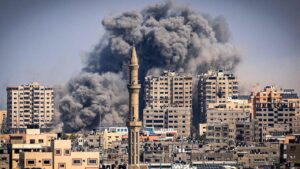
“Neither was it existential, nor imminent,” he told Al Jazeera. “We have to keep in mind the reality of the situation which is that two nuclear-equipped countries attacked a non-nuclear weapons state without having gotten attacked first. Israel was not attacked by Iran – it started that war; The United States was not attacked by Iran – it started this confrontation at this point.”
Parsi said the attacks on Iran “will send shockwaves” throughout the world because it will be very difficult for countries that risk ending up in the crosshairs of the US and Israel to feel that they are safe without having a nuclear deterrent.
“So I fear that we will see proliferation but I also think that this has more or less guarantee that Iran will be a nuclear weapons state in five to 10 years from now.”
‘No increase in radiation levels’
Iran’s nuclear agency on Sunday said radiation system data and field surveys do not show signs of contamination or danger to residents near the sites.
“Following the illegal US attack on the Fordow, Natanz, and Isfahan nuclear sites, field surveys and radiation systems data showed: No contamination recorded,” the organisation said in a social media post, adding that there was no danger to residents around. Shortly after the attacks, the agency insisted its work would not stop.
“The Atomic Energy Organisation of Iran assures the great Iranian nation that despite the evil conspiracies of its enemies, with the efforts of thousands of its revolutionary and motivated scientists and experts, it will not allow the development of this national industry, which is the result of the blood of nuclear martyrs, to be stopped,” it said in a statement.
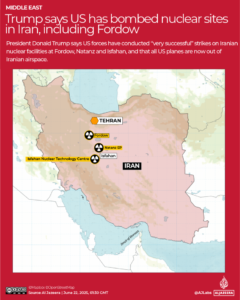
Parsi of the Quincy Institute for Responsible Statecraft, said it was likely Iran had taken precautionary actions ahead of the US attacks.
“It appears that they already had gotten an advanced warning – but I think also even short of that, when Trump that said he is going to make a decision within two weeks, I don’t think the Iranians took that seriously,” he told Al Jazeera.
“They understood that he was buying to try time while moving military assets in order to actually strike. So I think for some time they have moved those assets – where they are is unclear at this point.”
Parsi said Iran’s most valuable nuclear asset is its stockpile of enriched uranium.
“As long as they continue to have that, they still actually have very much a nuclear programme that still could be weaponised,” he added.


Advertisement
“And I think we are going to start hear from the Israelis in rather short order, that this was not the type of successful strike Trump has claimed but they are going to start making the case that there needs to be a more ongoing bombing campaign against Iran.”
‘Catastrophic consequences’
Al Jazeera correspondent Kimberly Halkett said Trump was advised that the bombings would allow for the dismantling of Iran’s nuclear programme.
“Donald Trump has been advised that, as commander-in-chief, this will not lead to escalation,” Halkett reported from Washington, DC. “But he knows there is a chance that there could be an escalation as a result of his action.”
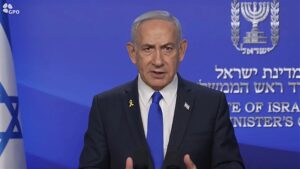
Benjamin Netanyahu
Israeli Prime Minister Benjamin Netanyahu praised Trump’s decision to attack Iran: “Congratulations, President Trump. Your bold decision to target Iran’s nuclear facilities with the awesome and righteous might of the United States will change history,” Netanyahu said.
UN Secretary-General Antonio Guterres said he was “gravely alarmed” by the “dangerous escalation” of the US strikes: “There is a growing risk that this conflict could rapidly get out of control – with catastrophic consequences for civilians, the region, and the world,” he said in a statement.
At least 430 people have been killed and 3,500 injured in Iran since Israel began its attacks, Iranian state-run Nour News said, citing the Ministry of Health.
In Israel, 24 civilians have been killed by Iranian missile attacks, according to local authorities, in the worst direct conflict between the longtime enemies. More than 450 Iranian missiles have been fired towards Israel, according to the Israeli Prime Minister’s Office.
Israeli officials said nearly 1,300 people have been injured since the beginning of the hostilities, with over a dozen in serious condition.