
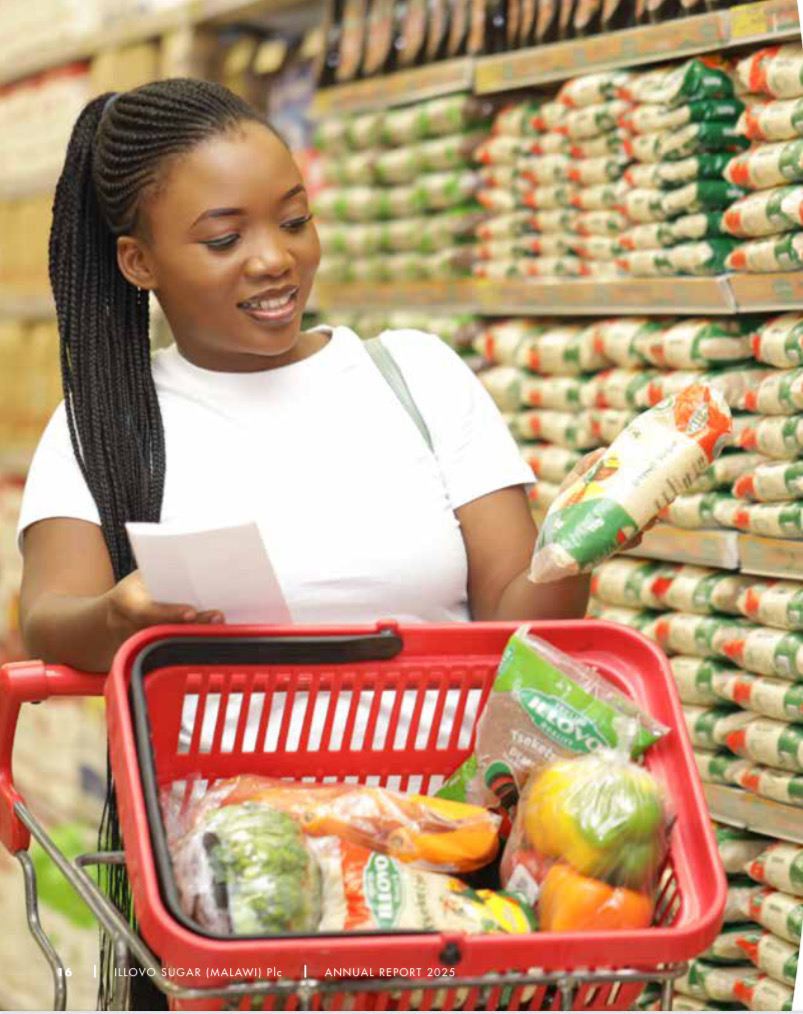
* Scaling up secondary distribution to rural areas by expanding container depots in strategic locations to a total of 54 from 10 in 2025 financial year
* Refines its route-to-market strategy to improve product availability and customer experience
* The expansion supports Strategic Development Goal (SDG) 10-‘Reduced Inequalities’; and SDG 11-‘Sustainable Cities and Communities’
By Duncan Mlanjira
In order to improve access to sugar, Illovo Sugar Malawi Plc has instigated several measures, that include expanding and put in place secure direct distribution lines, that had been falling prey to the scarcity of the essential household product, manipulated by unscrupulous primary distribution lines.
At the Investors Day Forum on Friday, February 20 at Sunbird Mount Soche to present its financial report performances for the year ended August 2025, as well as share future business strategies to its shareholders and stakeholders, Illovo management announced that it has scaled up secondary its distribution to rural areas.



This include expanding shipping containers turned into sugar selling depots in strategic locations to a total of 54 from 10 in 2025 financial year and refines its route-to-market strategy to improve product availability and customer experience.
One other challenge the company faces is the illicit cross border trade to neighbouring countries of Mozambique, Tanzania and Zambia, most of which is in K1kg brown sugar package — and to counter that the company scaled up the production of smaller 500g and 200g packs as a measure of accessibility and affordability.
The expansions and other initiatives are meant to support Strategic Development Goal (SDG) 10-‘Reduced Inequalities’; and SDG 11-‘Sustainable Cities and Communities’.

Managing Director Ronald Ngwira
In his report, Managing Director, Ronald Ngwira indicate that “over the past five years, Illovo Sugar’s route to consumer (RTC) model has delivered strategic gains, notably enhancing market penetration”, adding that the key achievement in financial year 2025 (FY25), “was the shift to active selling — with the majority of sales now driven by ‘Last Mile Resellers’ rather than traditional passive channels such as chain stores and supermarkets”.
“The deployment of 54 container depots across rural markets has significantly expanded our footprint, while secondary distribution — currently above 70% — has facilitated the transfer of best practices across our trading network.
“During the year, we also began directly engaging with industrial customers, marking a strategic move to own this specialised segment. This approach is expected to deepen our market understanding and improve customer experience.
“Furthermore, despite its past success, the Route to Consumer model now faces key challenges. These issues highlight the need for a strategic review to realign the model with current realities and ensure we meet Malawi’s estimated domestic sugar demand of 190,000 metric tonnes (MT) while supporting government effort to address illicit cross border trade of 30,000–40,000MT.”

Advertisement
On the export front, Ngwira highlights that Illovo’s route to the consumer “involved focusing resources on markets and partners with the highest potential return and selling of smaller packing to generate value and convenience to distribution partners and consumers for speciality (EU & USA)”.
“Smaller packing constituted 74% and 49% sales volume contribution to USA and Europe respectively. The contribution is designed to grow and increase the regional footprint.”
Ngwira also underlined that the company continues to experience forex exchange challenges which remains a major problem and setback to their services as it affects the company in many angles including the purchase of equipment and spare parts from other countries.
Additionally, he mentioned that weather changes has also become the crucial factors affecting the company having contributed to the production of inadequate sugar in a required period.
However, Ngwira challenged that the company is doing everything possible by putting up measures that will assist them to expand the sugar production which will also be available for exports and meet the investors needs in the process.
“We are working on a number of new initiatives that we have initiated to ensure productivity goes up by introducing some new agricultural irrigation systems such as cotton farming so that we can work with our neighbours surrounding the estate and give them a viable economic diversification and also for us to have access to an export commodity that can give the company foreign exchange to run the sugar business.

Financial performance
For the financial year ending August 31, 2025, the MD reports that the Illovo Group recorded a turnover of K476.7 billion, up from K313.7 billion in the previous year, “reflecting strong market positioning despite economic challenges”.
The Group achieved profit before tax of K126.2 billion from K55.9 billion and that some of the challenges the business endured were: unusually high rainfall between April and July which adversely affected cane harvesting and haulage, and overall cane supply to the factory leading to a reduced and intermittent cane supply and delays in factory start up.
Export sales volumes dropped from 27kt in the prior year to 12kt due to the following:
* A government-imposed export ban (lifted in July 2025) aimed at curbing domestic sugar shortages caused by high local demand and illegal cross border sales;
* A 15% reciprocal tariff by the US from August 2025, impacting customer liquidity and delaying shipments to this key preferential market;
* Zimbabwe’s introduction of a 30% surtax on sugar imports, which halted planned exports;
* Extended transit times (up to 90 days for the US, 60 days for the EU) and elevated sea freight costs due to Mediterranean conflict.
On shaper price performance, Board chairperson, Jimmy Lipunga reports that the 2024/2025 financial year, Illovo Sugar Malawi Plc “demonstrated a period of notable price stability with modest gains”.
“In the 2024 calendar year, the company registered a capital gain of 7.54%, closing the year at MK1,355.08. The company’s market capitalisation grew from MK966.78 billion at the end of 2024 to a peak of MK1.28 trillion by August 2025, reflecting a significant increase in its overall market valuation alongside its share price gains.”

Board chair Jimmy Lipunga (left)