
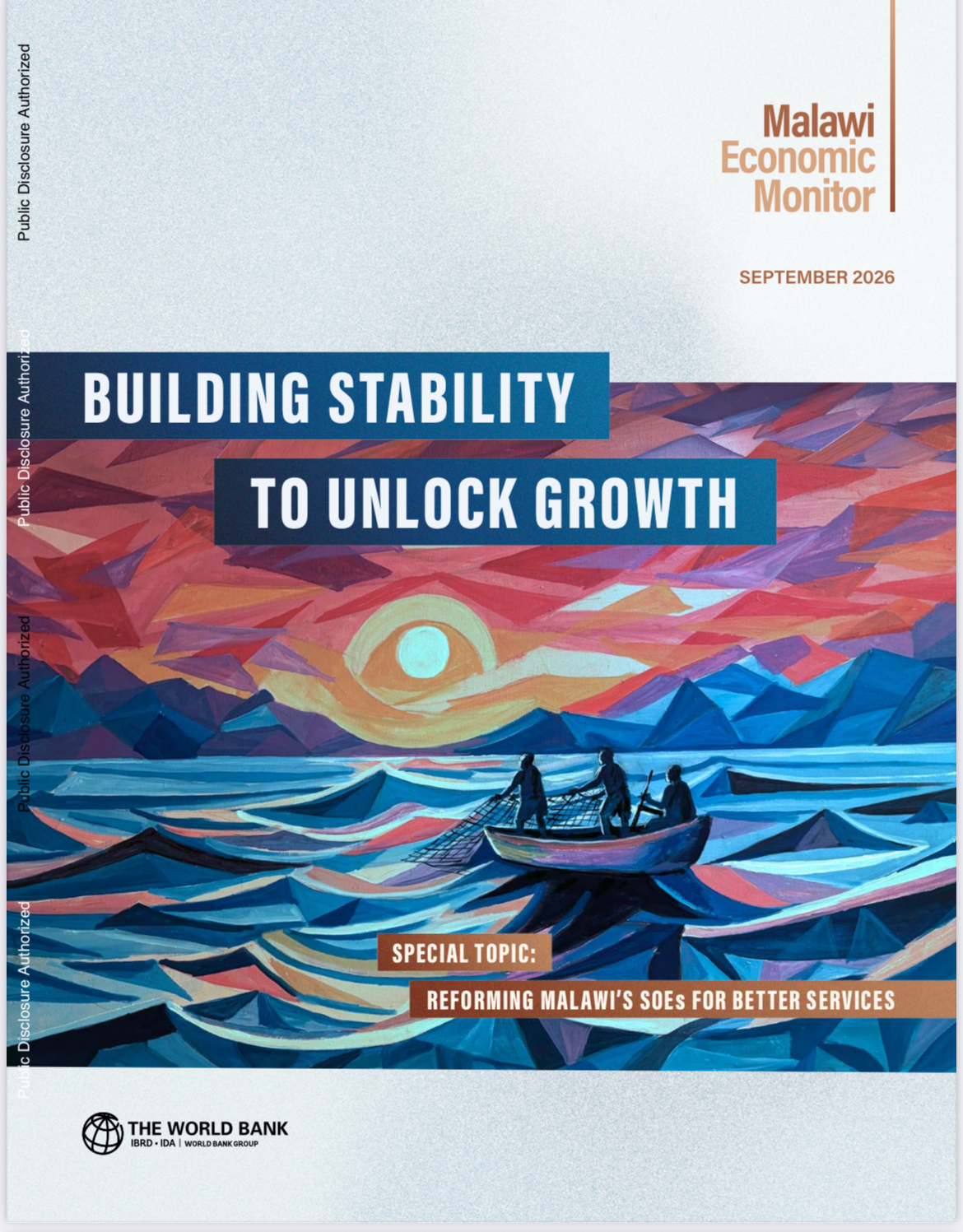
* Despite modest growth and early signs of adjustment — World Bank’s Malawi Economic Monitor
* The conflict in the Middle East has driven sharp increases in global energy and commodity prices
* Amplifying inflationary pressures, constraining growth prospects, and compounding Malawi’s longstanding vulnerabilities
* Including persistent external and fiscal imbalances, and limited fiscal and foreign exchange buffers
By Duncan Mlanjira
The September edition of the World Bank’s Malawi Economic Monitor (MEM), that analyses the country’s economic and structural development issues, highlights that Malawi economy continues to face significant macroeconomic and structural challenges amid a difficult global environment.

Advertisement
Entitled; ‘Building Stability to Unlock Growth’, the overview on economic developments underscores that the conflict in the Middle East “has driven sharp increases in global energy and commodity prices, amplifying inflationary pressures, constraining growth prospects, and compounding Malawi’s longstanding vulnerabilities — including persistent external and fiscal imbalances, and limited fiscal and foreign exchange buffers”.
“Malawi’s growth performance continues to lag most regional peers. While the economy has been showing signs of an uptick, the pace of growth remains constrained by persistent structural bottlenecks — including unreliable energy supply, foreign exchange distortions, shallow domestic supply chains, and a challenging business environment.
“Firms operate at low capacity, face rising costs, and struggle to access long-term credit — all factors that limit productive investment and export diversification.
“As a result, the economy remains highly vulnerable to external shocks, and unable to generate broad-based growth,” says the reporting.
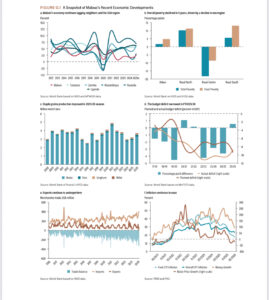
It adds that “the rate of real GDP growth is estimated at 2.5% for 2025, and is projected to reach 2.7% in 2026 — however, with a population growing by around 2.6% per year, per capita incomes will not improve significantly”.
“Recent data from the 5th and 6th Integrated Household Surveys underscores the scale of Malawi’s challenges. Despite modest gains in literacy and educational attainment, food poverty has deepened, inequality has risen, and many workers — particularly among the youth — have become increasingly dependent on casual labor.
“These findings point to a structural gap in Malawi’s economy, which still lacks the resilience and job-generating capacity necessary to convert human-capital gains into sustained welfare improvements.”
On the agriculture front, the report indicates that while showing some progress, the sector “continues to perform below potential”.
“Yields remain low, reflecting weather variability, limited access to inputs, and shortcomings in public support programs.

Malawi heavily relies on rain-fed agriculture
“Heavy reliance on rain-fed production, combined with persistent subsidy inefficiencies, undermine productivity gains and expose the sector to climate-related shocks.
“Key export crops, such as tobacco, face declining prices while their supply chains struggle to address certain structural flaws — with a cascading impact on the capacity to generate foreign-exchange earnings from such exports.
“Inflationary pressures remain elevated, reflecting both domestic imbalances and global shocks.
“While headline inflation has moderated, amid easing maize prices and a slowdown in money supply growth, it remains high — with rising non-food inflation linked to increases in fuel and electricity prices and continued currency pressures.”
On food prices, which the World Bank takes cognizance that they account for more than half of the consumer price index, “remain a key driver of inflation and a major source of vulnerability for households”.
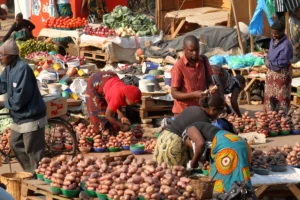
“Although recent maize imports and seasonal factors have helped stabilise prices, underlying structural constraints in agricultural production persist, leaving food security fragile and dependent on imports.
“Fiscal consolidation efforts have started to yield some results, but fiscal imbalances remain severe.
“The fiscal deficit narrowed to 8.8% of GDP in FY2025/26 from a three year average of 10.7% — thanks to expenditure controls coupled with value added tax (VAT) rate increases and the rollout of an electronic invoicing system, which boosted revenues.
“For the first time in several years, the budget was executed within the approved limits, and the government recorded a significant reduction in its primary deficit.
“However, public finances remain under pressure from high interest costs, which absorb a significant share of domestic revenues and continue to crowd out productive and social spending.”
The report further observes that “public debt remains elevated and in distress, reflecting years of large fiscal deficits, ongoing heavy reliance on high-cost domestic borrowing, and the legacy of expensive external commercial borrowing”.
“External vulnerabilities are acute. The trade deficit has widened significantly, as imports of fuel and fertilizer outpaced stagnant export revenues dominated by tobacco.

Forex scarcity continued to be a huge challenge
“Official foreign-exchange reserves are critically low, covering less than one month of imports.
Distortions in the exchange rate and foreign-exchange market undermine export competitiveness and discourage formal trade, while their constraining impact on imports of essential goods and production inputs further weakens economic activity.
“To deepen the reform agenda, the government has developed the National Economic Recovery Plan (NERP). The NERP showcases areas of genuine strength: broad cross-government coordination, comprehensive sectoral coverage, and a results-oriented monitoring framework well aligned with MW2063 ambitions.
“However, its credibility as a macro-fiscal stabilisation tool is undermined by internal inconsistencies: expansionary investment proposals sit uneasily alongside consolidation objectives, revenue assumptions are overly optimistic, and a continued reliance on administrative controls risks entrenching the very market distortions that underpin the country’s economic crisis.”
Thus the World Bank suggests that an International Monetary Fund (IMF) programme “would be instrumental to anchor the NERP’s reform agenda, as it would provide the conditionality needed to ingrain fiscal discipline, signal policy predictability and credibility to investors, and help unlock concessional financing from multilateral partners — thus creating the conditions for the NERP to become fiscally sustainable and implementable”.
“The outlook remains subdued, with the pace of growth expected to pick up gradually but not enough to significantly raise household incomes or reduce poverty.
“External shocks, persistent inflation, fiscal pressures, and structural constraints continue to pose significant risks to the country’s recovery.
“Addressing these challenges will require sustained efforts across four interconnected policy objectives:
1. Restoring macroeconomic stability — A solid macroeconomic foundation is the bedrock for all other reforms.
Re-anchoring inflation expectations and reducing cost-of-living pressures require stronger fiscal discipline and a broader revenue base, including through the elimination of inefficient tax exemptions and wider modernisation of the tax system.
Debt sustainability must be pursued by restructuring external obligations, reprofiling domestic debt to reduce interest costs, and enhancing public sector efficiency.
“Decisive action to resolve the foreign exchange crisis is essential.
2. Enabling a dynamic private sector — Durable macroeconomic stability requires growth led by the private sector. Key priorities include creating stronger incentives for formal exports, enhancing trade facilitation, and leveraging digital systems to improve competitiveness.
Agricultural policy reforms, including on land registration and pricing predictability, are needed to support food security and rural incomes.
In the mining sector, clear limits to the state’s equity participation in mining developments and upgrades to geological data platforms will be critical to attract investment.
3. Improving service delivery and resilience — Strengthening social protection and improving local service delivery through fiscal decentralisation are key priorities.
Developing a unified social protection reform plan, updating benefit structures, and improving the equity and transparency of intergovernmental fiscal transfers will contribute to building a more resilient safety net, and ensuring that frontline services are adequately funded and accountable to citizens.
4. Strengthening critical infrastructure for growth — This objective encompasses two priorities: expanding reliable electricity supply, and enhancing the efficiency of the road sector.
Immediate steps include securing financing for new power projects, and enabling electric utilities to access regional power markets.
Medium-term efforts should then focus on accelerating major energy investments, resolving implementation bottlenecks, and promoting private sector participation in the development of transport infrastructure.

Advertisement