
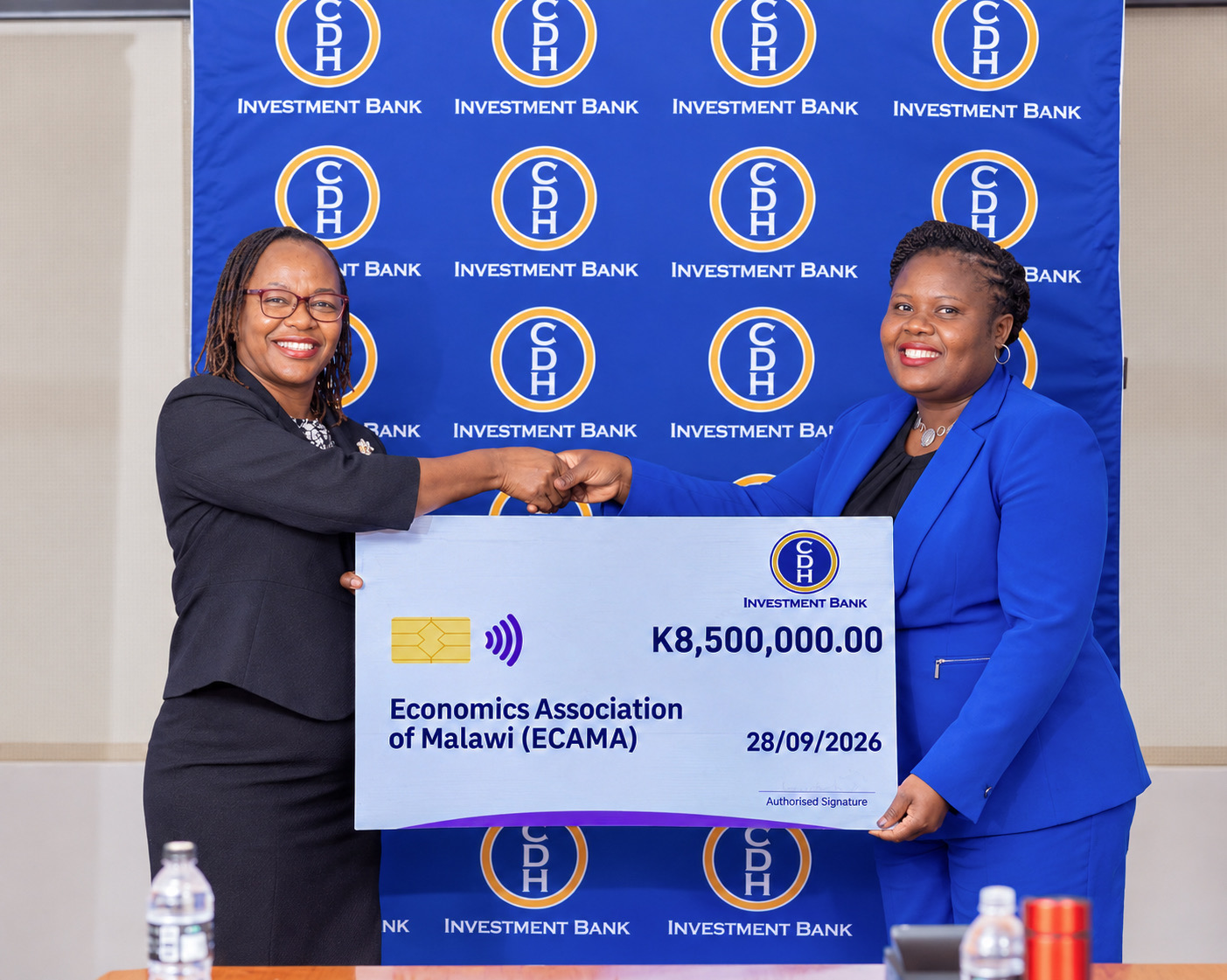
CDH Investment Bank’s Jennie Madinga hands the sponsorship to ECAMA’s Executive Director, Esmie Kanyumbu
* The conference aims to bring together policymakers, the private sector, and scholars to turn policy reforms into practical, implementable actions that advance Malawi’s economic development
By Duncan Mlanjira
CDH Investment Bank has supported Economics Association of Malawi (ECAMA) with K8.5 million towards the 2026 annual conference set for October 29-30 at Sunbird Nkopola in Mangochi.

To be held under the theme; ‘From Policy to Practice: Making Reforms Work’, the conference aims to bring together policymakers, the private sector, and scholars to turn policy reforms into practical, implementable actions that advance Malawi’s economic development.
Presenting the sponsorship in Lilongwe, CDH Investment Bank’s Account Relationship Manager-Corporate & Public Sector, Jennie Madinga, highlighted that the sponsorship is the bank’s acknowledgement of the vital role played by ECAMA in driving Malawi’s economic growth.
She added that the bank took cognizance that the conference will provide a platform for stakeholders to discuss and develop action plans to translate policies into tangible outcomes, contributing to MW2063 national vision.
She added that CDH Investment Bank’s continued support is to ensure that ECAMA succeeds in steering the economic growth of the country.

Advertisement
In her vote of thanks, ECAMA Executive Director, Esmie Kanyumbu described the support as a timely boost ahead of the annual conference.
“We are grateful to CDH Investment Bank for being a reliable partner over the years and for supporting the 2026 conference,” she said.
She also assured CDH that ECAMA will tirelessly continue to knock on the government doors to discuss issues that will advance this country’s economy.
Last week, ECAMA graced the launch of World Bank Group’s Malawi Economic Monitor where Kanyumbu highlighted key reforms that should be prioritised to support faster and more inclusive growth in Malawi.
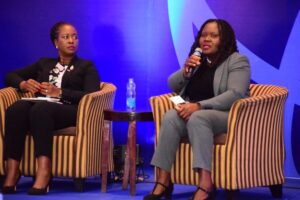
Kanyumbu during the panel discussion
In a panel discussion, Kanyumbu stated that the reforms centre on three main areas:
* First, the agricultural sector — which must be positioned towards higher productivity, value addition and exports.
This requires prioritising climate-resilient and high-value crops, expanding irrigation, introducing improved seed varieties and strengthening extension services;
* Second, private sector capacity — needs to be unlocked by providing preferential treatment to priority sectors, including ATMM, as well as other sectors with strong potential to generate foreign exchange;
* Third, debt restructuring and fiscal consolidation — efforts must be intensified to create fiscal space and free up resources that can be directed towards more productive sectors of the economy.
ECAMA reported on its media platform that Kanyumbu also emphasised “the need for external adjustment measures that address structural challenges and incentives affecting formal exports and vulnerable households”.
“A key part of this approach involves putting in place systems that promote export diversification and reduce reliance on a narrow range of exports.
If Malawi were to prioritise one reform over the next 12 months, ECAMA identified agriculture as the most strategic choice: “The sector already has structures in place and can, therefore, be organised and transformed relatively quickly.
“With the right policies and investments, this presents a significant opportunity to improve productivity, generate foreign exchange, create jobs and support more inclusive economic growth,” reported ECAMA on its official Facebook account.

Advertisement