
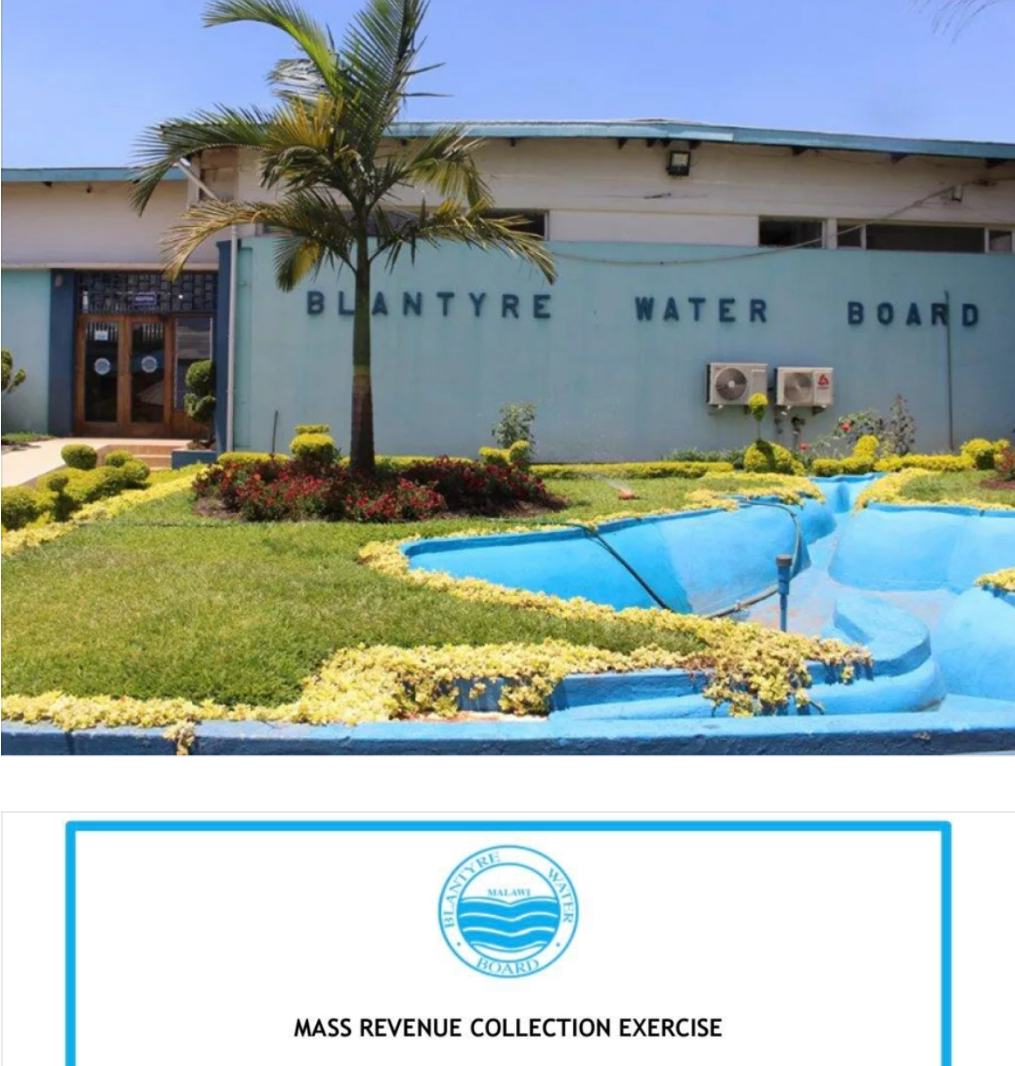
* Customers with substantially overdue bills or large outstanding balances, who are unable to pay in full, are encouraged to visit their respective BWB Zone Office
* To discuss and agree on a sustainable payment plan — subject to the Board’s procedures and approval
By Duncan Mlanjira
In its efforts to improve revenue collection and ensure sustainable delivery of water services, Blantyre Water Board has embarked on a mass revenue collection exercise that started on Monday, October 26 through to November 26.

Advertisement
In a public notice published on its media platform, BWB states that during this period, “all customers with outstanding water bills are urged to settle their accounts promptly to avoid enforcement action”.
“Customers with substantially overdue bills or large outstanding balances, who are unable to pay in full are encouraged to visit their respective BWB Zone Office to discuss and agree on a sustainable payment plan — subject to the Board’s procedures and approval.
“Accounts that have remained disconnected for an extended period will be liable for the removal (uprooting) of the water connection infrastructure, in accordance with BWB procedures.”
The notice further urges all customers with outstanding balances “to take advantage of this exercise to regularise their accounts to avoid possible disruptions or further enforcement measures”.
It emphasises that management appreciates “the continued cooperation of its customers and remains committed to providing reliable and reliable water services”.
This notice is mostly for customers on post-paid accounts, which have also risen after BWB removed faulty prepaid meters in most parts of the city.
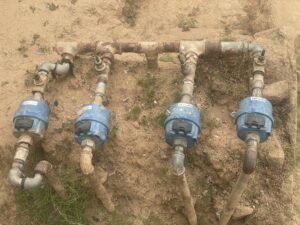
Postpaid water meters

Prepaid meters
Mid this month, concerned citizen Gift Kandodo-Phiri raised a pertinent debate as regards to post-paid water consumption billing by all water boards that they are profiteering by charging three times — water consumption, meter rental and meter reading.
Kandodo-Phiri published on social media that “every month, in every township from Ndirande to Area 25 in Lilongwe to Chiputula in Mzuzu, a familiar ritual takes place”.
“A meter reader from Water Board knocks and bends over a meter, writes a number and leaves a bill and on that bill, you are not just asked to pay for the water you used — you are asked to pay for the man who came to check it, and for the meter he checked.
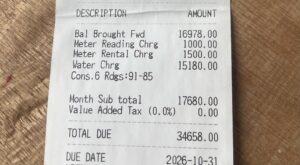
Postpaid bill
“This is the reality of water billing in Malawi. A citizen is charged three times: once for the water, once for the meter, and once for the reading of that meter.
“It is time we called it what it is: an insult,” wrote Kandodo-Phiri, while describing this as: “We pay a fee to be billed.
“Let us break down the logic, or lack thereof. The Water Boards, Blantyre, Lilongwe, Northern Region (NRWB), and others exist for one primary mandate: to supply potable water to Malawians.
“To fulfill that mandate, they need two things: a pipe to deliver the water, and a meter to measure it. Both are tools of their trade.
“Just as a minibus owner does not charge passengers a fee for using his steering wheel, a service provider should not charge customers for its own operational equipment.
“Yet, every month, Malawians see this on their invoice: water consumption charge, meter rental fee (K1,500), meter reading fee.”

Efficient system enjoyed by prepaid customers
He thus wonder which other industry applies this system, asking: “Does ESCOM charge you a fee to check your meter? Does Airtel/TNM charge you a fee to calculate your airtime balance?
“Does a shop owner in Limbe Market charge you K500 for using his calculator to total your groceries? — No.
“The cost of measuring the service is inherently part of doing business. By offloading it to the consumer, the Water Boards have institutionalised laziness and profiteering.
“We are literally paying them to tell us how much more we must pay them?
“The deeper question is: who approved this? Was there ever a public hearing where Malawians agreed that they should rent a meter that they will never own?
“Was there a Parliamentary debate that concluded that citizens should pay a salary for the meter reader?
“If we accept paying to be billed today, what will we pay for tomorrow? A fee for breathing the air near their pipes? A fee for calling their customer care line to complain about no water?
“Water is life. It is not a luxury — and it should never come with an insult,” concluded Kandodo-Phiri.
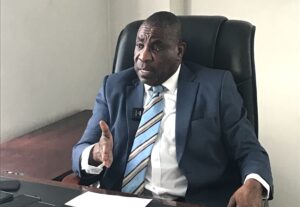
Consumer Association of Malawi Executive Director, John Kapito
When contacted if Consumer Association of Malawi (CAMA) was aware of this triple billing, Executive Director, John Kapito maintained that it was unfortunate consumers have never officially complained of such an anomaly.
“These are matters that are affecting every one; consumers, the private sector etc,” he said, adding that lodging a complaint perhaps comes with a challenge in that it can be expensive.
Kapito thus contends that perhaps the Confederation of Chambers of Commerce & Industry (MCCCI) “should intervene as well to protect the business community but it will carry weight if the public came forward to complain”.
He, however, observed that “water consumers are craft” in that at one time, when they were grouped by the water boards into associations, an issue was reported, which CAMA begun investigating.
But the consumers all publicly declared they were not part of such an investigation — thus CAMA dropped the investigations.

Advertisement